Concept and Signal Model
Reconfigurable Intelligent Surfaces: Controlling the Propagation Environment
Traditional wireless system design treats the propagation channel as an uncontrollable random entity: the transmitter and receiver are optimised to cope with whatever channel nature provides. Reconfigurable intelligent surfaces (RIS) introduce a paradigm shift — the channel itself becomes a design variable. An RIS is a planar array of sub-wavelength reflecting elements, each of which can independently adjust the phase (and potentially amplitude) of the impinging electromagnetic wave. By jointly optimising the BS precoder and the RIS reflection coefficients, the system can constructively combine the direct and reflected signal paths, creating a programmable wireless environment.
The concept draws from three distinct research traditions: (i) reflect-arrays in antenna engineering, where passive elements shape the reflected beam; (ii) relay-aided communications in information theory, where an intermediate node assists source-destination communication; and (iii) metamaterials in physics, where sub-wavelength structures manipulate electromagnetic waves. RIS unifies these ideas in a practically appealing architecture: a thin, lightweight surface that requires no RF chains, no power amplifiers, and no analogue-to-digital converters — only a simple control circuit that sets the phase of each element.
RIS-Assisted Communication System Model
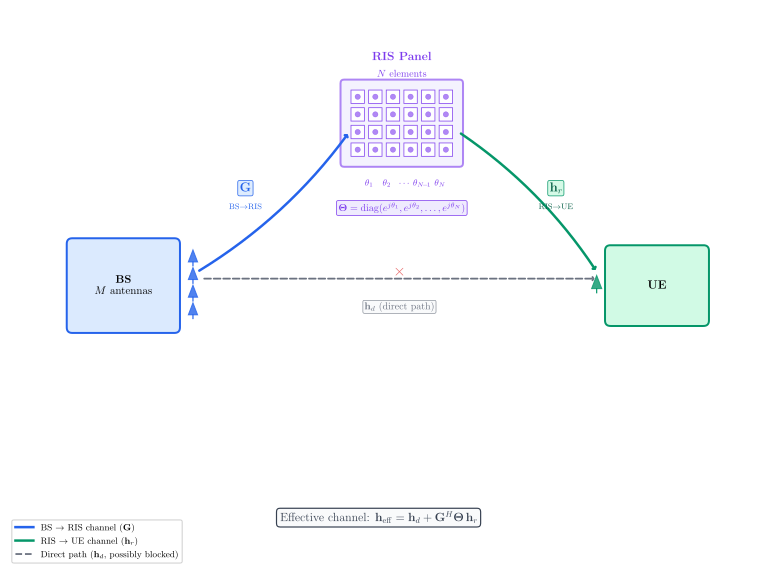
Definition: Reconfigurable Intelligent Surface (RIS)
Reconfigurable Intelligent Surface (RIS)
A reconfigurable intelligent surface is a planar array of passive reflecting elements, where each element applies a reflection coefficient to the incident electromagnetic wave. The reflection is characterised by:
- Phase shift : controlled via tunable impedance elements (varactor diodes, PIN diodes, or liquid crystals)
- Amplitude : ideally (lossless reflection); in practice due to absorption losses
The collective reflection behaviour of the surface is described by the diagonal phase-shift matrix:
Unlike a relay, the RIS does not decode, amplify, or retransmit the signal — it merely reflects the incident wave with element-wise phase adjustments. This passive operation requires no RF chains and consumes only minimal power for the control circuitry.
The term "intelligent" refers to the ability to adaptively configure the phase shifts based on channel state information, as opposed to static reflect-arrays whose elements have fixed phase responses. Alternative names in the literature include intelligent reflecting surface (IRS), large intelligent surface (LIS), and software-controlled metasurface.
Definition: Cascaded Channel Model
Cascaded Channel Model
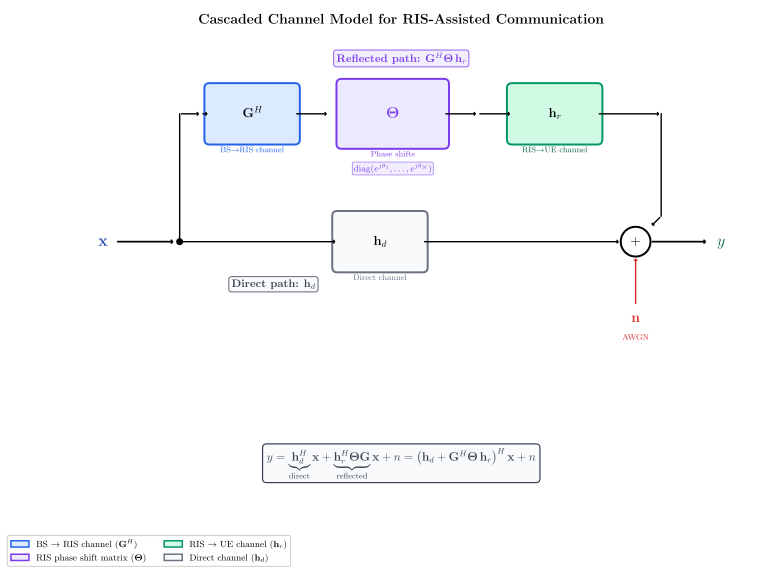
Consider a system with an -antenna BS, an -element RIS, and a single-antenna user. Let be the BS beamforming vector and the transmitted symbol with . The received signal is:
where:
- : direct BS-to-user channel
- : BS-to-RIS channel matrix
- : RIS-to-user channel vector
- : RIS phase-shift matrix
- : additive white Gaussian noise
Combining both paths, the effective channel is:
Defining the phase-shift vector and the diagonal matrix (an matrix whose -th row is , where is the -th row of ), we can write:
This formulation reveals that the RIS phase vector linearly combines the rows of , offering degrees of freedom to shape the effective channel. The received SNR is:
subject to the power constraint and the unit-modulus constraints for all (assuming lossless reflection ).
The key structural difference from conventional relay channels is that the BS-RIS and RIS-user channels appear as a product (cascaded channel ), not a sum. This multiplicative structure means the RIS path suffers from the product of two path losses, which is the fundamental reason why large numbers of elements () are needed to achieve significant gains.
Cascaded Channel Signal Flow
RIS and RF Imaging
The RIS signal model shares deep connections with the sensing matrix formulation in compressed sensing and RF imaging. The cascaded channel has the same structure as a measurement matrix where controls the measurement configuration. In the RF Imaging (RFI) book, this connection is exploited for RIS-aided radar sensing and target localisation, where the controllable RIS phases create a configurable sensing aperture. The channel estimation problem (Section 28.2) is essentially a sparse recovery problem identical to those solved in the RFI book using OMP, LASSO, and AMP algorithms.
RIS versus Relay and Reflect-Array Systems
It is instructive to compare the RIS with two related technologies:
Half-duplex decode-and-forward (DF) relay: The relay decodes the source message and retransmits it, requiring two time slots (half-duplex loss) and full RF chain hardware. The relay provides a power gain proportional to (number of relay antennas), since each antenna independently amplifies the signal. However, the relay consumes significant power for signal processing and transmission.
Passive reflect-array: A reflect-array is a surface with fixed phase elements designed for a specific beam direction. It provides high directional gain but cannot adapt to changing channels or user positions. The RIS generalises the reflect-array by making the phase shifts reconfigurable in real time.
RIS advantages: (i) Full-duplex operation (reflects and receives simultaneously); (ii) no self-interference; (iii) no noise amplification (unlike amplify-and-forward relays); (iv) very low power consumption (only control circuit); (v) thin, lightweight, conformable to building surfaces.
RIS disadvantages: (i) No signal amplification (passive); (ii) "double path loss" from cascaded channel; (iii) channel estimation is challenging (no RF chains at RIS); (iv) requires very large to compete with active relays.
RIS Phase Alignment for Coherent Combining
RIS Beam Pattern vs Direct Link
Visualise the beam pattern of an RIS-assisted link compared to the direct link alone. The RIS is modelled as a uniform linear array (ULA) with elements at half-wavelength spacing. The plot shows the normalised array gain as a function of angle for the RIS reflected path with optimally aligned phases versus the direct path. Observe how the RIS creates a highly directional beam whose width scales as and whose peak gain scales as (in power). Increasing narrows the beam and increases the peak gain, while changing the frequency affects the element spacing relative to wavelength.
Parameters
Example: SNR with a 4-Element RIS (SISO)
A single-antenna BS communicates with a single-antenna user via a 4-element RIS. There is no direct link (). The cascaded channel coefficients are:
with , , , .
The transmit power is W and noise variance W.
(a) Compute the optimal RIS phase shifts.
(b) Compute the received SNR with optimal and random phases.
Optimal phase shifts
The optimal phase for element aligns to be real and positive:
SNR computation
With optimal phases, the coherent sum is:
With random phases, .
Optimal phases provide a 5.6 dB gain over random phases with only 4 elements.
Historical Note: From Reflect-Arrays to Intelligent Surfaces
1963-2020The concept of reconfigurable reflecting surfaces has roots spanning decades. Reflect-arrays (Berry, Malech, and Kennedy, 1963) combined the focusing capability of parabolic reflectors with the conformability of printed antenna arrays. Frequency selective surfaces (Munk, 2000) extended the concept to filtering applications. The term "intelligent reflecting surface" emerged around 2018--2019, when Wu and Zhang (IEEE TWC, 2019) and Huang et al. (IEEE TWC, 2019) formulated the joint active-passive beamforming problem, connecting the antenna engineering tradition with information-theoretic analysis. Di Renzo et al. (IEEE JSAC, 2020) provided the first comprehensive survey bridging the electromagnetic physics and communication theory perspectives, establishing RIS as a distinct research area within wireless communications.
Historical Note: Metasurfaces and Programmable Electromagnetic Environments
2014-2020The physical realisation of RIS draws heavily on metamaterial research. Cui et al. (2014) proposed "coding metasurfaces" where digital bits control the reflection state of sub-wavelength elements, enabling real-time reprogramming of the electromagnetic response. Liaskos et al. (2018) coined the term "HyperSurface" for software-controlled metasurfaces embedded in indoor environments, envisioning a future where walls, ceilings, and furniture actively shape wireless propagation. The convergence of metamaterial physics, antenna engineering, and communication theory in the 2018--2020 period produced the RIS paradigm as we know it today.
Key Takeaway
An RIS is fundamentally passive: it reflects incident signals with controllable phase shifts but does not amplify, decode, or retransmit. This means no RF chains, no power amplifiers, no self-interference, and minimal power consumption — but also no signal amplification and a "double path loss" from the cascaded BS-RIS-user channel. The coherent beamforming gain from elements is the mechanism that compensates for this double path loss.
Reconfigurable Intelligent Surface (RIS)
A planar array of passive reflecting elements, each with a controllable phase shift, that shapes the wireless propagation environment by coherently reflecting incident signals. Also called IRS (intelligent reflecting surface) or LIS (large intelligent surface).
Related: Phase-Shift Matrix, Cascaded Channel
Cascaded Channel
The product channel formed by the BS-to-RIS link (), the RIS phase-shift matrix (), and the RIS-to-user link (). The multiplicative structure causes "double path loss" but enables coherent combining gain.
Related: Reconfigurable Intelligent Surface (RIS), Phase-Shift Matrix
Phase-Shift Matrix
The diagonal matrix describing the collective reflection behaviour of an -element RIS. Each diagonal entry applies a controllable phase shift to one element.
Related: Reconfigurable Intelligent Surface (RIS), Cascaded Channel
Quick Check
In the RIS-assisted channel model , why does the reflected path suffer from a "double path loss" compared to a single-hop direct link?
Because the RIS absorbs half the signal energy during reflection
Because the signal traverses two independent propagation links (BS-to-RIS and RIS-to-user), and the cascaded channel gain is the product of the two individual gains
Because the RIS operates in half-duplex mode, losing 3 dB
Because the phase-shift matrix has eigenvalues less than one
The reflected path gain is proportional to , which is the product of the BS-RIS and RIS-user channel gains. If each link has path loss , the product gives , which is typically much weaker than a single direct link of comparable total distance. This is why RIS requires many elements () to compensate through coherent combining gain ().