Signal Processing Foundations for Sensing
Radar Sensing Fundamentals
The fundamental task of radar sensing is to extract information about targets — their range (distance), radial velocity, and angle — from the echoes of a transmitted waveform. The key tool is the matched filter, which maximises the output signal-to-noise ratio (SNR) for a known waveform in additive white Gaussian noise.
Consider a transmitted baseband signal with bandwidth and duration . A point target at range with radial velocity produces an echo:
where is the complex target reflectivity (incorporating path loss and radar cross section), is the round-trip delay, is the Doppler frequency shift, and is additive white Gaussian noise. The factor of 2 in both and arises from the two-way (transmit and receive) propagation in monostatic radar.
The matched filter for delay estimation correlates the received signal with a time-shifted copy of the transmitted waveform:
This correlation peaks at , yielding the target range . The width of the correlation peak determines the range resolution.
Definition: Ambiguity Function
Ambiguity Function
The ambiguity function of a waveform is defined as:
The squared magnitude is called the ambiguity surface and characterises the joint range-Doppler resolution of the waveform. It satisfies the following properties:
-
Peak normalisation: , where is the waveform energy.
-
Symmetry: .
-
Volume conservation (Moyal's identity): This fundamental constraint means that the ambiguity volume is fixed: narrowing the main lobe in one dimension necessarily raises sidelobes elsewhere. The ambiguity surface cannot be made arbitrarily narrow in both delay and Doppler simultaneously.
-
Marginals: The zero-Doppler cut is the autocorrelation of ; the zero-delay cut is related to the spectral autocorrelation.
The ambiguity function is the central tool for waveform design in radar signal processing. An ideal "thumbtack" ambiguity function — a sharp peak at the origin with uniformly low sidelobes — cannot exist due to Moyal's identity. In practice, waveform design aims to shape the ambiguity function to concentrate energy near the origin with acceptable sidelobe levels.
Definition: Range-Doppler Map
Range-Doppler Map
A range-Doppler map is a two-dimensional representation of the radar scene obtained by evaluating the matched filter output across a grid of delay-Doppler hypotheses. For a sequence of received pulses (or OFDM symbols), the range-Doppler map is:
where is the received signal on the -th subcarrier (or range bin) of the -th symbol (or pulse), indexes the range bins, and indexes the Doppler bins. The map displays peaks at the range-Doppler coordinates of each target. In matrix form, this is a 2D-FFT applied first across the subcarrier (fast-time) dimension for range processing, then across the symbol (slow-time) dimension for Doppler processing.
The range-Doppler map is the radar analogue of the time-frequency representation used in communication signal processing. Each bin in the map corresponds to a hypothesis about a specific delay-Doppler pair, and targets appear as peaks above the noise floor. Target detection is performed by applying a threshold (e.g., CFAR — constant false alarm rate) to the map.
Theorem: Radar Range and Velocity Resolution
For a waveform with bandwidth and coherent observation time :
-
Range resolution: Two targets separated by less than in range cannot be resolved. This follows from the width of the autocorrelation (zero-Doppler cut of the ambiguity function), which is approximately in delay.
-
Velocity resolution: equivalently, the Doppler resolution is . Two targets separated by less than in radial velocity cannot be resolved.
-
Maximum unambiguous range (for pulsed radar with PRI ):
-
Maximum unambiguous velocity (for pulsed radar with PRI ):
The time-bandwidth product characterises the waveform's degrees of freedom: a large enables simultaneously fine range and velocity resolution. The resolution cell volume in the range-velocity plane is , which shrinks as increases.
Derivation
Range resolution. The matched filter output for a signal with bandwidth has a main lobe width of approximately in the delay domain. Two point targets at delays and can be resolved when , i.e., when .
Velocity resolution. The coherent integration of pulses over a total observation time produces a sinc-like peak in the Doppler domain with a main lobe width of in frequency. Two targets with Doppler shifts and can be resolved when . Since , the velocity resolution is .
Maximum unambiguous range. For a pulse repetition interval (PRI) , echoes from targets beyond arrive after the next pulse is transmitted, causing range ambiguity.
Maximum unambiguous velocity. The Doppler phase shift between consecutive pulses is . Unambiguous estimation requires , i.e., , yielding .
Example: Resolution of a 77 GHz Automotive Radar
A 77 GHz automotive radar has bandwidth MHz and a coherent processing interval of ms (corresponding to chirps at a PRI of ). Compute the range resolution, velocity resolution, maximum unambiguous range and velocity, and the time-bandwidth product.
Wavelength and range resolution
mm.
Velocity resolution
Maximum unambiguous range and velocity
Time-bandwidth product
, providing approximately million degrees of freedom in the delay-Doppler plane. In practice, automotive radars use up to 4 GHz bandwidth to achieve sub-5 cm range resolution.
Ambiguity Function Geometry
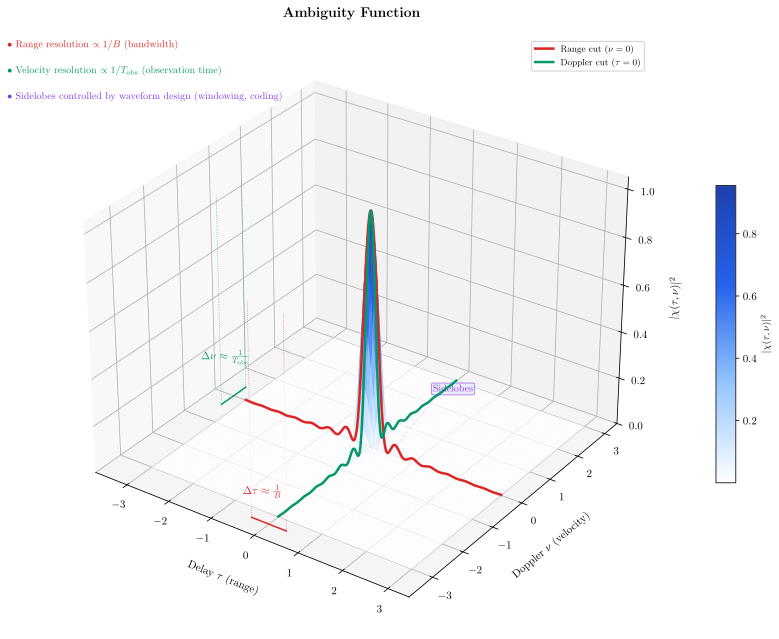
Ambiguity Function: Bandwidth vs Resolution
Ambiguity Function Surface
Explore the ambiguity function for different waveform types. Select among three waveforms: (1) a linear frequency modulated (LFM) chirp, which produces a ridge-shaped ambiguity tilted in the delay-Doppler plane; (2) an OFDM waveform with random data, yielding a near-thumbtack shape with data-dependent sidelobes; and (3) a random phase-coded waveform with low autocorrelation sidelobes. Adjust the bandwidth and duration to observe how these parameters control the width of the main lobe in the delay and Doppler dimensions, respectively. Note that Moyal's identity ensures the total volume is conserved: narrowing the main lobe in one dimension spreads energy to sidelobes.
Parameters
Range-Doppler Processing via 2D-FFT
For a coherent processing interval (CPI) consisting of pulses (or OFDM symbols), each sampled at range bins, the received data can be arranged into a matrix where the entry is the signal at the -th range sample of the -th pulse. A single point target at range bin with Doppler bin contributes:
The range-Doppler map is obtained by applying:
- An IFFT across rows (subcarrier/fast-time dimension) for range compression;
- An FFT across columns (symbol/slow-time dimension) for Doppler processing.
This 2D-FFT has computational complexity and produces a range-Doppler map where each target appears as a peak at coordinates . The peak height is proportional to (coherent processing gain), while the noise floor is proportional to , yielding an output SNR gain of over a single sample.
Range-Doppler Map with Targets
Visualise the range-Doppler map produced by 2D-FFT processing of a simulated OFDM radar signal. Place multiple targets at random range-velocity positions and observe how they appear as peaks in the map. Adjust the number of targets to see how closely spaced targets interact. Vary the SNR to observe the transition from clear peaks to noise-limited detection. Increase the bandwidth to sharpen the range resolution (narrower peaks along the range axis).
Parameters
Ambiguity Function
The function that characterises the joint range-Doppler resolution of a radar waveform. Its squared magnitude is the ambiguity surface; Moyal's identity constrains its total volume to be constant.
Related: ISAC, Range-Doppler Map
Range-Doppler Map
A two-dimensional representation of the radar scene produced by applying a 2D-FFT to the received signal matrix. Each pixel corresponds to a range-velocity hypothesis; targets appear as peaks above the noise floor.
Related: Ambiguity Function
Common Mistake: Confusing Resolution with Maximum Unambiguous Range/Velocity
Mistake:
Assuming that finer range resolution (larger bandwidth) also increases the maximum unambiguous range.
Correction:
Range resolution and maximum unambiguous range depend on different parameters. Increasing bandwidth improves resolution but does not affect , which depends on the pulse repetition interval . Similarly, velocity resolution depends on the coherent processing interval, while depends on the PRI.
In OFDM radar: depends on total bandwidth , while depends on subcarrier spacing. Increasing (more subcarriers) improves resolution without affecting the unambiguous range.
Quick Check
A radar system operates at a carrier frequency of 28 GHz with a signal bandwidth of MHz and a coherent processing interval of ms. What are the range resolution and the velocity resolution ?
m, m/s
m, m/s
m, m/s
m, m/s
Range resolution: m. Wavelength: mm. Velocity resolution: m/s.