MIMO Radar and ISAC Beamforming
MIMO Radar: From Phased Arrays to Waveform Diversity
Classical phased-array radar transmits a coherent waveform from all antennas, forming a narrow beam in a single direction. The beam must be mechanically or electronically steered to scan the angular domain, limiting the achievable search rate. MIMO radar fundamentally changes this paradigm by transmitting orthogonal waveforms from each antenna, illuminating the entire angular sector simultaneously. The orthogonality enables the receiver to separate the contribution of each transmit antenna and form a virtual aperture that is much larger than the physical array.
Consider a MIMO radar with transmit antennas and receive antennas. Each transmit antenna transmits a unique waveform , designed to be orthogonal to the waveforms of all other antennas:
Orthogonality can be achieved through time-division (sequential transmission), frequency-division (non-overlapping subbands), code-division (orthogonal codes), or Doppler-division (slow-time coding with interleaved phase shifts).
ISAC System Architecture
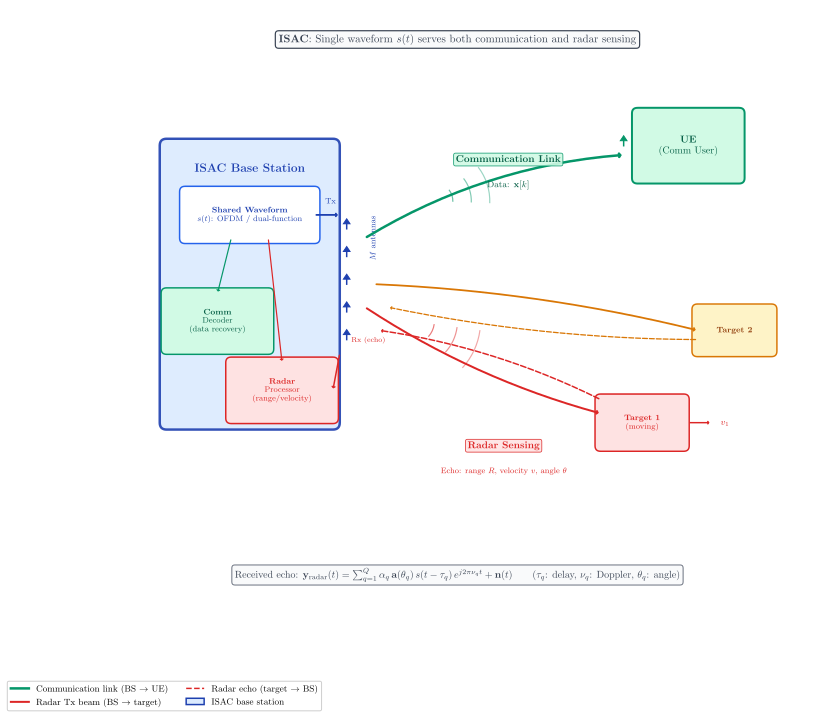
Definition: MIMO Radar
MIMO Radar
A MIMO radar system employs transmit antennas, each transmitting an independent, orthogonal waveform, and receive antennas. The signal model for a single point target at angle with complex reflectivity is:
where:
- : transmit array steering vector
- : receive array steering vector
- : vector of orthogonal transmit waveforms
- : noise vector
After matched filtering to separate the waveforms, the virtual data matrix for the target is:
Vectorising: , where is the virtual steering vector of dimension .
The key distinction from phased-array radar is that MIMO radar does not form a transmit beam; instead, it illuminates the entire scene and achieves spatial resolution through the virtual aperture at the receiver.
Two MIMO radar paradigms exist: (i) widely separated antennas (statistical MIMO), where spatial diversity improves target detection against fading, and (ii) colocated antennas (waveform-diversity MIMO), where the virtual aperture improves angular resolution. This chapter focuses on the colocated case, which is most relevant to ISAC systems with compact antenna arrays.
Theorem: Virtual Aperture of Colocated MIMO Radar
A colocated MIMO radar with transmit antennas at positions and receive antennas at positions creates a virtual array with element positions:
The virtual array has up to distinct elements. For a transmit ULA with spacing and a receive ULA with spacing (or equivalently, ):
- The virtual array is a filled ULA with elements and spacing .
- The virtual aperture is , which is times the physical receive aperture.
- The angular resolution is:
This virtual aperture provides the angular resolution of an array with physical elements, using only physical antennas.
Virtual array construction
The phase shift experienced by a signal at angle for the -th transmit and -th receive antenna is:
After matched filtering to separate the orthogonal transmit waveforms, the virtual data for the transmit-receive pair contains the phase . This is identical to the response of a single physical antenna at position . The set of all such positions defines the virtual array.
For the specific case of a transmit ULA with spacing and a receive ULA with spacing , the virtual positions are for and . When , the positions form a filled ULA with elements at spacing . The total aperture is , yielding the stated angular resolution.
Joint Communication-Sensing Beamforming
In a MIMO ISAC system, the transmit signal must simultaneously form communication beams towards users and a radar beam towards the target. Consider a system with transmit antennas serving single-antenna communication users and sensing one target at angle . The transmitted signal is:
where is the communication precoding matrix, is the data vector, is the sensing beamforming vector, and is the radar probing waveform.
The transmit covariance matrix is:
subject to the total power constraint .
Communication metric: The SINR for user is:
Sensing metric: The radar beampattern gain in direction is:
The CRB for angle estimation of a target at is inversely proportional to and to the second derivative of the beampattern at .
The joint optimisation problem is:
where is the minimum required sensing beampattern gain. The Pareto frontier of this problem — the set of all achievable (rate, CRB) pairs — characterises the fundamental communication-sensing trade-off.
A common parametric approach uses a trade-off weight :
When , all resources are devoted to communication (maximum rate, no sensing constraint); when , all resources are devoted to sensing (optimal radar beampattern, no communication). Intermediate values trace out the Pareto frontier.
Structure of the Optimal ISAC Beamformer
The optimal solution to the ISAC beamforming problem has a revealing structure. When the communication channel vectors and the sensing steering vector are not aligned (the typical case), the optimal transmit covariance can be decomposed as:
where is a regularised zero-forcing beamformer for user (balancing multi-user interference suppression with sensing beam compatibility) and concentrates energy towards the target direction in the null space of the communication channels.
When the target happens to lie in the same direction as a communication user (), the communication beam to that user simultaneously serves as the sensing beam, and the trade-off vanishes — both functions benefit from the same spatial resources. This synergy between communication and sensing directions is a key benefit of ISAC in scenarios like V2X, where the vehicle communicates with another vehicle that is also a radar target.
Deterministic-Random Tradeoff for ISAC
Liu and Caire established the fundamental information-theoretic tradeoff between sensing and communication in ISAC systems. Their key insight is that the communication function requires the transmitted signal to carry random information (entropy), while the sensing function benefits from deterministic (known) waveforms that maximise the estimation accuracy (minimise the CRB).
The deterministic-random tradeoff characterises the Pareto frontier of achievable (rate, CRB) pairs:
- When the entire signal is deterministic (), the CRB is minimised (optimal sensing).
- When the entire signal carries random data (), the CRB increases because the receiver must first estimate the data before extracting sensing information.
- The intermediate region is governed by the allocation of signal dimensions between deterministic sensing pilots and random data symbols.
This work provides the missing converse for the ISAC problem: it proves that no system can simultaneously achieve the communication capacity and the optimal sensing CRB when the two functions compete for signal dimensions. The result was awarded the 2025 IEEE ComSoc/IT Joint Paper Award, recognising its fundamental contribution to the field.
OTFS as an ISAC Waveform
Yuan, Schober, and Caire proposed OTFS (Orthogonal Time Frequency Space) as a waveform for ISAC systems operating in high-mobility scenarios. While OFDM is the natural ISAC waveform in low-to-moderate Doppler (Section 29.3), its performance degrades in high-Doppler environments (e.g., V2X at highway speeds, LEO satellite communication) where inter-carrier interference (ICI) corrupts both communication and sensing.
OTFS modulates data in the delay-Doppler domain using the Zak transform, where the channel is sparse and quasi-static. For sensing, OTFS provides a direct mapping between the delay-Doppler grid and the range-velocity plane, making target parameter extraction particularly natural.
Key advantages of OTFS for ISAC:
- Doppler resilience: OTFS spreads each data symbol across the entire time-frequency plane, achieving full diversity and avoiding the ICI problem of OFDM.
- Direct range-Doppler estimation: The delay-Doppler channel representation is sparse and directly reveals target parameters.
- Efficient joint processing: A single Zak-domain matched filter serves both communication (channel estimation and equalisation) and sensing (target detection and parameter estimation).
Related work by Gaudio, Kobayashi, and Caire developed the DD-domain waveform design framework, optimising the input symbols in the delay-Doppler grid to balance communication and sensing metrics.
ISAC Beampattern with Trade-off Parameter
Visualise the ISAC transmit beampattern as a function of the sensing-communication trade-off parameter . A ULA with antennas forms a beam that balances between a communication direction and a sensing direction. When , the beam points entirely towards the communication user; when , it points towards the sensing target. Intermediate values produce a beampattern that serves both directions with reduced gain in each. Adjust the antenna count to observe how more antennas enable better spatial separation between the two beams, reducing the trade-off.
Parameters
MIMO Radar Virtual Aperture Construction
ISAC Beampattern Trade-off Animation
MIMO Radar Virtual Aperture
Visualise the virtual aperture created by a MIMO radar with transmit and receive antennas. The physical transmit and receive ULAs are shown along with the resulting virtual array. The angular beampattern of the virtual array is displayed, showing how the effective aperture of elements produces a narrow beam. Adjust the number of transmit and receive antennas to see how the virtual aperture grows, and change the target angle to verify that the virtual array beampattern peaks at the correct direction.
Parameters
Common Mistake: Grating Lobes in MIMO Virtual Arrays
Mistake:
Assuming that the MIMO virtual array always produces a clean beampattern without grating lobes, regardless of the physical array spacing.
Correction:
The virtual array element spacing must satisfy to avoid grating lobes, just as with a physical array. If the transmit spacing is and , the virtual array has grating lobes that create ambiguous angle estimates.
For ISAC systems at high frequencies (mmWave, sub-THz), the half-wavelength spacing is very small ( mm at 77 GHz), which limits the physical antenna size and the achievable element gain. Sparse array designs (nested, coprime) can mitigate this at the cost of increased sidelobe levels.
Quick Check
A colocated MIMO radar has transmit antennas and receive antennas, with the transmit ULA spacing chosen as to produce a filled virtual ULA. How many virtual array elements are created, and by what factor is the angular resolution improved compared to a phased-array radar using only the 12 receive antennas?
20 virtual elements, angular resolution improved by a factor of 20/12
96 virtual elements, angular resolution improved by a factor of 8 (equal to )
96 virtual elements, angular resolution improved by a factor of 96
96 virtual elements, angular resolution improved by a factor of 12
The MIMO radar creates virtual elements. The virtual aperture is , which is times the physical receive aperture . Since angular resolution is inversely proportional to aperture, the resolution improves by a factor of . This is achieved with only physical antenna elements, compared to 96 elements for a conventional phased array with the same resolution.