TOA, TDOA, AOA, and RSSI
Radio-Based Positioning: From Connectivity to Location
Every wireless communication link carries implicit information about the spatial relationship between transmitter and receiver. Propagation delay encodes distance, phase differences across antenna elements encode angle, and received power encodes (a noisy function of) distance. Localisation is the art of extracting and fusing these spatial observables to estimate position.
The importance of positioning has grown dramatically with 5G NR, which defines positioning as a native network service rather than an overlay. Use cases range from regulatory E911 requirements (tens of metres) to industrial IoT asset tracking (sub-metre) and autonomous driving (decimetre).
This section formalises the four fundamental measurement models --- TOA, TDOA, AOA, and RSSI --- and develops the geometric interpretation that underpins all subsequent positioning algorithms.
Definition: Time-of-Arrival (TOA) Measurement Model
Time-of-Arrival (TOA) Measurement Model
Let the user equipment (UE) be at unknown position and let base station be at known position . The time-of-arrival is the one-way propagation delay:
where m/s is the speed of light and is the Euclidean distance.
A noisy TOA estimate yields the range measurement:
where is the ranging standard deviation, related to bandwidth and SNR by the Cramer-Rao bound on delay estimation:
Here is the root-mean-square (effective) bandwidth of the transmitted signal.
Geometric interpretation: Each TOA measurement defines a circle of radius centred at . The UE position lies at the intersection of at least three such circles (in 2D).
TOA requires precise clock synchronisation between UE and BS. A clock offset at the UE introduces a common range bias to all measurements, increasing the number of unknowns from 2 (position) to 3 (position + clock bias). This is the same issue addressed by GPS through a fourth satellite measurement.
Definition: Time-Difference-of-Arrival (TDOA) Measurement Model
Time-Difference-of-Arrival (TDOA) Measurement Model
TDOA eliminates the need for UE clock synchronisation by differencing TOA measurements from pairs of base stations. Choosing BS 1 as the reference, the TDOA between BS and BS 1 is:
The corresponding range-difference measurement is:
where under the assumption of independent TOA errors.
Geometric interpretation: Each TDOA measurement defines a hyperbola with foci at and . The locus of points satisfying is one branch of a hyperbola. With base stations, independent TDOA measurements (and hence hyperbolas) are available. In 2D, at least 3 BSs are needed (2 independent hyperbolas) to determine the position.
TDOA requires synchronisation among the base stations (not the UE). In modern cellular networks, BSs are typically synchronised to a common GPS-disciplined clock or via network-based protocols, making TDOA the more practical approach for downlink positioning.
Geometric Interpretation of TOA and TDOA
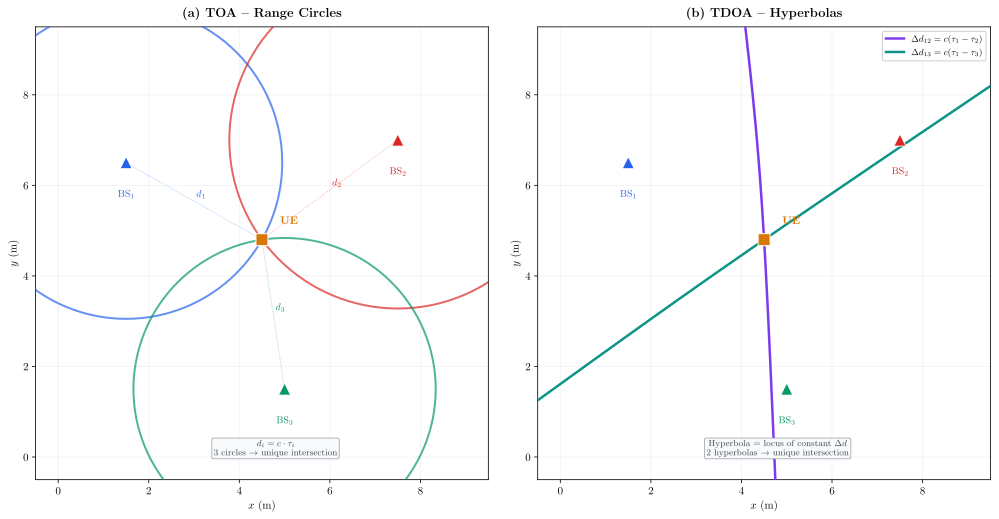
Comparing TOA and TDOA: Synchronisation Trade-offs
The fundamental trade-off between TOA and TDOA is summarised as follows:
| Property | TOA | TDOA |
|---|---|---|
| Synchronisation | UE-BS required | BS-BS only |
| Unknowns (2D) | 2 () or 3 with clock bias | 2 () |
| Min. BSs (2D) | 3 (synced) or 4 (unsynced) | 3 (= 2 hyperbolas) |
| Geometry | Circles | Hyperbolas |
| Noise amplification | None (direct ranges) | TDOA noise is TOA |
| Practical use | Round-trip time (RTT) | Downlink observed TDOA |
In practice, round-trip time (RTT) measurements circumvent the UE clock issue by measuring the two-way delay, at the cost of halving the effective measurement rate and requiring the UE to transmit. 5G NR supports both RTT-based (Multi-RTT) and TDOA-based (DL-TDOA) positioning methods.
Definition: Angle-of-Arrival (AOA) Measurement Model
Angle-of-Arrival (AOA) Measurement Model
An antenna array at BS with elements can estimate the angle of arrival of the signal from the UE. The true angle satisfies:
The noisy AOA measurement is modelled as:
The angular estimation variance is bounded by the CRB for array processing (see Chapter 7):
where is the element spacing and is the per-element SNR.
Geometric interpretation: Each AOA measurement defines a bearing line (half-line) from in the direction . Two bearing lines from distinct BSs suffice to determine the 2D position (triangulation), though at least three are preferred for robustness.
AOA accuracy improves with more antenna elements ( for a ULA) and higher SNR, but degrades as the signal arrives near endfire () due to the factor. Massive MIMO base stations with elements can achieve sub-degree angular resolution, making AOA-based positioning increasingly practical in 5G systems.
Definition: Received Signal Strength Indicator (RSSI) / RSS-Based Ranging
Received Signal Strength Indicator (RSSI) / RSS-Based Ranging
The received power at the UE from BS follows the log-distance path loss model:
where is the transmit power, is the path loss at reference distance , is the path loss exponent, and is log-normal shadow fading with standard deviation (typically 4--12 dB).
Inverting the path loss model gives a range estimate:
The multiplicative nature of the errors in linear scale yields a highly uncertain range estimate. In dB-distance domain, the relationship is linear:
so the log-distance error has standard deviation in decades of distance.
Geometric interpretation: Like TOA, each RSSI measurement defines a circle, but the radius uncertainty is much larger due to shadowing (-- dB corresponds to distance errors of factor 2--5). RSSI positioning is therefore coarser than TOA/TDOA but requires no timing infrastructure.
Despite its low accuracy, RSSI remains widely used in WiFi and Bluetooth positioning due to its universal availability --- every receiver measures signal strength. Fingerprinting techniques (Section 30.4) can significantly improve RSSI-based accuracy by learning environment-specific signal maps.
TOA Range Circles and Intersection
TOA Circles and TDOA Hyperbolas
Visualise the geometric primitives of radio-based positioning. In TOA mode (Mode 1), circles of radius are drawn around each BS; the UE position lies near their intersection. In TDOA mode (Mode 2), hyperbolas corresponding to range differences are shown. Increase the noise to see how measurement uncertainty affects the intersection region. Adding more BSs improves geometric diversity and shrinks the uncertainty region.
Parameters
Example: TOA Positioning with Three Base Stations
Three base stations are located at , , and (metres). The measured ranges (from TOA) are m, m, and m.
(a) Write the system of range equations.
(b) Linearise by subtracting the first equation from the others and solve for the UE position .
Range equations
Each range measurement gives:
Expanding:
Linearisation by differencing
Subtract equation 1 from equations 2 and 3 to eliminate the quadratic terms :
Eq. 2 Eq. 1:
Eq. 3 Eq. 1:
The estimated UE position is metres.
Verification
Check the estimated ranges:
The residuals m are consistent with the measurement noise.
Theorem: CRB for Time-of-Arrival Estimation
The variance of any unbiased estimator of the propagation delay from a received waveform with bandwidth and received SNR satisfies:
where is the root-mean-square (effective) bandwidth of the transmitted signal . The corresponding range accuracy bound is:
For a rectangular spectrum of bandwidth , , giving .
Wider bandwidth creates a sharper autocorrelation peak, enabling finer timing discrimination. Higher SNR reduces the noise floor against which the timing peak must be detected. The CRB is inversely proportional to both, confirming the engineering intuition that "bandwidth buys accuracy."
Fisher information for delay
The log-likelihood for delay estimation from the baseband received signal yields the Fisher information:
where is the time derivative of and Parseval's theorem converts to the frequency domain.
CRB and range bound
The CRB gives . Multiplying by : .
Theorem: Geometric Dilution of Precision (GDOP)
For TOA-based 2D positioning with base stations at positions and equal ranging accuracy , the PEB at position can be written as:
where the geometric dilution of precision is:
and is the Jacobian matrix with rows (unit direction vectors from each BS to the UE).
The GDOP depends only on geometry, not on measurement accuracy: it captures how the spatial configuration of BSs amplifies or reduces the ranging errors when mapped to position errors. when the geometry is ideal (isotropic), and when the BSs are collinear.
GDOP separates the two factors that determine positioning accuracy: measurement quality (, set by bandwidth and SNR) and geometry (GDOP, set by BS placement). Improving either factor helps, but geometry cannot be compensated by better measurements alone. This is why network planners optimise BS locations for positioning coverage, not just communication coverage.
From FIM to GDOP
With equal , the FIM is . Therefore and .
Common Mistake: RSSI-Based Ranging Is Far Less Accurate Than TOA
Mistake:
Using RSSI to estimate distance with the same confidence as TOA-based ranging.
Correction:
RSSI ranging accuracy is fundamentally limited by shadow fading (-- dB), which translates to distance errors of factor 2--5. At 100 m true distance with dB and , the range error is approximately 60 m.
In contrast, TOA with 100 MHz bandwidth achieves m. RSSI is useful only for coarse proximity detection (e.g., "which room?") or as a supplement to TOA/AOA, never as a primary ranging modality for metre-level positioning.
Time-of-Arrival (TOA)
A positioning measurement based on the one-way propagation delay from transmitter to receiver. TOA defines a range circle centred on the transmitter. Requires clock synchronisation between transmitter and receiver (or round-trip measurement).
Related: Time-Difference-of-Arrival (TDOA), Position Error Bound (PEB)
Time-Difference-of-Arrival (TDOA)
A positioning measurement based on the difference in propagation delay between two transmitters. TDOA defines a hyperbola with foci at the two transmitters. Eliminates the need for UE clock synchronisation but requires inter-transmitter synchronisation.
Position Error Bound (PEB)
The minimum achievable RMS position error for any unbiased estimator, derived from the Fisher information matrix: . Analogous to GDOP in GNSS, the PEB captures the joint effect of measurement accuracy and BS geometry.
Related: Time-of-Arrival (TOA), Geometric Dilution of Precision (GDOP)
Geometric Dilution of Precision (GDOP)
A scalar metric that captures how BS geometry amplifies ranging errors into position errors: . Low GDOP (near 1) indicates an ideal isotropic geometry; high GDOP indicates poor angular diversity among BSs.
Related: Position Error Bound (PEB)
Non-Line-of-Sight (NLOS)
A propagation condition where the direct path between transmitter and receiver is blocked, and the signal arrives via reflection or diffraction. NLOS introduces a positive range bias that is the dominant error source in practical positioning systems.
Related: Time-of-Arrival (TOA), Simultaneous Localisation and Mapping (SLAM)
Quick Check
A cellular network has 4 synchronised base stations. Using downlink TDOA measurements (with BS 1 as reference), how many independent hyperbolas can be formed, and how many unknowns must be solved for in 2D?
4 hyperbolas, 2 unknowns
3 hyperbolas, 2 unknowns ()
6 hyperbolas, 3 unknowns
3 hyperbolas, 3 unknowns (, clock bias)
With BSs and one reference, there are independent TDOA measurements, each defining a hyperbola. Since the UE clock cancels in TDOA, only 2 unknowns (the 2D position ) remain. The system is overdetermined (3 equations, 2 unknowns), which enables a least-squares solution.