Positioning in 5G NR
Positioning as a Native 5G Service
Unlike previous generations where positioning was an afterthought, 5G NR treats positioning as a first-class network service. 3GPP Release 16 introduced a comprehensive positioning framework with dedicated reference signals (PRS, SRS for positioning), new positioning methods (DL-TDOA, DL-AoD, UL-TDOA, UL-AoA, Multi-RTT), and a positioning architecture involving a dedicated Location Management Function (LMF).
The key enablers for improved positioning in 5G are:
- Wide bandwidth (up to 400 MHz in FR2): reduces ranging error () from tens of metres (LTE, 20 MHz) to sub-metre
- Massive antenna arrays (32--256 elements): enables precise angle estimation ()
- Dense deployments: more BSs means better geometry (smaller PEB)
- Dedicated PRS: comb-based frequency-domain design with long sequences for high processing gain
Release 17 and 18 further enhance positioning with carrier-phase measurements, sidelink positioning, and NR-RedCap positioning for IoT devices.
5G NR Positioning Architecture
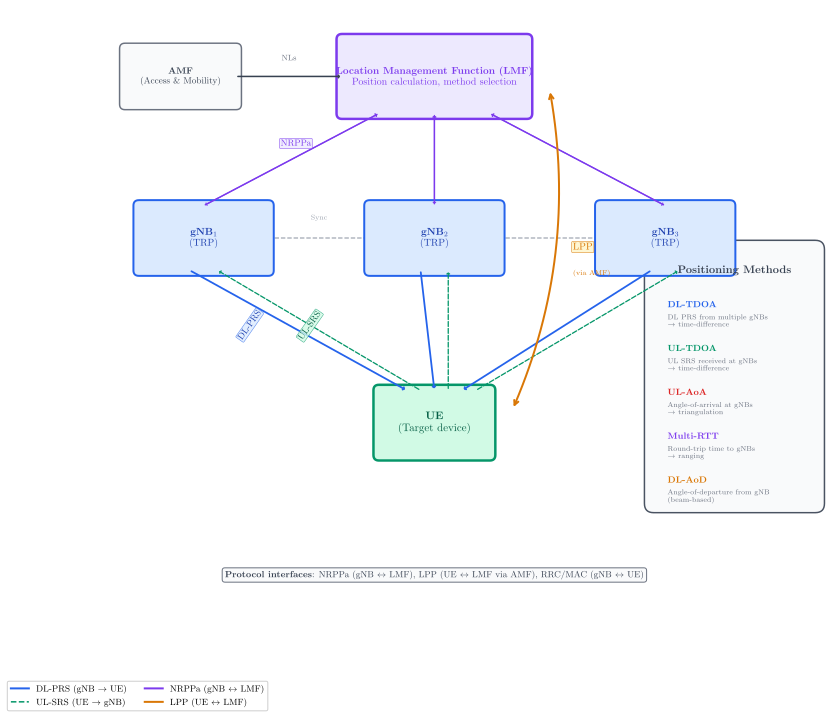
Definition: 5G NR Positioning Methods
5G NR Positioning Methods
3GPP defines the following RAT-dependent positioning methods for NR (TS 38.305):
Downlink methods (UE measures, network or UE computes):
-
DL-TDOA (Downlink Time Difference of Arrival): The UE measures the Reference Signal Time Difference (RSTD) between PRS transmissions from multiple gNBs. The RSTD corresponds to TDOA, producing hyperbolic position loci. Requires at least 3 gNBs (in 2D) and inter-gNB synchronisation.
-
DL-AoD (Downlink Angle of Departure): The gNB transmits PRS on multiple beams. The UE reports the beam with the strongest RSRP, and the gNB (or LMF) maps beam indices to angular sectors. With beam refinement (hierarchical beamsweeping), angular resolution improves to . A single gNB with a 2D array can provide azimuth and elevation.
Uplink methods (gNB measures, network computes):
-
UL-TDOA (Uplink Time Difference of Arrival): Multiple gNBs measure the time of arrival of the UE's SRS for positioning. The LMF computes TDOA and triangulates. This method avoids the need to send assistance data to the UE.
-
UL-AoA (Uplink Angle of Arrival): One or more gNBs estimate the azimuth and zenith angles of arrival of the UE's SRS using their antenna arrays. With massive MIMO arrays, sub-degree accuracy is feasible at high SNR.
Round-trip methods:
- Multi-RTT (Multiple Round-Trip Time): The UE and multiple gNBs exchange PRS and SRS, measuring the round-trip time. The RTT eliminates clock bias: , where the processing times and are known and subtracted. Multi-RTT combines the advantages of TOA (circles) with no need for UE-gNB synchronisation.
Hybrid methods combine two or more of the above (e.g., DL-TDOA + UL-AoA) to exploit complementary information from range and angle measurements.
Each method has distinct trade-offs in terms of infrastructure requirements, UE complexity, latency, and accuracy. DL-TDOA is the workhorse for wide-area outdoor positioning; UL-AoA leverages massive MIMO arrays; Multi-RTT is the most robust (no inter-gNB sync needed); DL-AoD enables single-BS positioning with a 2D antenna panel.
Positioning Reference Signal (PRS) Design in NR
The NR Positioning Reference Signal (PRS) is a downlink reference signal specifically designed for high-accuracy timing measurements. Key design parameters:
Frequency domain: PRS uses a comb structure with comb size , meaning the PRS is transmitted on every -th subcarrier. Different gNBs use different comb offsets to enable frequency-domain multiplexing and avoid inter-cell interference.
Time domain: PRS occupies consecutive OFDM symbols within a slot. Across these symbols, the comb offset is staggered (shifted) to fill in the frequency gaps, effectively providing full-bandwidth measurements over symbols. This "staircase" pattern maximises the effective bandwidth for ranging.
Sequence: Gold sequences with a length-31 generator polynomial, initialised by the cell ID, slot number, and PRS resource ID, ensuring low cross-correlation between gNBs.
Bandwidth: PRS can span up to 272 resource blocks (approximately 100 MHz at 30 kHz SCS), enabling sub-metre ranging. In FR2 (mmWave), bandwidths up to 400 MHz reduce to the decimetre level.
The SRS for positioning in the uplink mirrors the PRS design philosophy, with comb sizes and configurable bandwidth. It is used for UL-TDOA and Multi-RTT.
5G Positioning Accuracy Requirements
3GPP and industry bodies have defined accuracy targets for different use cases, driving the evolution of positioning capabilities across releases:
| Use Case | Horizontal (m) | Vertical (m) | Release |
|---|---|---|---|
| Commercial (regulatory E911) | (floor) | Rel-16 | |
| Commercial (indoor) | Rel-16 | ||
| Industrial IoT | Rel-16 | ||
| IIoT (stringent) | Rel-17 | ||
| V2X (lane-level) | N/A | Rel-17 | |
| Sidelink ranging | Rel-18 |
Achieving sub-metre accuracy requires:
- Bandwidth MHz (FR1) or MHz (FR2)
- At least 3--4 hearable gNBs with good geometry
- LOS or effective NLOS mitigation
- Carrier-phase measurements for cm-level accuracy (Rel-17+)
The jump from metre-level to decimetre-level accuracy represents a qualitative shift: at sub-30 cm, the system can distinguish individual lanes on a road, specific shelves in a warehouse, or different rooms in a building.
Example: DL-TDOA Positioning in a 5G Urban Deployment
A UE in an urban area receives PRS from four gNBs at positions (in metres): , , , . The system operates at 100 MHz bandwidth (SCS = 30 kHz).
The UE measures the following RSTDs (with BS 1 as reference): ns, ns, ns.
(a) Convert RSTDs to range differences.
(b) Estimate the UE position using linearised LS.
(c) Estimate the achievable PEB given m.
Range differences from RSTDs
The range differences are :
Negative range differences indicate the UE is closer to the reference BS 1 than to BSs 2, 3, 4.
Linearised LS solution
The TDOA equation for BSs and 1 is:
Squaring both sides and linearising (using the same differencing approach as in the TOA case with additional manipulation to handle the term), the linearised system with gives:
Solving yields m.
PEB computation
With equal m and the UE at the centre of the square deployment, the direction vectors to the four BSs are uniformly distributed at angles. The FIM is:
(due to symmetry, cross-terms cancel). Therefore:
With 100 MHz bandwidth, this is achievable in LOS conditions.
5G NR Positioning Methods Comparison
| Method | Measurement | Min BSs | Sync Req. | UE Complexity | Best Use Case |
|---|---|---|---|---|---|
| DL-TDOA | Range difference | 3 | BS-BS | Low | Wide-area outdoor |
| DL-AoD | Angle (beam ID) | 1 | None | Low | Single-BS indoor with 2D array |
| UL-TDOA | Range difference | 3 | BS-BS | Low (SRS Tx) | UE-assisted, no DL PRS needed |
| UL-AoA | Angle of arrival | 1 | None | Low (SRS Tx) | Massive MIMO deployment |
| Multi-RTT | Round-trip time | 3 | None | Medium | No sync infrastructure |
| Hybrid | Range + angle | 2 | Varies | Medium | Maximum accuracy |
Bandwidth Determines Ranging Precision
The CRB for TOA-based ranging gives . For a rectangular-spectrum signal at SNR dB:
| Bandwidth | (1) | Technology |
|---|---|---|
| 1.4 MHz (LTE-1.4) | 100 m | Basic cell-ID level |
| 20 MHz (LTE-20) | 7 m | LTE OTDOA |
| 100 MHz (NR FR1) | 1.4 m | 5G sub-6 GHz |
| 400 MHz (NR FR2) | 0.35 m | 5G mmWave |
The inverse relationship explains why 5G mmWave bands (with up to 400 MHz bandwidth) achieve decimetre ranging accuracy — a 20 improvement over LTE.
However, wider bandwidth also means higher sampling rates (up to 800 MSa/s for 400 MHz), increasing ADC power consumption and baseband processing load. Power-efficient wideband receivers are a key hardware challenge for 5G positioning.
- •
FR2 (mmWave) propagation limits range to 200 m, requiring dense deployments
- •
400 MHz bandwidth requires 800 MSa/s ADC — power-hungry for IoT devices
- •
Multipath resolution improves with bandwidth but also complicates NLOS identification
Historical Note: Cellular Positioning from 2G to 5G
1990--2023Cellular positioning capabilities have evolved dramatically across mobile generations, driven by regulatory mandates and commercial applications:
2G (GSM, 1990s): Cell-ID and Timing Advance (TA) provided accuracy of 100--500 m. Adequate for E-911 but too coarse for commercial location services.
3G (UMTS, 2000s): Observed TDOA (OTDOA) with dedicated positioning reference signals improved to 20--100 m. A-GPS integration provided metre-level outdoor accuracy.
4G (LTE, 2010s): Enhanced OTDOA with PRS achieved 10--50 m. LTE Release 14 introduced Enhanced Cell-ID with RTT for indoor use.
5G (NR, 2020s): Native positioning with PRS, multiple methods, and the LMF architecture targets sub-metre accuracy. Release 17 introduces carrier-phase positioning for cm-level precision.
The 1000 accuracy improvement from 2G to 5G mirrors the 1000 increase in signal bandwidth from 200 kHz (GSM) to 400 MHz (NR FR2).
Comparison of 5G NR Positioning Methods
Compare the achievable PEB for different 5G positioning methods (DL-TDOA, UL-AoA, Multi-RTT, and hybrid DL-TDOA + UL-AoA) as a function of bandwidth, number of antennas, and number of BSs. The range accuracy is computed from the CRB on delay estimation at SNR = 10 dB. The angular accuracy is derived from the array CRB. Observe how hybrid methods that fuse range and angle measurements consistently outperform single-measurement approaches, and how wide bandwidth benefits TOA/TDOA methods while large arrays benefit AoA methods.
Parameters
Gauss-Newton Iterative Positioning Convergence
Animate the convergence of the Gauss-Newton algorithm for TOA-based positioning. The initial estimate (from linearised LS) is shown as a square; subsequent iterations are shown as circles converging toward the true position (star). The ranging circles are drawn for the current noise realisation. Increase the noise to observe how convergence slows and the final estimate deviates further from the true position. The residual norm is plotted alongside the spatial trajectory.
Parameters
Quick Check
In 5G NR, the PRS uses a comb structure with comb size and occupies OFDM symbols with staggered comb offsets. What is the effective subcarrier occupation after combining all symbols?
Every subcarrier is used (100% occupation)
Every 4th subcarrier (25% occupation)
Every 2nd subcarrier (50% occupation)
Every 16th subcarrier (6.25% occupation)
With and 4 symbols with staggered offsets , every subcarrier is covered exactly once across the 4 symbols. This "staircase" pattern ensures that the effective bandwidth for ranging equals the full allocated bandwidth, maximising the timing resolution. The staggering is essential: without it, only 25% of subcarriers would carry PRS, reducing the effective bandwidth and degrading ranging accuracy.