How to Read a Wireless Paper
Why Reading Papers Is a Skill
A PhD student in wireless communications will read hundreds of papers over the course of their studies. The difference between productive and unproductive reading comes down to method: knowing what to extract, in what order, and when to stop.
Most beginners make the same mistake: they start at page 1 and read linearly to the end. This is the slowest and least effective approach. A systematic multi-pass strategy lets you decide in under 10 minutes whether a paper is relevant, and extract the key contributions in under 30 minutes.
This section presents a structured workflow adapted from Keshav's classic three-pass method, specialized for wireless communications papers.
The Three-Pass Method (Keshav, 2007)
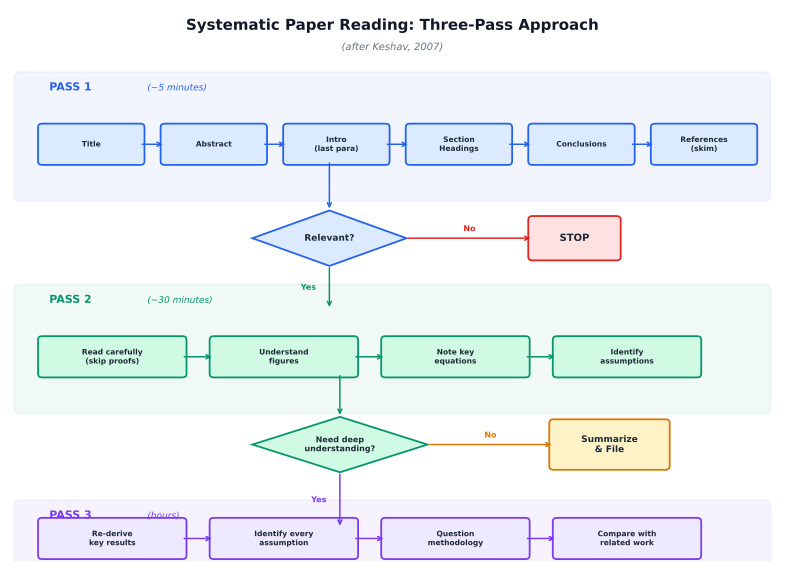
The three-pass approach structures reading into increasing levels of depth:
Pass 1 — Bird's-eye view (5 minutes): Read the title, abstract, introduction (first and last paragraph), section headings, and conclusion. Goal: decide if the paper is relevant to your work.
Pass 2 — Grasp the structure (20 minutes): Read the full paper but skip proofs and derivations. Focus on figures, tables, and the system model. Mark key equations. Goal: summarize the paper in one paragraph.
Pass 3 — Reconstruct the argument (1--2 hours): Re-derive the main results. Challenge every assumption. This pass is only for papers central to your own research.
Most papers never need Pass 3. A well-executed Pass 2 is sufficient for literature reviews and related-work sections.
How to Read a Wireless Paper in 30 Minutes
Complexity: 30 minutes per paperSteps 6--10 form the "system model checklist" — the five questions every wireless paper must answer. If any is ambiguous, the paper has a clarity problem.
Systematic Paper Reading Flowchart
Definition: The Five Components of a Wireless System Model
The Five Components of a Wireless System Model
Every wireless communications paper builds on a system model with five essential components:
- Signal model: The input--output relationship (e.g., )
- Channel model: Statistical distribution and structure of (Rayleigh, Rician, clustered, spatial correlation)
- CSI assumption: What the transmitter and receiver know about (perfect, estimated with error, statistical only)
- Design variable: The quantity being optimized (precoder , power , schedule )
- Performance metric: The objective function (sum rate, BER, outage probability, energy efficiency)
A well-written paper states all five explicitly. A critical reader identifies all five before reading the proposed solution.
Common source of confusion: papers that use "capacity" when they mean "achievable rate with Gaussian signaling" or "mutual information." These are equal only for the AWGN channel.
Example: Dissecting a System Model: MU-MIMO Downlink
Consider the following excerpt from a hypothetical paper:
"We consider a base station with antennas serving single-antenna users. The received signal at user is where and . We design precoders to maximize the sum rate under a total power constraint ."
Identify each of the five system-model components and flag any missing information.
Identify the five components
- Signal model: (multi-user MIMO downlink with linear precoding)
- Channel model: i.i.d. Rayleigh fading,
- CSI assumption: Not stated! This is a gap. The paper must specify whether the BS has perfect CSI, estimated CSI, or statistical CSI.
- Design variable: Precoders
- Metric: Sum rate,
Flag missing information
- CSI model is not specified — this is critical because ZF and MMSE precoders require channel estimates, and the quality of these estimates affects performance significantly.
- Path loss and large-scale fading are absent — all users see the same average SNR, which is unrealistic.
- Antenna correlation is ignored ( covariance) — this overestimates spatial multiplexing gains at sub-6 GHz.
- The noise variance must be related to the SNR definition. Is SNR or ?
Red Flags When Reading a Paper
The following patterns should trigger skepticism:
- No baselines: The proposed scheme is compared only to itself (e.g., varying a parameter) but not to existing methods.
- Asymptotic-only results: Performance is shown only for unrealistically large or without finite-size validation.
- Perfect CSI everywhere: Many papers assume perfect CSI at the transmitter — check whether this is realistic for the claimed scenario (especially at mmWave or high mobility).
- Missing SNR definition: Is it per-antenna, per-user, total? or ? This single ambiguity can shift curves by 3--10 dB.
- Suspiciously smooth curves: BER curves without visible Monte Carlo noise at very low error rates suggest either too few realizations or analytical (not simulated) results presented as simulations.
- No complexity analysis: A scheme that provides 0.5 dB gain but requires the computational cost may not be practically useful.
Quick Check
During Pass 1 of the three-pass reading method, which of the following should you NOT attempt?
Read the abstract and conclusion
Re-derive the main theorem from scratch
Scan figure captions and section headings
Identify the claimed contributions
Re-deriving results is a Pass 3 activity. In Pass 1 you only assess relevance and scope — spending time on proofs defeats the purpose of the triage pass.
Structuring a Wireless Research Paper
A standard wireless communications paper follows this template:
I. Introduction (1.5--2 pages)
- Motivation and context
- Literature review with explicit comparison to prior work
- Contributions list (numbered)
- Notation paragraph
II. System Model (1--1.5 pages)
- Signal model equation
- Channel model with statistical assumptions
- CSI model
- Constraint description
III. Proposed Method (2--4 pages)
- Problem formulation
- Algorithm derivation
- Complexity analysis
IV. Analytical Results (1--2 pages, if applicable)
- Theorems with proofs (or proof sketches with appendix)
- Special cases and asymptotic behavior
V. Numerical Results (2--3 pages)
- Simulation setup table
- Baseline descriptions
- Figures with discussion
VI. Conclusion (0.5 page)
- Summary of findings and future directions
Each section should be self-contained enough that a reviewer can jump directly to it.
Common Writing Mistakes in Wireless Papers
Based on patterns from hundreds of peer reviews:
System model mistakes:
- Using and inconsistently
- Not defining whether vectors are column or row
- Mixing and for complex-valued systems
Results presentation mistakes:
- Plotting BER vs. SNR without specifying the SNR definition
- Using different simulation parameters for different schemes
- Not showing confidence intervals or mentioning trial counts
Writing style mistakes:
- Starting the abstract with "In this paper, we..."
- Claiming "significant" improvement without statistical evidence
- Burying the main result in the middle of a paragraph
Quick Check
A paper states: "We consider a MIMO system with where is the channel matrix." What is the most critical missing information?
The modulation scheme
The statistical model for (distribution, correlation)
The paper length
The number of figures
Without knowing whether is Rayleigh, Rician, correlated, or deterministic, the results cannot be interpreted or reproduced. This is the most critical gap.
Historical Note: The IEEE Peer Review System
1912--presentThe IEEE peer review system dates back to the founding of the Institute of Radio Engineers (IRE) in 1912, which merged with AIEE to form IEEE in 1963. The IEEE Transactions on Information Theory, launched in 1953, established the rigorous review culture that defines wireless communications research today. The median review cycle for IEEE Trans. Wireless Communications is 4--8 months, with 1--3 revision rounds. The acceptance rate for top IEEE journals (TWC, TSP, JSAC) is approximately 20--30%, making careful paper construction — the subject of this section — essential for career success in academic research.
Historical Note: The Reproducibility Movement in Signal Processing
2017--presentIn 2017, the IEEE Signal Processing Society launched its Reproducible Research initiative, awarding badges to papers that provide code and data. This was motivated by growing evidence that many published results in communications and signal processing could not be independently replicated. A landmark 2019 analysis of 300+ papers from IEEE TWC found that fewer than 5% provided source code. The initiative catalyzed a culture shift: by 2023, several IEEE journals began requiring code availability statements, and the Foundations and Trends monograph series (e.g., Bjornson et al., 2017) set the standard for fully reproducible wireless research.
Definition: Reproducibility vs. Replicability
Reproducibility vs. Replicability
In the context of wireless research:
-
Reproducibility: Running the same code with the same data produces the same results. This is the minimum standard.
-
Replicability: An independent implementation using the same methodology produces consistent (not necessarily identical) results. This is the stronger standard.
A paper is reproducible if its code and parameters are available. A paper is replicable if its methodology is described with sufficient clarity that another researcher can write new code from the paper alone and obtain consistent conclusions.
Definition: The Standard Wireless System Model Equation
The Standard Wireless System Model Equation
The canonical MIMO system model equation that appears in the majority of wireless research papers is:
where:
- is the received signal vector
- is the channel matrix
- is the transmitted signal vector
- is AWGN
For multi-user systems, the model becomes: , separating the desired signal from multi-user interference.
Recognizing which variant of this model a paper uses is the first step in the Pass 2 extraction (Step 6 in the algorithm above).
Common Mistake: Confusing with
Mistake:
Comparing BER curves from two papers at the same "SNR" without checking whether one uses and the other .
Correction:
The two are related by: where is the modulation order. For 64-QAM (), the difference is dB! Always convert to a common SNR definition before comparing results across papers. Check the axis label and the paper text — some papers label the axis "" but actually plot .
Why This Matters: Information-Theoretic Bounds as Paper-Reading Anchors
The capacity results from the ITA book (Information Theory) provide essential context when reading wireless papers. A proposed scheme's rate should always be compared against the Shannon limit or the capacity region of the relevant channel (AWGN, fading, MAC, BC). If a paper claims to exceed capacity, there is a bug. If a scheme is within 1 dB of capacity, further improvement is marginal. The ITA book's treatment of finite-blocklength bounds (Polyanskiy et al., 2010) is particularly relevant for evaluating URLLC papers.
BER (Bit Error Rate)
The fraction of received bits that differ from the transmitted bits. Estimated via Monte Carlo: . The fundamental performance metric for uncoded or coded systems.
Related: BLER (Block Error Rate), SNR (Signal-to-Noise Ratio)
BLER (Block Error Rate)
The fraction of transmitted blocks (codewords) that contain one or more bit errors after decoding. The standard metric for coded systems (e.g., LTE/NR where target BLER is for eMBB).
SNR (Signal-to-Noise Ratio)
The ratio of signal power to noise power. Multiple definitions exist in wireless (, , per-antenna, total). Always specify which definition is used — this single ambiguity is the most common source of confusion in wireless research.
Related: BER (Bit Error Rate), BLER (Block Error Rate)