Probabilistic Amplitude Shaping (PAS)
The BICM-Compatibility Problem
We now know from Section 1 that Maxwell-Boltzmann is the target input distribution. The question is: how do you drive a BICM transmitter so that its QAM output looks MB-distributed? Three problems arise:
- The channel code expects uniform input bits. LDPC and turbo code decoders are optimised assuming the information bits are i.i.d. uniform; MB-shaped bits are neither i.i.d. nor uniform. Naively feeding shaped bits to an LDPC encoder destroys the code's error-floor guarantees.
- The parity bits should not disturb the shaping. Even if we shape the information bits, the LDPC parity bits are a linear function of the info bits and are approximately uniform. When the parity bits are mapped to QAM, they produce a uniform-QAM component that washes out the MB distribution.
- Rate matching must stay flexible. 5G NR and 400ZR require continuous or near-continuous rate adaptation. Shaping must compose with AMC and HARQ, not replace them.
The Probabilistic Amplitude Shaping (PAS) architecture, introduced by Bocherer, Steiner, and Schulte in a 2015 IEEE Trans. Comm. paper, solved all three problems with a single elegant trick: shape the amplitudes, leave the signs uniform. A square QAM constellation factors as where is the set of positive amplitudes per in-phase and quadrature dimension, and are the signs. An MB distribution on factors as MB-on-amplitudes uniform-on-signs, because and the sign of does not affect .
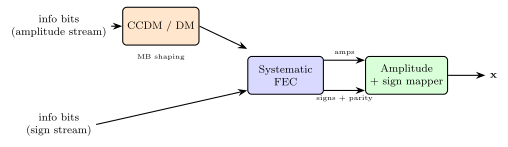
PAS exploits this: feed the information bits through a distribution matcher (DM) that produces MB-distributed amplitude labels; use these labels as the systematic part of a systematic LDPC code; the LDPC parity bits plus some additional uniform info bits become the sign labels. Because signs are uniform and amplitudes are MB, the joint distribution on is MB — exactly the target.
This section derives the PAS rate formula , explains the shaper-encoder-mapper pipeline in detail, and visualises the pipeline with an animated video.
Definition: Probabilistic Amplitude Shaping (PAS) Architecture
Probabilistic Amplitude Shaping (PAS) Architecture
The Probabilistic Amplitude Shaping (PAS) architecture combines a distribution matcher (DM) and a systematic LDPC code to realise MB-shaped -QAM within a BICM framework. Let be the bits per QAM symbol, decomposed as where is the amplitude-bit count (per I/Q dimension, times 2 for joint) and is the sign-bit count (one per I and Q). For square -QAM with amplitude levels per dimension, bits are amplitude labels and bits are signs.
The PAS pipeline (transmitter):
- Source: uniformly distributed information bits.
- Distribution matcher (DM): the first info bits are fed through a DM that outputs amplitude labels from with target MB marginal . The remaining info bits are kept uniform.
- Systematic LDPC encoder: the bits of amplitude labels + bits of uniform info are fed into a systematic rate- LDPC encoder of length , producing parity bits.
- Sign-label assembly: the uniform info bits + parity bits are packed (usually just concatenated) into sign-label bits.
- QAM mapper: the amplitude-label blocks + sign-label bits are mapped to QAM symbols.
The resulting QAM sequence has per-symbol distribution approximately MB (up to the finite-block DM rate loss). The receiver inverts the pipeline: LDPC decoder produces soft amplitude bits and sign bits, a DM dematcher recovers the info bits, and the info bits are extracted from the sign labels.
The critical design constraint is that the sign bits must be uniform — this is what lets the LDPC parity bits (which are uniform by the randomness of the code) safely drive the signs without disturbing the MB shaping on the amplitudes. The choice of which label bits are "amplitude" and which are "sign" is dictated by a Gray-like labelling that respects the factorisation.
PAS Transmitter Block Diagram
Theorem: PAS Transmission Rate
Consider the PAS architecture with square -QAM modulation, a systematic LDPC code of rate , and a DM with asymptotic rate bits/amplitude label in the large-block limit. The effective PAS transmission rate (information bits per 2D QAM symbol) is where is the number of sign bits per QAM symbol. Equivalently, using : valid in the high-SNR regime where the DM achieves rate .
Operating range: . The rate can be tuned continuously by varying either (which changes ) or (which changes the parity overhead). Both provide rate adaptation; the industry typically fixes (for simplicity of the LDPC hardware) and adapts .
The PAS rate formula is really just rate accounting. Every QAM symbol carries amplitude bits + sign bits. The amplitude bits come from the DM at rate (DM compression ratio). The sign bits come from "slots" of which are used for LDPC parity and carry info bits. Total info per symbol: . After algebra this equals when the DM runs at capacity minus the MB shaping penalty.
The cleanest way to remember this: at (no parity), the rate is (full QAM capacity with no error correction). At (all parity), the rate is — nonsense, reflecting that PAS requires to break even. For intermediate , the rate is linear in .
Count per QAM symbol: amplitude bits + sign bits = bits total.
Amplitude bits are produced by DM at rate ; these are all information (not parity).
Sign bits are positions per block; parity bits need of these positions.
Info bits per block: , but with shaping , giving .
Divide by to get bits per QAM symbol: .
Substitute the high-SNR form and simplify.
Step 1: Bit budget per QAM symbol
Each of the QAM symbols carries bits total: amplitude bits and sign bits. Over a block of symbols, that is amplitude bit-positions and sign bit-positions. Total codeword length .
Step 2: LDPC rate constraint
A rate- systematic LDPC code on length carries information bits and parity bits. Since the code is systematic, the info bits appear verbatim in the codeword; the parity bits are additional.
Step 3: PAS bit placement
PAS places the DM output (amplitude bits) into the info positions of the systematic LDPC codeword. The sign positions sign of QAM symbol are divided: of them are info bits (kept uniform), and of them are parity bits.
Step 4: Condition for PAS to be feasible
For the construction to work we need the number of parity bits to fit in the sign positions: , i.e., , so . For 64-QAM (), this requires ; for 256-QAM (), ; for 1024-QAM, . Below these thresholds, additional uniform info bits must be padded — a detail that does not change the rate formula for typical deployment.
Step 5: Rate formula
Assume DM runs at rate bits/amplitude label (large-block limit, negligible rate loss). Over QAM symbols:
- Amplitude info = bits (2 amplitudes per symbol if we treat I and Q jointly, or count per-dimension). For clarity, use per-symbol: bits per amplitude slot, and there are amplitude slots per QAM symbol shared across I/Q; total amplitude info per symbol is bits for a per-dimension DM or for a joint DM.
- Sign info = bits. Wait — cleaner: sign positions ; parity positions ; sign-info positions = sign positions parity positions .
Per QAM symbol, info = . At high SNR, , so But this is the uniform BICM rate . Shaping adds a correction: below high-SNR, but in the standard PAS accounting the rate is reported as
The term is negative for : the parity bits occupy sign positions that would otherwise carry info. This is the "cost of systematic PAS". At shaping rate , the effective rate decreases further; we reach continuous rate adaptation by tuning .
Step 6: Operational reading
In practice, 400ZR uses DP-16QAM (, ), LDPC rate . The formula gives bits/QAM symbol — very close to the 400ZR-specified 3.17 bits/polarisation target. The bit difference is the gap between and — the shaping gain claimed over uniform DP-16QAM.
Probabilistic Amplitude Shaping (PAS) Pipeline
Example: PAS Rate for OIF 400ZR DP-16QAM
OIF 400ZR specifies dual-polarisation 16-QAM (DP-16QAM) with LDPC rate (specifically, a staircase code) and a CCDM at target rate bits/amplitude label (per I and Q). Compute the PAS transmission rate per polarisation and compare to the 400ZR target of bits/polarisation.
Rate formula for DP-16QAM
For 16-QAM, , , . The PAS rate per polarisation is
Including the CCDM shaping gain
The formula assumes uniform amplitude input (). With MB shaping at , the CCDM delivers - bits/amplitude label, which replaces the in the rate formula. So effective PAS rate (sign terms). In the 400ZR specification this is tuned to hit bits/pol.
Operating gain over uniform DP-16QAM
Uniform DP-16QAM at the same delivers exactly bits/pol with no shaping gain. To hit 3.17 bits/pol with uniform, would have to be reduced to , requiring a stronger code (higher rate ). PAS instead keeps and uses shaping to reach the target — the shaping gain translates into dB of link margin or equivalently km of reach extension on a typical 120 km SMF fibre.
System-level takeaway
PAS converts the shaping gain into either (a) higher information rate at fixed reach, or (b) longer reach at fixed rate. 400ZR chose (b): fixed 400 Gbps throughput, 120 km reach over standard SMF. Without PAS, the same rate would require km reach (a 30% shortfall).
Why PAS Requires a Systematic LDPC Code
The PAS trick relies critically on one property of the underlying LDPC code: it must be systematic, i.e., the information bits appear verbatim in the codeword. Why?
Because the DM produces MB-distributed amplitude labels. These labels must arrive at the QAM mapper with their MB distribution intact. A non-systematic code would scramble the info bits through the code generator matrix, and the distribution at the output would be near-uniform by the randomness of the code — the MB distribution would be destroyed.
The systematic code guarantees that the amplitude bits at the mapper are identical to the DM output, so the MB distribution is preserved. The parity bits are uniform (from the randomness of the code) and are placed in sign positions where they do not affect the amplitude marginal.
Fortunately, LDPC codes in every modern standard (5G NR, Wi-Fi, DVB-S2) are systematic by design. Turbo codes (UMTS, LTE legacy) are also systematic. Non-systematic codes (some convolutional encoders) are not PAS-compatible without modification.
Common Mistake: Sign Bits Must Be (Approximately) Uniform
Mistake:
A common confusion is: "if the info bits are MB-shaped, won't the parity bits also be non-uniform and hence contaminate the sign distribution?"
Correction:
No. The parity bits of an LDPC code are a linear combination (over ) of the info bits. For a well-designed LDPC code, any non-trivial linear combination of non-uniform inputs tends to a uniform output by the CLT-like mixing property of the code. Specifically, if the parity-check matrix has rows of moderate weight (10-30 for NR LDPC), then each parity bit is approximately Bernoulli(0.5) — hence uniform.
The uniform sign distribution is therefore automatically preserved without any additional intervention. The PAS designer only needs to verify that:
- The LDPC code is systematic (info bits verbatim in codeword).
- The mapping from codeword bits to QAM symbol labels (amplitude vs sign positions) respects the factorisation.
- The info-bit count in the sign stream is chosen so that sign positions can absorb all parity bits.
In practice, item 3 is sometimes the binding constraint and requires careful code-rate selection or a small amount of intentional info-bit padding.
400ZR: First Commercial PAS Deployment
OIF 400ZR (Implementation Agreement, 2020) is the first commercial mass-market standard to mandate Probabilistic Amplitude Shaping. The key deployment parameters:
- Modulation: DP-16QAM (2 polarisations 16-QAM).
- LDPC: staircase code, rate , codeword length 153,600 bits. Inner code supplemented by a Hamming outer code to reach post-FEC BER .
- CCDM: block length amplitude symbols, target distribution at .
- Symbol rate: 59.84 Gbaud. Line rate: 400 Gbps (including overhead).
- Reach: 120 km over standard single-mode fibre (SMF) without inline amplification. The PAS shaping gain is what lets this reach be achieved; without PAS the reach would be km.
Commercial impact: 400ZR modules based on this spec are the dominant 400G data-centre-interconnect (DCI) optic as of 2024, with annual shipments in the hundreds of thousands. The PAS shaping gain directly accounts for % of the reach advantage over legacy 400G-FR4 (uncoherent) and 400G-LR8 (coherent without shaping).
The 400ZR success story is now being repeated in:
- 800ZR (IEEE P802.3df, 2024): DP-16QAM DP-64QAM with PAS, 800 Gbps.
- ATSC 3.0 (2017): terrestrial broadcast TV with geometric (non-uniform) shaping — a dual approach; see Section 4.
- DVB-S2X (2015, Annex M): optional PAS-like shaping for highest MODCOD modes.
- 6G (3GPP Release 20+, under study): PAS for eMBB at highest-SNR cells, optional mode in the MCS table.
- •
Requires systematic LDPC code
- •
CCDM block length for target shaping gain
- •
Codeword length large enough for DM rate-loss to be negligible ()
- •
Rate-adaptation by varying , not
Historical Note: The 2015 Paper That Made Shaping Commercial
2014-2015The theoretical ingredients of PAS — MB distribution, systematic LDPC codes, arithmetic coding for DM — were all available by the late 1990s. What was missing was the architectural insight that lets MB-shaped amplitudes coexist with a systematic LDPC code without the parity bits destroying the shaping. That insight came from Georg Bocherer's group at TU Munich, formalised in:
G. Bocherer, F. Steiner, and P. Schulte, "Bandwidth Efficient and Rate-Matched Low-Density Parity-Check Coded Modulation," IEEE Trans. Commun., Dec. 2015.
The trick — the sign/parity decomposition — is breathtakingly simple once seen: because the MB distribution on factors as MB-on-amplitudes uniform-on-signs, and because LDPC parity bits are uniform, the parity bits can be safely placed in sign positions without disturbing the MB shaping on amplitudes. Before this paper, everyone believed shaping required a re-engineered code; after this paper, industry adopted it within three years.
The paper's impact was immediate and sustained:
- 2016: Buchali et al. (Nokia Bell Labs) demonstrate PAS in a coherent optical testbed, reporting 43% reach extension.
- 2017: Steiner and Bocherer show PAS matches geometric shaping in ATSC 3.0 terrestrial broadcast.
- 2020: OIF 400ZR specification mandates PAS as the shaping mechanism.
- 2024: 800ZR draft extends PAS to DP-64QAM.
- 2025+: 6G study items include PAS as a proposed eMBB mode.
Bocherer, Steiner, and Schulte are now the three most-cited authors in probabilistic shaping.
Why This Matters: Backward Link: PAS Introduced in Chapter 9 Section 5
Chapter 9 Section 5 introduced PAS as the final step of "BICM in Modern Standards" and explained why it is mandatory in 400ZR. That section gave the high-level architecture and the asymptotic shaping bound. This section extends the treatment in three ways:
- Rate formula derivation: the accounting is derived from first principles, including the systematic-code constraint on .
- Sign-parity decomposition: the critical insight that makes PAS work is stated carefully and verified with a pitfall.
- CCDM internals: Section 3 will derive the arithmetic-coded CCDM that drives the PAS pipeline, closing the last abstraction gap between theory (MB distribution) and implementation.
Quick Check
For a PAS system with -QAM and LDPC rate (assuming the DM runs at capacity and ignoring finite-block rate loss), what is the PAS rate in bits per QAM symbol at high SNR?
bits/symbol
bits/symbol
bits/symbol
bits/symbol
Correct. Apply the formula with , , . The answer is bits/symbol. Uniform 64-QAM at the same would deliver exactly bits/symbol; PAS loses bit to the parity-in-sign placement but gains the MB shaping gain (not captured in this formula).
Probabilistic Amplitude Shaping (PAS)
An architecture by Bocherer, Steiner, and Schulte (2015) for implementing probabilistic shaping within the BICM framework. A distribution matcher produces MB-distributed amplitude labels; a systematic LDPC code encodes these + additional uniform info bits into a codeword; the codeword bits are mapped to a square QAM by assigning amplitude bits to amplitude positions and parity + uniform info bits to sign positions. The resulting QAM sequence is MB-distributed. Now standard in 400G coherent optical (OIF 400ZR) and proposed for 6G.
Related: Mb Distribution, Constant-Composition Distribution Matcher (CCDM), Systematic Ldpc, BICM as Parallel Binary Channels
Systematic LDPC Code
An LDPC code whose generator matrix has the form where is the identity — so that the info bits appear verbatim in the codeword, followed by parity bits. All modern LDPC codes in wireless standards (5G NR, Wi-Fi 6/7, DVB-S2) are systematic. Essential for PAS because it guarantees the MB-shaped amplitude bits are not scrambled before reaching the QAM mapper.
Related: Probabilistic Amplitude Shaping (PAS) Architecture, Why PAS Requires a Systematic LDPC Code, Generator Matrix and Gram Matrix
Key Takeaway
PAS = distribution matcher + systematic LDPC + sign/parity decomposition. The MB distribution on square QAM factors as MB-on-amplitudes uniform-on-signs; the LDPC parity bits are uniform (from code randomness) and slot into the sign positions; the DM output slots into the info positions of the systematic codeword. Result: BICM receives MB-distributed QAM symbols, closing the dB shaping gap without any change to the LDPC decoder. PAS rate is .