The Relay Channel Model
Why Relaying?
In all the channel models we have studied so far — the DMC, the Gaussian channel, the MAC, the broadcast channel — communication is single-hop: the transmitter talks directly to the receiver (or receivers). But in many practical scenarios, a helping node sits between source and destination. This node — the relay — can hear the source and help the destination.
The fundamental question is deceptively simple: how much can a relay help? The answer turns out to depend critically on what the relay does with its observation. It can decode the message and re-encode it (decode-and-forward), compress its observation and forward the compressed version (compress-and-forward), or even decode a function of multiple messages (compute-and-forward). Each strategy leads to a different achievable rate, and no single strategy is universally optimal. This richness is what makes the relay channel one of the most fascinating — and still not fully solved — problems in network information theory.
Definition: Discrete Memoryless Relay Channel
Discrete Memoryless Relay Channel
A discrete memoryless relay channel consists of:
- A source alphabet , a relay input alphabet ,
- A destination alphabet , a relay observation alphabet ,
- A channel transition probability .
At time , the source sends , the relay sends (which can depend only on its past observations ), the destination receives , and the relay receives .
The strictly causal constraint on the relay is essential: at time , the relay input is a function of only — not of .
The strictly causal constraint models the physical reality that the relay cannot transmit and process its current observation simultaneously. This is what makes the relay channel fundamentally different from a MAC with a common message.
Relay Channel
A three-terminal communication channel where a source communicates to a destination with the help of a relay node that can hear the source and transmit to the destination, subject to a strictly causal processing constraint.
Related: Full-Duplex Relay, Half-Duplex Relay
Definition: Full-Duplex Relay
Full-Duplex Relay
A relay operates in full-duplex mode if it can transmit and receive simultaneously on the same channel. The channel model allows arbitrary dependence between the relay's received and transmitted signals.
The full-duplex assumption is the standard model in the information-theoretic literature. It simplifies the analysis but is often difficult to realize in practice due to self-interference: the relay's own transmitted signal overwhelms its receiver.
Full-Duplex Relay
A relay that transmits and receives simultaneously on the same channel. Standard in information-theoretic analysis but challenging in practice due to self-interference.
Related: Half-Duplex Relay
Definition: Half-Duplex Relay
Half-Duplex Relay
A relay operates in half-duplex mode if it can either transmit or receive at any given time, but not both. The channel use is divided into two phases:
- Listen phase: relay receives (sets or idle),
- Transmit phase: relay sends (does not receive).
Let denote the fraction of time the relay listens. The achievable rate depends on the optimization over , introducing a scheduling dimension absent in the full-duplex model.
Half-Duplex Relay
A relay that can either transmit or receive at any given time, requiring time-division between listening and transmitting phases. More practical than full-duplex.
Related: Full-Duplex Relay
Definition: Code for the Relay Channel
Code for the Relay Channel
A code for the relay channel consists of:
- A message uniformly distributed on .
- An encoder that maps to a codeword .
- A set of relay functions where .
- A decoder that maps to an estimate .
The probability of error is . A rate is achievable if there exists a sequence of codes with . The capacity is the supremum of all achievable rates.
Definition: Degraded and Reversely Degraded Relay Channels
Degraded and Reversely Degraded Relay Channels
The relay channel is physically degraded if forms a Markov chain, i.e., the destination's observation is a degraded version of what the relay sees. In this case, the relay has a "better view" of the source than the destination.
The relay channel is reversely degraded if , i.e., the destination has a better channel than the relay.
For the degraded relay channel, decode-and-forward achieves capacity. For the reversely degraded channel, the relay is essentially useless: the capacity equals the direct-link capacity .
The degraded relay channel is the only general class for which capacity is known exactly. The general relay channel capacity remains an open problem — one of the longest-standing open problems in network information theory.
The Three-Terminal Relay Channel
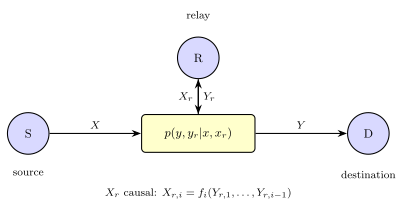
The Three-Terminal Relay Channel
Historical Note: Van der Meulen and the Birth of Relay Channel Theory
1971-1979The relay channel was introduced by Edward van der Meulen in 1971 as one of the simplest multi-terminal channel models. Despite its apparent simplicity — just three nodes — the capacity of the general relay channel remains unknown to this day, more than fifty years later.
The foundational results came from Cover and El Gamal in their celebrated 1979 paper, which established the cut-set bound, decode-and-forward, and compress-and-forward as the three pillars of relay channel coding. What is remarkable is that these three strategies, proposed in 1979, remain the dominant approaches in the field. Essentially all subsequent relay coding schemes can be understood as variants or combinations of these three ideas.
The practical impact was delayed by decades: it was not until the early 2000s, with the emergence of cooperative communications and sensor networks, that relay channels moved from a theoretical curiosity to a central topic in wireless system design.
Quick Check
In the relay channel, why must the relay's input depend only on past observations and not on the current observation ?
Because the relay cannot decode and re-encode in the same time slot
Because of the strictly causal constraint: the relay cannot use information it has not yet received
Because allowing to depend on would make the channel a MAC
Because the relay operates in half-duplex mode
Correct. The strictly causal constraint models the physical reality that processing and transmission cannot happen instantaneously at the same time as reception. The relay must base its current transmission on what it has already observed.
Common Mistake: Causal vs. Strictly Causal Relay
Mistake:
Assuming the relay can use its current observation to form its transmitted signal at time .
Correction:
The standard relay channel model uses a strictly causal constraint: . If the relay could use (causal, not strictly causal), the model changes fundamentally — in fact, a causal relay can simulate a noiseless link from relay observation to relay input, which trivially achieves higher rates. The strictly causal constraint is what makes the problem nontrivial and physically meaningful.
Why This Matters: Relay Channels in Cooperative Wireless Networks
The relay channel is the theoretical foundation for cooperative communication in wireless networks. In LTE-Advanced and 5G NR, relay nodes are deployed to extend coverage to cell-edge users and to provide diversity against fading. The decode-and-forward and compress-and-forward strategies studied in this chapter map directly to the "Type I" and "Type II" relay architectures in 3GPP standards.
See Book telecom, Ch. 22 for the wireless system design perspective on cooperative relaying, and Chapter 25 of this book for cooperative diversity and CoMP.
Key Takeaway
The relay channel is the simplest multi-terminal model where cooperation helps: a relay hears the source and assists the destination, subject to a strictly causal constraint. Despite over fifty years of research, the capacity of the general relay channel remains open — but the three main coding strategies (decode-and-forward, compress-and-forward, compute-and-forward) cover most practical scenarios.