The Diamond Network
From One Relay to Two: The Diamond Network
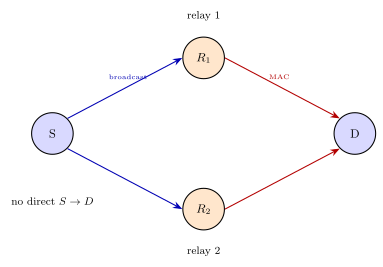
The relay channel has a single relay helping the source-destination pair. The natural next step is to ask: what happens with multiple relays? The diamond network is the simplest such model: a source communicates to a destination through two parallel relays, with no direct link between source and destination. This "diamond" topology (source → relay 1 and relay 2 → destination) is the building block for understanding larger relay networks and foreshadows the noisy network coding results of Chapter 23.
The diamond network reveals a key challenge: the two relays' signals must somehow be coordinated at the destination, even though the relays cannot communicate with each other. How to achieve this coordination — through decode-and-forward, compress-and-forward, or a hybrid — is the central question.
Definition: The Diamond Network
The Diamond Network
The diamond network consists of:
- A source with input ,
- Two relays and with observations and inputs ,
- A destination with observation ,
- Broadcast channel: (source to relays),
- Multiple-access channel: (relays to destination),
- No direct link from source to destination.
The relays operate under the strictly causal constraint: .
Diamond Network
A four-node relay network where a source communicates to a destination through two parallel relays with no direct source-destination link. The source broadcasts to both relays, which then transmit to the destination over a multiple-access channel.
Related: Relay Channel
Theorem: Cut-Set Bound for the Diamond Network
The capacity of the diamond network satisfies where the four terms correspond to: (1) the broadcast cut, (2) the MAC cut, (3) and (4) hybrid cuts isolating one relay with the source or destination.
The diamond network has four non-trivial cuts, compared to two for the single-relay channel. The broadcast cut limits how fast the source can send to both relays. The MAC cut limits how fast the relays can jointly send to the destination. The hybrid cuts capture scenarios where one relay is the bottleneck.
Enumerate all cuts
Partition the four nodes into a source-side set containing and a destination-side set containing . The non-trivial partitions are:
- vs. : broadcast cut.
- vs. : MAC cut.
- vs. : hybrid cut isolating .
- vs. : hybrid cut isolating .
Apply the cut-set bound
For each cut, the information flow is bounded by the mutual information across that cut. Since the relays have no direct link, the relay inputs are independent (). Taking the minimum over all cuts and maximizing over the input distribution yields the bound.
Definition: Quantize-Map-and-Forward
Quantize-Map-and-Forward
Quantize-map-and-forward (QMF) is a relay strategy for general networks:
- Each relay quantizes its observation at the noise level (resolution ).
- Each relay maps the quantized observation to a channel input using a random mapping.
- The destination collects all relay transmissions and jointly decodes.
QMF achieves within a constant gap of the cut-set bound for a wide class of Gaussian relay networks. The gap depends on the number of nodes but not on the channel gains or SNR — a universal approximation result.
Example: The Gaussian Diamond Network
Consider a Gaussian diamond network where:
- Source to relays: , , with , , noise variance , and source power .
- Relays to destination: , with , , relay powers , noise variance . Compute the broadcast cut and the MAC cut of the cut-set bound.
Broadcast cut
The source broadcasts to both relays. The total capacity of this broadcast link is: (This is an upper bound; the exact expression depends on the noise correlation structure.)
MAC cut
The two relays form a MAC to the destination:
Cut-set bound
The cut-set bound is bits (the MAC cut is the bottleneck in this example). The diamond network capacity is at most bits per channel use.
From the Diamond Network to Noisy Network Coding
The diamond network is the stepping stone to noisy network coding (Chapter 23). The key observation is that compress-and-forward generalizes naturally to networks with multiple relays: each relay compresses its observation and forwards the compressed version. The Lim-Kim-El Gamal-Chung noisy network coding scheme does exactly this, and achieves within a constant gap of the cut-set bound for any network topology.
The diamond network is the simplest test case for these general results, and it already illustrates the main ideas: compression at the relay level, joint decoding at the destination, and the interplay between the broadcast and MAC cuts.
The Diamond Network Topology
Diamond Networks in Wireless Relay Deployment
The diamond network models a common wireless deployment scenario: a base station (source) communicates to a cell-edge user (destination) through two relay nodes. In 5G NR, this arises in integrated access and backhaul (IAB) architectures where multiple relay hops are used. The diamond network analysis reveals that the bottleneck is often the MAC cut (relay-to-destination), suggesting that relay placement should prioritize strong relay-destination links over strong source-relay links — a counterintuitive but information-theoretically grounded design principle.
- •
Relay synchronization needed for coherent MAC transmission
- •
Half-duplex constraint reduces effective capacity by ~50%
Common Mistake: Relay Coordination Does Not Require Message Sharing
Mistake:
Assuming that the two relays in a diamond network must share decoded messages to cooperate effectively.
Correction:
In the diamond network, the relays have no direct link and cannot share information. Cooperation emerges through code design: the source uses superposition coding to send different information to each relay, and the relays transmit correlated signals because they both heard (noisy versions of) the same source transmission. In compress-and-forward, each relay independently compresses and forwards, and all coordination happens at the destination through joint decoding.
Quick Check
In the diamond network, the capacity is generally limited by the minimum of the broadcast cut and the MAC cut. If we double the power of both relays (but not the source), which cut is affected?
Only the broadcast cut increases
Only the MAC cut increases
Both cuts increase equally
Neither cut changes
Correct. The MAC cut depends on the relay powers and relay-destination channels. Doubling relay power increases the MAC cut. The broadcast cut depends only on source power and source-relay channels, so it remains unchanged.
Key Takeaway
The diamond network — source to two parallel relays to destination — is the simplest multi-relay model. Its analysis reveals that capacity is limited by the minimum of broadcast and MAC cuts, and that compress-and-forward strategies (quantize-map-and-forward) can achieve within a constant gap of the cut-set bound without requiring relays to decode or coordinate with each other.