The OTFS Transmitter: Three Stages
The Three-Stage Transmitter
We have all the pieces; now we assemble them. The OTFS transmitter produced by Hadani and Rakib in 2017 has three stages:
- Place QAM data symbols on the discrete DD grid .
- Precode with the ISFFT to obtain a TF-grid signal .
- Modulate with a standard OFDM-like Heisenberg transform to produce the time-domain waveform .
The elegance of this design is that stage 3 is identical to an OFDM transmitter. Only stage 2 — the ISFFT precoder — distinguishes OTFS from OFDM. Concretely, if you have 5G OFDM hardware, you can deploy OTFS by adding a software ISFFT block before the existing OFDM modulator. This is the concrete engineering argument for OTFS deployability.
We outline the full chain here and elaborate each stage in Sections 2-3 (transmitter) and Section 4 (receiver).
OTFS Transmitter (Hadani-Rakib Three-Stage Form)
Complexity:In software, the ISFFT is a 2D FFT with one axis flipped — . The Heisenberg transform is length- IFFTs, also . Both are well within the capability of 5G NR silicon.
Definition: OTFS Transmit Signal
OTFS Transmit Signal
The OTFS transmit signal is where the basis waveforms are Each basis is a delay- Doppler- shifted copy of a prototype "cell pulse," with the DD grid acting as the coefficient lattice.
Key Takeaway
OTFS is a Gabor expansion on the critical DD lattice. Each data symbol contributes a delay-Doppler-shifted copy of a prototype pulse to the transmit waveform. The ISFFT-plus-OFDM two-step is just an FFT-accelerated way to compute this Gabor expansion. The mathematical essence is: "send one delay-Doppler-shifted pulse per DD cell, superposed." This is the direct realization of the Chapter 2 Gabor analysis.
OTFS Transmitter Block Diagram
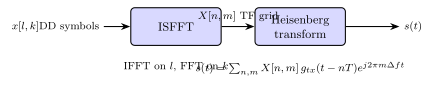
OTFS Transmitter Step-by-Step
Watch the signal transform at each stage: (1) DD grid with QPSK symbols, (2) TF grid after ISFFT, (3) time-domain waveform after Heisenberg modulation. Adjust grid size and see how the stage transforms change. This is the operational sequence for a full OTFS frame generation.
Parameters
Example: Smallest Complete OTFS Frame:
Build an OTFS signal for with QPSK data and a rectangular prototype pulse. Compute and the resulting time-domain waveform.
ISFFT to $X_{TF}$
. Expanding: . Similarly: . . . So and all others zero — all the data has been concentrated at one TF cell by the ISFFT. This is a particular feature of this symmetric input.
Heisenberg transform
Only is non-zero. for . A single subcarrier tone on the first OFDM symbol, zero on the second.
Interpret
This particular produces a "spread" TF image that collapses to a single TF cell. The ISFFT exchanges the roles of DD and TF: the original had four non-zero cells; has one. Different inputs produce spread images in the opposite direction — illustrating the spreading duality.
Deploying OTFS on Existing 5G NR Hardware
A key practical argument for OTFS is deployability: OTFS can be added to existing 5G NR infrastructure as a software-only precoder. Concretely:
- Transmitter: an ISFFT block is added after the UE data mapper, before the OFDM modulator. This is a 2D FFT — a software operation.
- Receiver: a SFFT block is added after the OFDM demodulator. Also software.
- RF front-end: unchanged. Same ADC/DAC, same PA, same filters.
- Channel estimation pilots: replaced with embedded pilot scheme (Chapter 7). A firmware update to the baseband.
No change to hardware. No change to cell-search, timing, or frequency synchronization. The key realization is that OTFS's waveform is identical to OFDM's — only the data mapping changes. This is the engineering argument behind CommIT's cell-free OTFS deployment studies: existing O-RAN radio units work as-is.
- •
ISFFT/SFFT are 2D FFTs — additional operations per frame
- •
Firmware update to existing 5G modems feasible; no silicon changes required
- •
OTFS can coexist with OFDM on the same TDD/FDD air interface by frame type