The Heisenberg Transform: TF Grid to Time
From TF Samples to a Continuous Waveform
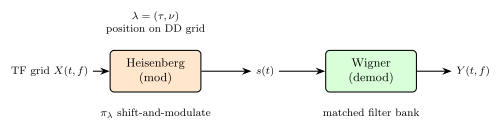
The ISFFT leaves us with a TF grid — a set of discrete complex numbers, one per TF cell. The physical radio wants a continuous-time waveform . The Heisenberg transform bridges this gap by superposing time-frequency shifted copies of a prototype pulse, one per TF cell. Under the (idealized) bi-orthogonal pulse assumption, the Heisenberg transform is exactly the OFDM modulator already used in 4G/5G.
In this section we write out the Heisenberg transform, show that it is unitary, and establish the adjoint Wigner transform (used at the receiver in Section 4). The structural point: the Heisenberg/Wigner pair is how DD-domain information travels through the physical time-frequency channel.
Definition: Heisenberg Transform
Heisenberg Transform
Given a TF grid of size , a prototype pulse , symbol duration , and subcarrier spacing , the Heisenberg transform is The output lives on the time interval (for rectangular ) or a slightly longer interval (for pulses with tails).
The name "Heisenberg transform" comes from the underlying non-commutative algebra of delay and Doppler operators (the Heisenberg-Weyl algebra). The transform is a sum of the projective-representation operators applied to the prototype pulse, weighted by .
Theorem: The Heisenberg Transform Is Unitary (Critical Lattice)
If the prototype pulse satisfies the Gabor-frame critical lattice condition with bounded and bounded below on (Chapter 2 Theorem TExistence of Gabor Frames (Critical Lattice)), then the Heisenberg transform is unitary. In particular,
Unitarity means no energy is gained or lost in the transform — the total power of the waveform equals the total power of the TF symbols. This is what Parseval's theorem enforces for OFDM; it holds identically for the Heisenberg transform with an appropriately chosen pulse.
Under a non-ideal pulse (not satisfying the bi-orthogonality), the transform is not strictly unitary, and small cross-symbol interference appears. For rectangular with a CP, this mismatch is minimized (CP makes the convolution circular) but not eliminated entirely under time-varying channels.
Inner product expansion
where .
Gabor orthogonality
Under the bi-orthogonality assumption, .
Parseval
Off-diagonal terms vanish, leaving . Unitarity follows.
Definition: Wigner Transform (Adjoint of Heisenberg)
Wigner Transform (Adjoint of Heisenberg)
At the receiver, the Wigner transform recovers the TF grid from a received waveform : where is the receive prototype pulse. When (matched filtering), the Wigner transform is the adjoint of the Heisenberg transform — composing them returns the identity, up to the noise from the channel.
Theorem: Heisenberg-Wigner Roundtrip
Under the critical-lattice bi-orthogonal pulse assumption with (matched filter), for a clean (noise-free, LTI-channel-free) reception:
Start with a TF grid, go to time-domain waveform, come back to TF grid with the adjoint — perfect recovery. This is the baseline for the full OTFS chain: any imperfection comes from (i) the actual (time-varying) channel, (ii) noise, (iii) pulse-shape mismatch. Sections 3 and 4 quantify these imperfections.
Compose
.
Substitute
Expand the Heisenberg sum: .
Apply bi-orthogonality
The cross-term integrates to under bi-orthogonal pulse assumption: only the term survives.
Collect
. Roundtrip is identity.
Heisenberg-Wigner Pair as the TF Modulator-Demodulator
Why This Is Just OFDM With Better Names
Under the rectangular-pulse, critical-lattice assumption, the Heisenberg transform reduces exactly to an OFDM modulator:
- Per-OFDM-symbol inverse DFT: the inner sum over .
- Per-frame serialization: the outer sum over .
The only "new" thing the Heisenberg transform brings is the operator interpretation: time-shift and frequency-shift as independent operators that collectively generate the TF lattice. This operator view makes the generalization to non-rectangular pulses (and non-integer lattice densities) conceptually clean.
For practical OTFS deployment, the take-away is: the modulator is OFDM. Only the precoder (ISFFT) is different.
Heisenberg Transform of a Simple TF Grid
Enter a simple TF grid pattern (single symbol, row, column, random) and observe the resulting time-domain OTFS waveform . Watch how the waveform structure reflects the TF data: a single TF cell produces a windowed sinusoid; a TF row produces a multitone burst; random data produces a noise-like Gaussian waveform.
Parameters
Example: Waveform of a Single TF Cell
Let — single TF-grid cell at the first OFDM symbol, fourth subcarrier. Compute with rectangular of width .
Substitute
for , zero elsewhere.
Interpret
A single complex sinusoid at frequency , time- gated to the first OFDM symbol. Exactly what one expects from OFDM.
Compare with OTFS full frame
If instead the DD grid had a single entry , the ISFFT would produce — a plane wave across the whole TF grid. The Heisenberg transform would then give a time-domain waveform that is a sum of sinusoids, spread uniformly over the entire frame. OTFS's spreading is visible in both DD and time domains.
Zak-OTFS: Direct Modulation on the DD Plane
Mohammed, Hadani, Chockalingam, and Caire propose Zak-OTFS, an alternative construction that bypasses the two-stage ISFFT + OFDM approach. In Zak-OTFS, the transmit waveform is constructed directly as an inverse Zak transform of the DD grid data: (for the continuous version; the discrete version uses a length- inverse DFT on blocks of length ).
Under idealized bi-orthogonal pulses, Zak-OTFS produces the same time-domain waveform as Hadani-Rakib OTFS. The advantages of Zak-OTFS are conceptual clarity (one transform instead of two) and a cleaner treatment of pulse-shape effects in the DD domain. The CommIT contribution in this formulation is the rigorous demonstration of equivalence under critical-lattice conditions, and the identification of a clean way to handle fractional Doppler via Zak-domain windowing (see Chapter 10).
For the remainder of this book we use the Hadani-Rakib two-step form (widely adopted in the literature) but note the Zak-OTFS alternative where relevant.