Integer vs Fractional Doppler
The Convenient Fiction
Chapters 4-9 presented OTFS under the assumption that each path's Doppler shift and delay land exactly on a DD-grid point: and . The math is clean, the diversity theorem is , and the detectors of Chapter 8 achieve it.
The point is that this integer assumption is a convenient fiction. Real channels produce paths with arbitrary real-valued Dopplers; each is almost surely non-integer. When with , the path's response in the DD grid is no longer a single point but a smeared response spread across neighboring Doppler bins — the inter-Doppler interference (IDI).
This section defines fractional offsets, examines how they arise physically, and motivates the treatment of Sections 2-5.
Definition: Fractional Delay and Doppler Offsets
Fractional Delay and Doppler Offsets
A physical path with continuous delay and Doppler decomposes into integer and fractional parts on the DD grid: with and . The integer part is the nearest DD grid cell; the fractional part quantifies how far off-grid the path is.
We typically assume (delay resolution is fine enough at realistic bandwidths; see §1.2) and focus on fractional Doppler as the dominant effect.
Why Delay Is Usually Fine, Doppler Rarely Is
Two asymmetries make fractional Doppler the practical problem, not fractional delay:
- Resolution scale: (bandwidth-limited); (frame-duration-limited). At MHz, ns — finer than typical path delay separations. At ms, Hz — comparable to or coarser than individual path Dopplers.
- Parameter range: gives — plenty of integer bins to land on. Hz gives — only 5 bins to quantize across. A typical path has with high probability.
Consequence: fractional delay is usually a perturbation of order of the delay resolution; fractional Doppler is routinely 50% of the Doppler resolution. The treatment below focuses on fractional Doppler; analogous arguments handle fractional delay at lower-bandwidth systems.
Theorem: DD Response Under Fractional Doppler
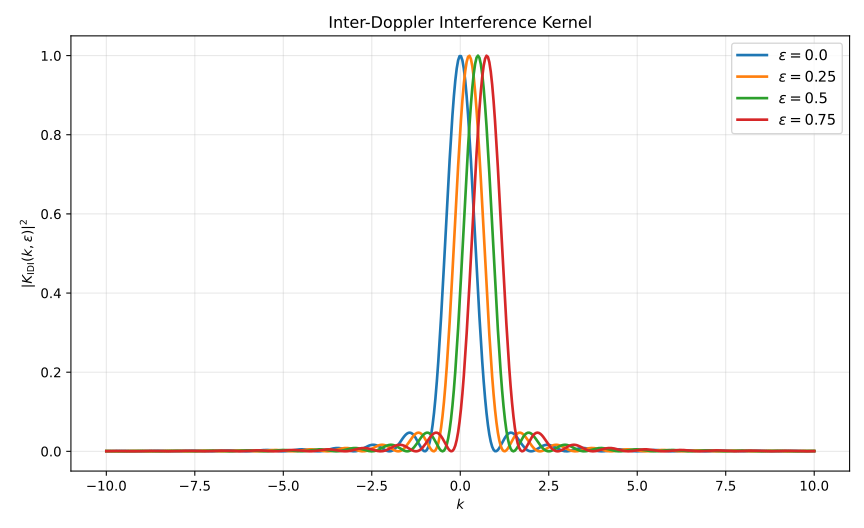
Consider a single path with delay (integer delay) and Doppler with fractional offset . Let be an embedded-pilot impulse. The received DD response is where the inter-Doppler interference (IDI) kernel is The kernel magnitude has a peak of at and falls off as for distant — a Dirichlet-kernel shape.
A fractional-Doppler path does not produce a clean single-cell response. Instead, its energy spreads across many Doppler bins according to the Dirichlet kernel. At (integer Doppler), the kernel collapses to — the familiar integer case. At (worst case), the kernel is evenly split between and , with spillover to .
This smearing is the single most important practical correction to the clean Chapter 4 theory. The rest of this chapter develops methods to handle it.
Path contribution to transmit waveform
The single path in the continuous DD model contributes . After OTFS demodulation (Wigner + SFFT), the received DD grid receives contributions at integer-delay position (assumed integer) and a complex exponential in the Doppler axis for OFDM symbol .
Doppler-axis DFT
The SFFT applies an -point DFT along the Doppler axis: .
Evaluate the geometric sum
. After normalization, this is the Dirichlet kernel stated in the theorem — with argument .
Read off the kernel
. At : the denominator makes the kernel (Dirichlet's peak at the origin). At : the kernel has a shifted peak and non-trivial sidelobes.
Key Takeaway
Fractional Doppler smears path energy across Doppler bins according to a Dirichlet kernel. A single path no longer produces a single DD-grid response; it produces a sinc-shaped pattern centered at the nearest integer bin, with energy leaking to neighbors. At (worst case), the leakage is roughly to neighbors. This is the fundamental OTFS problem addressed throughout this chapter.
Fractional Doppler and the IDI Kernel
Inter-Doppler Interference Kernel
Plot the IDI kernel magnitude as a function of Doppler offset for several fractional values . At , perfect single-bin localization. As grows, the kernel spreads, and at the energy is evenly split between and . Observe the sinc-like sidelobe structure that decays as .
Parameters
Example: Fractional Doppler in a Vehicular Channel
A vehicle at km/h at 3.5 GHz produces a single-LOS-path Doppler Hz. The OTFS frame has ms. Compute , and estimate the IDI power fraction to neighboring bins.
Doppler normalization
. , .
Main-lobe magnitude
. of energy at nearest bin; leaked.
Neighbor-bin split
(27%). (5%). Residual: in bins.
Implication
At this Doppler, 62% of path energy lands in bin 0, 27% in bin 1. Integer-Doppler detectors assigning all energy to bin 0 lose 27% of the path gain — a significant penalty. Mitigations of Sections 2-4 recover this energy.
When to Worry About Fractional Doppler
Fractional Doppler is consequential when:
- : the maximum Doppler index covers more than one bin. Very common at vehicular mobility (100 km/h at 3.5 GHz, ms gives ).
- Single-path dominant channel: when LOS accounts for of channel energy, fractional offsets in the single dominant path dominate detection error.
- Low SNR operation: at SNR dB, the IDI sidelobes mask paths that would otherwise be detected. Threshold-based estimators fail silently.
- Long frames: LEO satellite with ms pushes into the tens — deeply fractional regime.
Fractional Doppler is not critical when:
- Short frames: ms keeps for typical terrestrial channels; rounding to the nearest integer bin is adequate.
- Rich multipath: when many paths have IDI, the leakage averages out across DD cells and the per-cell impact is modest.
The rule of thumb: integer-Doppler assumption is fine for single-OFDM-symbol frames (), degrades at , becomes unusable at .
- •
Integer assumption valid when
- •
IDI becomes 30%+ of signal when
- •
Frame duration is the lever — larger means finer Doppler but worse IDI
Integer vs Fractional Doppler: Summary
| Aspect | Integer Doppler | Fractional Doppler |
|---|---|---|
| Channel response at path | Single DD cell | Dirichlet kernel across ~5 cells |
| Detector complexity | Sparse sum over paths | Dense coupling across 5-10 cells per path |
| Diversity order (§9 result) | ||
| Pilot estimation | Single threshold test | Interpolation / super-resolution |
| Prevalence | Only under special geometry | Generic case |
| Practical impact | Ideal baseline | Real-world mitigation needed |
| Treatment | Chapters 4-9 | This chapter |
IDI Kernel in the Doppler Axis