Inter-Doppler Interference (IDI)
The IDI Effect on the Input-Output Relation
Section 1 established that a single fractional-Doppler path smears its DD response across multiple bins via the IDI kernel. This section extends the full -path input-output relation to account for fractional offsets. The result is a sparse-but-extended channel model: instead of path taps, we have effective taps, where is the number of neighboring Doppler bins with significant leakage.
The point is that the input-output relation remains linear — the IDI kernel is a fixed function of , so the DD output is still a sparse 2D convolution. The convolution kernel is just richer (multi-tap instead of single-tap per path).
Theorem: DD Input-Output Under Fractional Doppler
For a channel with paths where each path has integer delay , integer Doppler , and fractional offset , the discrete DD input-output relation is where is the effective IDI support per path, typically for .
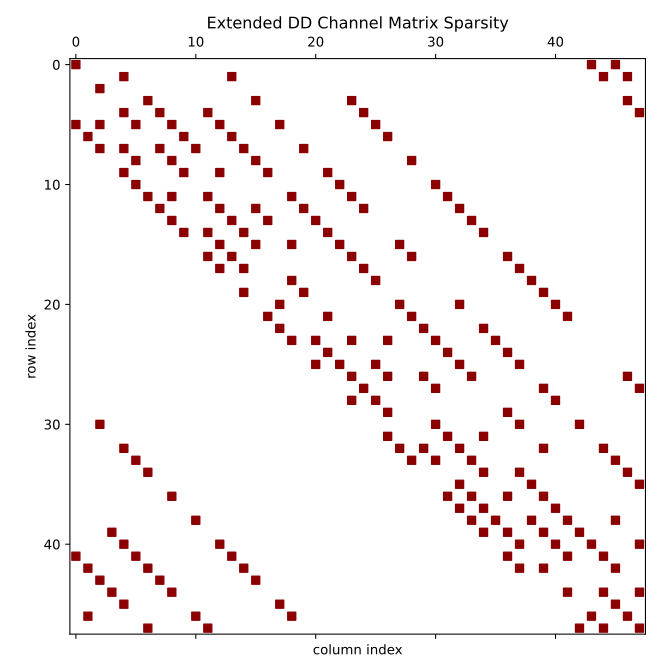
The equivalent extended channel matrix is sparse with taps per row — a modest expansion from the integer-case taps.
Each physical path contributes not a single DD-convolution tap but a small cluster of taps (the IDI kernel). The total number of taps is ; for and , this is 50 taps — still far less than the dense taps of OFDM. OTFS sparsity is preserved, just at a larger effective .
Per-path contribution
From Theorem TDD Response Under Fractional Doppler, path contributes to cell in proportion to , shifted by the integer indices .
Linearity
Multiple paths sum linearly: Y[\ell, k] = \sum_i h_i \cdot \text{(pathi's smeared contribution)}. The path response at shift is scaled.
Convolution form
Truncating to (essentially zero contribution beyond this range), the sum is a 2D convolution of with the extended kernel.
Sparsity
The extended kernel is sparse: non-zero taps out of . At : 50 taps; density on typical grids — still orders of magnitude sparser than OFDM's dense TF matrix.
Key Takeaway
Fractional Doppler widens the channel, not its density class. The OTFS channel under fractional offsets has effective taps, typically . Still far sparser than OFDM's dense matrix. The detectors of Chapter 8 (MP, LCD) remain applicable; they just operate on a slightly richer sparse factor graph.
IDI Power vs Fractional Offset
Plot the IDI power fraction — energy leaked to neighboring Doppler bins — as a function of . At : zero leakage (integer case). At : worst case, ~60% of energy in the main lobe, 40% leaked to neighbors. Quantifies when fractional effects matter.
Parameters
Theorem: Extended Channel Matrix Structure
The extended channel matrix can be written as where is a sparse shift-phase matrix (one non-zero per row), so the total matrix has at most non-zeros. Like the integer-case matrix, is block-circulant with circulant blocks (with fractional-shifted eigenvalues).
The extended matrix has the same block-circulant structure as the integer case but with more non-zero entries per row. The 2D DFT still diagonalizes it (providing efficient MMSE and LCD), and message passing still works (factor-graph degree bounded by ).
Per-path decomposition
Path 's contribution is a sum of shift-phase matrices weighted by IDI kernel values .
Block-circulant preserved
Each is a block-circulant shift matrix. Linear combinations are block-circulant. The full matrix retains this structure.
Eigenvalues
2D DFT diagonalizes with eigenvalues . Same structural form as integer case, just with -fold more terms per path.
Example: SNR Degradation From IDI
An OTFS system with Doppler bins receives a single path with . Using a detector that assumes integer Doppler (no IDI handling), compute the effective SNR loss.
Main-lobe energy
. The integer-Doppler detector assigns all path energy to bin 0; it captures only 68% of the actual energy.
IDI leakage (treated as noise)
Leaked energy: . At bins : leakage. Treated as noise by integer-Doppler detector.
Effective SNR
. At true SNR = 20 dB: (3.1 dB). 17 dB penalty from ignoring IDI.
Fractional-aware detector
With IDI-aware detection (e.g., LCD extended to include IDI kernel), the leakage becomes signal rather than noise: recovered SNR back toward 20 dB. Typical penalty: 0.5-1 dB from detector sub-optimality, vs. 17 dB from ignoring IDI entirely.
Extended DD Channel Matrix Sparsity Pattern
Fractional-Aware MMSE via Extended Matrix
Complexity:The algorithm is structurally identical to integer-Doppler MMSE (Algorithm ADD-Domain MMSE Detection via 2D FFT) — only the eigenvalues change. Fractional offsets affect only the pre-computed eigenvalue sum, not the runtime path. Total complexity: same as integer case.
Why This Matters: Message Passing With Fractional Doppler
The MP-OTFS algorithm of Chapter 8 extends to fractional Doppler with modest modifications: each factor node now has incident variables (instead of ). Messages still propagate; BP still converges in iterations. Complexity goes up from to — a constant factor () for typical . Practical impact: 5× more compute but same algorithmic framework.