Metasurface Unit-Cell Design
From Diagonal Multiplication to Physical Hardware
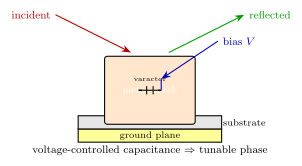
Chapter 1 modeled the RIS abstractly as a diagonal matrix of unit- modulus phasors. Where does such a matrix come from in silicon (or copper)? Each element of corresponds to a unit cell — a sub-wavelength patch of conductor coupled to a tunable reactive element (typically a varactor or a PIN diode) that adjusts the local reflection phase. Understanding the unit cell is what lets us judge the validity of the diagonal model, anticipate the quantization loss, and interpret calibration measurements.
Definition: Metasurface Unit Cell
Metasurface Unit Cell
A unit cell of a reconfigurable metasurface is a sub-wavelength () element consisting of:
- a conductive patch (usually a rectangular copper strip or a ring) etched on a dielectric substrate,
- a tuning element — a varactor diode or one or more PIN diodes — bridging the patch to a ground plane or to a neighbouring patch,
- a biasing network (thin DC lines) that sets the diode's state,
- an air/dielectric spacing above a ground plane that determines the cell's resonant frequency.
The effective reflection coefficient of the cell depends on the impedance the diode presents at the RF carrier frequency, which the controller adjusts via the DC bias.
Varactor Diode
A semiconductor diode used in reverse bias as a voltage-controlled capacitor: the depletion-region capacitance decreases with increasing reverse-bias voltage . In an RIS unit cell, tunes the resonant frequency of the element, sliding the reflection phase continuously across up to .
Related: PIN Diode, Metasurface Unit Cell
PIN Diode
A semiconductor diode with an Intrinsic layer between the P and N regions, used as an RF switch: forward-biased it conducts (low resistance); reverse-biased it is effectively open (high resistance). Used in RIS for discrete phase control — each diode toggles between two impedance states, giving 1-bit phase resolution per diode.
Related: Varactor Diode, -Bit Phase Quantization
Varactor-Based RIS Unit Cell
Theorem: Reflection Phase of a Grounded LC Resonator
Model a unit cell under plane-wave normal incidence as a shunt impedance loaded by the free-space impedance . The reflection coefficient seen from free space is
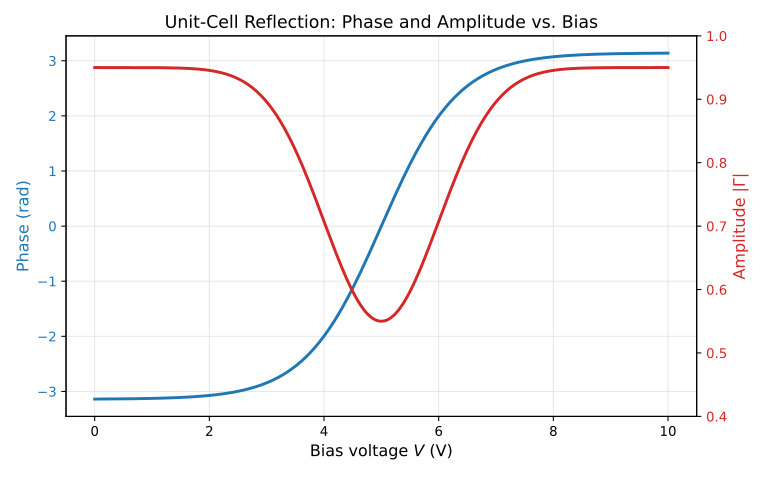
At resonance , and (phase ). Tuning to shift above or below the operating frequency rotates the phase of continuously between approximately and , with amplitude dipping near resonance (the element becomes lossy) and approaching far from resonance.
A grounded patch with a tunable capacitance can be modeled at normal incidence as a short-circuited transmission-line stub. The reflection phase of a short is ; adding inductance or capacitance in series shifts the phase. The shift is largest when the LC circuit is near resonance — this is why the phase changes rapidly with bias near the resonant bias point, and slowly elsewhere.
Transmission-line model
The reflection coefficient from an impedance terminating a free-space line of impedance is the standard , same as any impedance mismatch. Derive from wave continuity at the interface.
Phase behaviour of a series LC
For an LC series branch, is purely imaginary. Hence has unit magnitude (), with phase for . As sweeps from to (crossing through resonance at ), the phase sweeps through .
Real-diode corrections
Real diodes have series resistance , so acquires a small real part: . This makes near resonance (peak loss), giving the characteristic bowtie-shaped amplitude response of FUnit-Cell Reflection: Phase and Amplitude vs. Bias. The reflection-phase amplitude response is not flat — this is the origin of the amplitude–phase coupling discussed in Section 2.3.
Unit-Cell Reflection: Phase and Amplitude vs. Bias
PIN Diodes Give Discrete Phases
A single PIN diode in an RIS unit cell has two states: forward- biased (low impedance) and reverse-biased (high impedance). The resulting reflection phase takes two discrete values. To get -bit resolution one needs PIN diodes per element, each switching a different fraction of the cell's impedance. Three diodes per element (3-bit, 8 phase states) is the common practical choice — enough resolution to recover most of the continuous-phase gain (see Section 2.2) without exploding the biasing complexity.
Historical Note: From Phased Arrays to Metasurfaces
1990s–2020sThe idea of electronically tuning a passive reflecting surface is older than RIS. Frequency-selective surfaces (FSS) in the 1990s used diodes to switch band-passes on and off. The breakthrough that turned FSS into programmable metasurfaces was Tie Jun Cui's group at Southeast University (China), whose 2014 paper introduced the term "digital coding metasurface" and demonstrated a real-time reconfigurable panel. The RIS community of 2019 onward extended the idea from electromagnetic control to communication-theoretic optimization — treating the metasurface as a communication subsystem rather than an antenna curiosity.
Hardware Design Tradeoffs
A sane unit-cell designer balances three quantities:
- Phase range. Ideally the full ; a smaller range limits beamforming gain.
- Amplitude flatness. as close to 1 as possible across all phase states.
- Bandwidth. The phase-vs-frequency curve should be flat across the communication bandwidth; a narrow-band unit cell limits the RIS to narrowband operation (Chapter 18).
These three pull against each other. A tightly-resonant LC gives large phase range but narrow bandwidth and a deep amplitude dip; a loaded, higher-Q circuit flattens amplitude but shrinks phase range. Practical designs tend to compromise at phase range with over of fractional bandwidth.
- •
Typical unit-cell size at 28 GHz: (half-wavelength).
- •
Switching speed: (PIN diode) to (varactor-controller pipeline).
- •
Incident power handling: per cell in practical designs; damage above.