The Cascaded Channel, Dimensions, and Linearity
One Model to Rule Them All
We now present the cascaded channel model in full generality: multi-antenna BS, multi-element RIS, multi-antenna UE. The same model covers single-user and multi-user scenarios (with appropriate stacking), single-RIS and multi-RIS (with appropriate summation), narrowband and wideband (per subcarrier). Every optimization problem in this book — rate maximization, phase shift design, channel estimation, localization — starts from the formulas in this section. Nail them down now, and the rest of the book reads as a series of optimization tricks applied to these formulas.
Definition: Multi-Antenna Cascaded Channel
Multi-Antenna Cascaded Channel
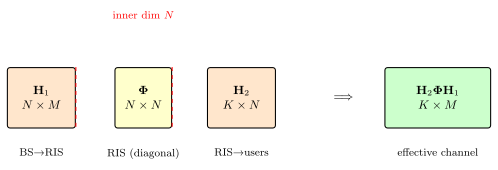
Consider a BS with antennas, an RIS with elements, and a UE with antennas. Define:
- : BS-to-RIS channel. Rows index RIS elements; columns index BS antennas.
- : RIS-to-UE channel. Rows index UE antennas; columns index RIS elements.
- : direct BS-to-UE channel (possibly zero).
- : the RIS phase-shift matrix.
The effective end-to-end channel is the matrix
The received signal under BS transmit signal with (covariance normalized by total power) is
Every dimension in has an interpretation: rows are the UE's spatial dimensions (which antenna receives the signal) and columns are the BS's (which BS antenna transmits the signal). The RIS is "in the middle" — it does not add dimensions, it modulates the dimensions it has.
Dimensions of the Cascaded Channel
Theorem: Rank of the Cascaded Channel
For the cascaded product ,
In particular, in a pure LoS scenario where both and are rank-1 outer products of steering vectors, the cascaded product is also rank-1, regardless of . A high-rank (rich-scattering) link is needed on both sides to get a multi-stream RIS channel.
The cascade can at most propagate as many independent streams as the narrowest channel admits. If the BS–RIS path has only a few independent directions, adding a high-rank RIS–UE path doesn't help — the bottleneck is upstream.
Rank of a product
is standard linear algebra.
Apply to the cascade
Setting : . Since is invertible (), . Hence the bound.
Keyhole implication
LoS with planar wavefronts yields rank-1 matrices: , similarly for . Product is rank-1. This is the RIS version of the well-known keyhole channel — a cascade of two rank-1 channels always gives a rank-1 end-to-end channel, which limits multi-antenna multiplexing gain.
Key Takeaway
The cascaded channel is linear in and in separately — but not jointly. The product is linear in for any fixed , and the resulting is linear in for any fixed . This bi-linear structure is what makes alternating optimization (Chapter 5) such a natural algorithm: fix one, optimize the other.
Theorem: Vectorized Cascaded Channel
Using the identity and the vec/Kronecker identities, the vectorized effective channel is
where denotes the column-wise Khatri–Rao product: the -th column of times the -th row of , vectorized. Concretely, is the matrix whose -th column is .
The product can be rewritten using the vec-diag identity so that appears as a linear factor of a known matrix. This is the form preferred by optimization algorithms.
Write the product as a sum
, a sum of rank-1 matrices weighted by .
Vectorize
.
Matrix-vector form
The sum is a matrix-vector product: columns of the matrix are the -Kronecker factors, vector is . This is precisely the Khatri–Rao structure stated.
Example: MISO-RIS in Vectorized Form
For a single-antenna UE, and . Rewrite this using the Khatri-Rao/vec identity.
Transpose setup
— but the cleanest form uses : .
Apply the vector identity
Introducing , we have . For a specific beamformer , the end-to-end scalar gain is — linear in , a convenient form for optimization.
Multi-User Stacking
For users each with a single antenna: stack their vectors into a matrix (one row per user). The cascaded channel becomes the matrix , and multi-user precoding uses this matrix the same way it uses any multi-user channel. Chapter 7 develops the multi-user algorithms; the model is an immediate extension of what we have here.
Singular Value Spectrum of the Cascaded Channel
Set the rank of (by choosing how many scattering clusters feed the BS–RIS link) and of . Observe the singular values of the product : the number of significant values is limited by the minimum of the two factor ranks. Only when both sides have sufficient scattering can the cascade support multiple streams.
Parameters
Common Mistake: Getting the Conjugation Right in Multi-Antenna Cascades
Mistake:
Using instead of when simplifying the multi-antenna cascade.
Correction:
is a diagonal matrix of (non-conjugated) phase shifts . The cascade is always written as — no Hermitian on . Misplacing the Hermitian inside the cascade flips the sign of every phase shift, sending every subsequent optimization in the wrong direction. This is a common source of bugs in RIS codebases — always sanity-check with the single-antenna identity of TDiagonal Factorization of the Cascaded Channel.