The RIS-Aided Wiretap Channel
Reshape the Channel to Deny the Eavesdropper
Physical-layer security is the information-theoretic foundation: if Bob's channel is better than Eve's, we can achieve positive secrecy rate — information transfer that Eve cannot decode even with infinite computing power. The key resource is the channel difference between Bob and Eve.
Without the RIS, the channel difference is determined by geometry (Bob close, Eve far) and luck (fading diversity). With the RIS, we can engineer the channel difference: focus coherently on Bob, null coherently at Eve. The RIS is a physical-layer security knob that didn't exist in classical systems.
The golden thread: the RIS programs the channel — here, it programs the channel difference. Secrecy is the output of this programming.
Definition: RIS-Aided Wiretap Channel
RIS-Aided Wiretap Channel
Consider Alice (BS) with antennas transmitting a signal to Bob. Eve (eavesdropper) listens from a nearby position. Both Bob and Eve receive signal via the same BS transmission, propagating through:
- Direct path (blocked or weak).
- RIS reflected path (shaped by ).
The received signals are
where are independent AWGN. The secrecy capacity of this degraded broadcast channel is
where . The RIS phase matrix appears in both and — tuning it affects both channels.
The secrecy capacity is always non-negative: if Bob's channel is worse than Eve's, no secrecy is possible and . The critical observation: the RIS can reverse the default channel ordering — even if Bob is far and Eve is close, a well-tuned can make Bob's effective channel stronger.
Theorem: RIS Secrecy Gain Over Direct Channel
Under optimal RIS phases focused on Bob and nulled at Eve (achievable when Bob and Eve are at different angles with adequate separation):
(no coherent combining at Eve; only direct contribution).
Secrecy capacity:
At high SNR: — the secrecy capacity grows logarithmically in (similar to comm rate but bounded by , not ). For : secrecy capacity increases by bits/s/Hz over no-RIS.
The RIS can steer the reflected beam toward Bob and away from Eve. The reflected-path SNR at Bob is ; at Eve, under ideal nulling, the reflected-path SNR is (uncorrelated with the Bob-focused beam). The secrecy rate benefits from this double-sided manipulation.
Bob's coherent gain
Optimal produces coherent power at Bob.
Eve's null
For Eve at different angle, the RIS-induced phase pattern destructively interferes at Eve's direction: (no coherent gain).
Secrecy rate
Subtract Eve's rate from Bob's: at high SNR.
Key Takeaway
RIS enables -bit secrecy gain. By focusing on Bob and nulling at Eve, the RIS dramatically widens the channel difference. For : secrecy rate grows by bits/s/Hz over a no-RIS baseline — enough to protect high-rate services even when Eve is physically closer than Bob.
RIS-Aided Wiretap Channel
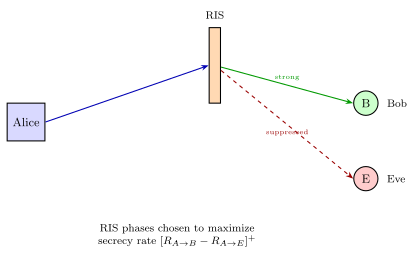
Example: Coffee-Shop Secrecy
Alice is a 5G BS. Bob is a legitimate user 50 m away. Eve is at the coffee shop 10 m away, between Alice and Bob. Direct-path secrecy is negative (Eve closer = better channel). A RIS panel is deployed to restore secrecy.
Without RIS
. . Eve has 14 dB more SNR than Bob. Secrecy capacity = 0.
With RIS
RIS on the building wall at 20 m from Alice, 30 m from Bob. Focus on Bob: . . For : , so . Null at Eve: direct Eve SNR.
Restored secrecy
With RIS, for the first time. Secrecy capacity becomes positive; 5G service over RIS can be secured against the closer eavesdropper.
Secrecy Rate vs. Eavesdropper Position
Move the eavesdropper around the coverage area and observe the secrecy rate. With RIS, secrecy is achievable over a wider region than without. Change to see the secure area expand.
Parameters
The CSI-on-Eve Problem
Designing the optimal requires knowing Eve's channel . Eve is uncooperative: she doesn't transmit pilots. Her channel must be estimated from side information (geography, traffic patterns) or modeled as uncertain (robust optimization, Section 15.4).
When Eve's channel is truly unknown:
- Worst-case design: assume Eve has the best possible channel; optimize for secrecy against worst-case Eve.
- Stochastic design: assume Eve's channel is drawn from a distribution; optimize expected secrecy.
- Artificial noise (Section 15.3): inject noise in direction orthogonal to Bob — degrades all non-Bob channels uniformly. Doesn't require knowing Eve's channel.
Common Mistake: Don't Assume Perfect Eve CSI
Mistake:
"Measure Eve's channel like a legitimate user; apply standard RIS optimization."
Correction:
Eve is adversarial and silent. Her channel cannot be pilot- estimated. Assuming perfect Eve CSI is an unrealistic simplification that overestimates secrecy capacity. In practice: use worst-case or stochastic design (Section 15.4), or use artificial noise (Section 15.3) to sidestep the need for Eve CSI. Papers claiming perfect-Eve-CSI secrecy gains should be read as upper bounds, not deployable guarantees.
Attack Models for RIS Secrecy
Understanding Eve's capabilities is foundational:
- Passive eavesdropper: listens without transmitting. Channel unknown to Alice. Most common attack model.
- Active attacker: transmits interference + listens. Can spoof pilot signals to confuse channel estimation.
- Co-located with Bob: very difficult; requires physical security. RIS cannot distinguish.
- Moving Eve: adversary follows Bob. Time-varying uncertainty; robust design needed.
Each attack model leads to different optimization problems. This chapter focuses on passive Eve with uncertain channel — the most common and tractable case.
- •
Typical Eve position uncertainty: m standard deviation (urban).
- •
Pilot-spoofing attacks are a known failure mode — use authentication + challenge-response.
- •
For high-security applications (government, military): combine RIS + crypto + physical security.