Context Managers
Why Context Managers Are Essential for Scientific Code
Scientific computing involves managing resources that must be properly acquired and released:
- Files: HDF5 datasets, CSV logs, checkpoint files
- GPU memory: CUDA contexts, tensor allocations
- Database connections: experiment tracking databases
- Timing blocks: profiling sections of code
- Random state: reproducible RNG seeds for experiments
The with statement guarantees cleanup even if exceptions occur.
Without it, resource leaks accumulate silently during long-running
simulations, eventually crashing your 12-hour training run.
Definition: Context Manager Protocol
Context Manager Protocol
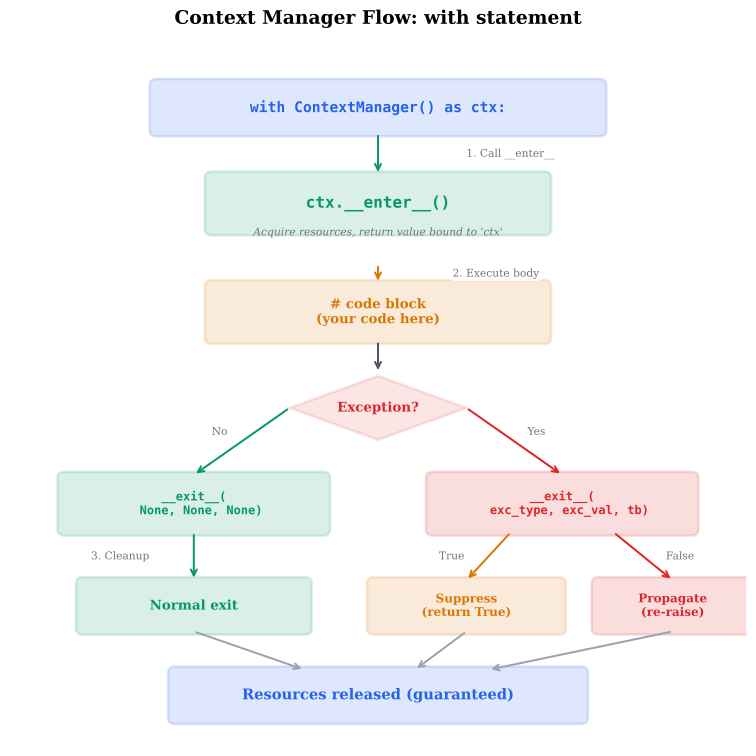
A context manager is any object that implements the context manager protocol — two dunder methods:
__enter__(self)— called when entering thewithblock; its return value is bound to theasvariable__exit__(self, exc_type, exc_val, exc_tb)— called when leaving thewithblock (whether normally or via exception)
class Timer:
    def __enter__(self):
        self.start = time.perf_counter()
        return self   # bound to the `as` variable

    def __exit__(self, exc_type, exc_val, exc_tb):
        self.elapsed = time.perf_counter() - self.start
        print(f"Elapsed: {self.elapsed:.4f}s")
        return False  # do not suppress exceptions

with Timer() as t:
    result = expensive_computation()
print(f"Stored: {t.elapsed:.4f}s")
If __exit__ returns True, the exception is suppressed. Returning
False (or None) lets the exception propagate normally.
Definition: contextlib.contextmanager — Generator-Based Context Managers
contextlib.contextmanager — Generator-Based Context Managers
The contextlib.contextmanager decorator lets you write context
managers using a generator function with a single yield:
from contextlib import contextmanager

@contextmanager
def timer(label: str = "Block"):
    start = time.perf_counter()
    try:
        yield start   # value bound to `as` variable
    finally:
        elapsed = time.perf_counter() - start
        print(f"{label}: {elapsed:.4f}s")

with timer("SVD") as t0:
    U, S, Vh = np.linalg.svd(large_matrix)
Everything before yield is the __enter__ logic. Everything
after yield (in the finally block) is the __exit__ logic.
The try/finally ensures cleanup even if an exception occurs.
Definition: contextlib.suppress — Ignoring Specific Exceptions
contextlib.suppress — Ignoring Specific Exceptions
contextlib.suppress is a context manager that silently catches
specified exception types:
from contextlib import suppress
import os

# Instead of:
try:
    os.remove("temp_checkpoint.pt")
except FileNotFoundError:
    pass

# Use:
with suppress(FileNotFoundError):
    os.remove("temp_checkpoint.pt")
Use sparingly — silencing exceptions can hide bugs. Only suppress exceptions you genuinely expect and want to ignore.
Example: Timing Context Manager for Profiling
Build a reusable timing context manager that collects timing data for different code sections, supports nested blocks, and can generate a profiling report.
Implementation with statistics
import time
from collections import defaultdict
from contextlib import contextmanager

class Profiler:
    """Lightweight profiler using context managers."""

    def __init__(self):
        self.timings = defaultdict(list)
        self._stack = []

    @contextmanager
    def section(self, name: str):
        """Time a code section."""
        self._stack.append(name)
        full_name = " > ".join(self._stack)
        start = time.perf_counter()
        try:
            yield
        finally:
            elapsed = time.perf_counter() - start
            self.timings[full_name].append(elapsed)
            self._stack.pop()

    def report(self) -> str:
        """Generate a profiling report."""
        lines = ["Profiling Report", "=" * 50]
        for name, times in sorted(self.timings.items()):
            import numpy as np
            arr = np.array(times)
            lines.append(
                f"{name:40s}  "
                f"calls={len(times):4d}  "
                f"total={arr.sum():.4f}s  "
                f"mean={arr.mean():.4f}s  "
                f"std={arr.std():.4f}s"
            )
        return "\n".join(lines)
Usage in a simulation loop
prof = Profiler()

for epoch in range(100):
    with prof.section("epoch"):
        with prof.section("forward"):
            y_pred = model(X)
        with prof.section("loss"):
            loss = criterion(y_pred, y)
        with prof.section("backward"):
            loss.backward()
        with prof.section("update"):
            optimizer.step()

print(prof.report())
# Profiling Report
# ==================================================
# epoch                                     calls= 100  total=5.2341s ...
# epoch > forward                           calls= 100  total=2.1034s ...
# epoch > loss                              calls= 100  total=0.3121s ...
# epoch > backward                          calls= 100  total=1.8922s ...
# epoch > update                            calls= 100  total=0.9264s ...
Example: GPU Memory Tracking Context Manager
Write a context manager that tracks GPU memory usage before and after a code block, useful for debugging memory leaks in PyTorch training loops.
Implementation
from contextlib import contextmanager

@contextmanager
def track_gpu_memory(device: str = "cuda:0", label: str = ""):
    """Track GPU memory allocation during a code block.

    Parameters
    ----------
    device : str
        CUDA device string.
    label : str
        Label for the log message.
    """
    try:
        import torch
        torch.cuda.synchronize(device)
        mem_before = torch.cuda.memory_allocated(device)
        peak_before = torch.cuda.max_memory_allocated(device)
        torch.cuda.reset_peak_memory_stats(device)

        yield

        torch.cuda.synchronize(device)
        mem_after = torch.cuda.memory_allocated(device)
        peak = torch.cuda.max_memory_allocated(device)

        delta = mem_after - mem_before
        prefix = f"[{label}] " if label else ""
        print(f"{prefix}GPU Memory: "
              f"delta={delta / 1e6:+.1f}MB, "
              f"current={mem_after / 1e6:.1f}MB, "
              f"peak={peak / 1e6:.1f}MB")
    except ImportError:
        print("PyTorch not available, skipping GPU tracking")
        yield
Usage
with track_gpu_memory(label="Model init"):
    model = LargeModel().cuda()

with track_gpu_memory(label="Forward pass"):
    output = model(input_tensor)

# [Model init] GPU Memory: delta=+450.2MB, current=450.2MB, peak=450.2MB
# [Forward pass] GPU Memory: delta=+128.5MB, current=578.7MB, peak=612.3MB
Example: Temporary Random Seed Context Manager
Write a context manager that temporarily sets a specific random seed for reproducibility, then restores the original RNG state when the block exits.
Implementation for NumPy
from contextlib import contextmanager
import numpy as np

@contextmanager
def temporary_seed(seed: int):
    """Temporarily set NumPy random seed, restore state on exit.

    Parameters
    ----------
    seed : int
        Random seed for the block.
    """
    state = np.random.get_state()
    np.random.seed(seed)
    try:
        yield
    finally:
        np.random.set_state(state)

# Usage:
np.random.seed(0)
print(np.random.rand())  # 0.5488...

with temporary_seed(42):
    print(np.random.rand())  # 0.3745... (seed=42)

print(np.random.rand())  # 0.7152... (continues from seed=0)
Why this matters
In scientific computing, you often need reproducible random numbers for a specific section (e.g., generating test data) without affecting the global RNG state used by the rest of the simulation. This context manager provides that isolation.
Context Manager Execution Flow
Context Manager Timing Comparison
Compare the overhead of different resource management patterns: manual try/finally, class-based context managers, and contextlib.contextmanager. Vary the workload to see when context manager overhead becomes negligible.
Parameters
Common Mistake: Accidentally Suppressing Exceptions in exit
Mistake:
Returning True from __exit__ suppresses any exception that
occurred in the with block:
class BadContext:
    def __enter__(self):
        return self

    def __exit__(self, exc_type, exc_val, exc_tb):
        print("Cleaning up")
        return True   # SUPPRESSES ALL EXCEPTIONS!

with BadContext():
    raise ValueError("Critical error!")

# The ValueError is silently swallowed — program continues
print("This runs!")
Correction:
Return False (or None) unless you intentionally want to
suppress specific exceptions:
class GoodContext:
    def __exit__(self, exc_type, exc_val, exc_tb):
        print("Cleaning up")
        return False  # let exceptions propagate

# Or suppress only specific exceptions:
class SelectiveContext:
    def __exit__(self, exc_type, exc_val, exc_tb):
        if exc_type is FileNotFoundError:
            return True   # suppress only this type
        return False      # propagate everything else
Context Managers You Already Use
Many Python standard library and scientific library objects are context managers:
# File I/O
with open("results.csv", "w") as f:
    f.write("snr,ber\n")

# HDF5 files
with h5py.File("data.h5", "r") as f:
    dataset = f["signals"][:]

# PyTorch inference mode
with torch.no_grad():
    predictions = model(test_data)

# Matplotlib figures
with plt.ioff():
    fig, ax = plt.subplots()
    ax.plot(data)
    fig.savefig("plot.png")

# Temporary directories
with tempfile.TemporaryDirectory() as tmpdir:
    save_checkpoint(model, f"{tmpdir}/model.pt")
    validate(f"{tmpdir}/model.pt")
# Directory and contents automatically deleted
Why This Matters: Context Managers in Production Research
Context managers are indispensable in production research pipelines:
- Experiment tracking:
with mlflow.start_run() as run:ensures experiment metadata is always properly closed - Distributed training:
with torch.distributed.init_process_group():manages multi-GPU coordination - Database connections:
with sqlite3.connect("results.db") as conn:ensures transactions are committed or rolled back - Temporary computation precision:
with torch.cuda.amp.autocast():for mixed-precision training
In Chapter 6, we will use context managers extensively for managing simulation resources and experiment lifecycle.
See full treatment in Chapter 6
Context Manager Patterns for Scientific Computing
# Code from: ch02/python/context_managers.py
# Load from backend supplements endpointResource Management in Scientific Pipelines
# Code from: ch02/python/resource_management.py
# Load from backend supplements endpointQuick Check
Which dunder methods must an object implement to be used as a
context manager with the with statement?
__init__ and __del__
__enter__ and __exit__
__open__ and __close__
__start__ and __stop__
__enter__ and __exit__These two methods define the context manager protocol.
context manager
An object that implements __enter__ and __exit__ methods,
enabling use with the with statement for automatic resource
management. Guarantees cleanup code runs even if exceptions occur.
Related: decorator
contextlib
Python standard library module providing utilities for working with
context managers: @contextmanager (generator-based), suppress
(exception ignoring), redirect_stdout, and ExitStack (dynamic
context manager composition).
Key Takeaway
Use context managers for any acquire/release pattern. The with
statement guarantees cleanup even on exceptions. Use
contextlib.contextmanager for simple cases (generator-based) and
class-based context managers when you need state or reusability.
In scientific code, timing blocks, GPU memory tracking, and
temporary RNG seeds are prime use cases.