Sparse Matrices with scipy.sparse
When Most of Your Matrix Is Zero
Many real-world matrices are sparse: the vast majority of entries are zero. A dense matrix requires 800 MB of memory (double precision), but if only 0.01% of entries are nonzero, a sparse format stores just 80 KB of data plus indexing overhead.
Sparse matrices arise in finite element methods, graph Laplacians, network adjacency matrices, and large-scale channel models in massive MIMO where the propagation matrix has a sparse structure due to limited scattering.
Definition: Sparse Matrix
Sparse Matrix
A matrix is called sparse when the number of nonzero entries is much smaller than the total number of entries . The sparsity is:
Sparse storage formats exploit this by storing only the nonzero entries and their positions, reducing both memory and computation from to .
Definition: COO (Coordinate) Format
COO (Coordinate) Format
The COO (coordinate list) format stores three arrays:
row: row indices of nonzero entriescol: column indices of nonzero entriesdata: values of nonzero entries
from scipy.sparse import coo_matrix

row = [0, 0, 1, 2, 2]
col = [0, 2, 1, 0, 2]
data = [1.0, 3.0, 2.0, 4.0, 5.0]
A = coo_matrix((data, (row, col)), shape=(3, 3))
COO is ideal for construction (easy to add entries) but inefficient for arithmetic and slicing. Convert to CSR or CSC for computation.
Definition: CSR (Compressed Sparse Row) Format
CSR (Compressed Sparse Row) Format
The CSR format stores:
data: nonzero values (length nnz)indices: column indices of nonzeros (length nnz)indptr: row pointer array (length ), where row has nonzeros atdata[indptr[i]:indptr[i+1]]
from scipy.sparse import csr_matrix

A_csr = csr_matrix(A_coo)   # convert from COO
A_csr = csr_matrix((data, indices, indptr), shape=(m, n))
CSR is optimal for:
- Row slicing:
A[i, :] - Matrix-vector products:
A @ x - Sparse solvers (LAPACK/ARPACK expect CSR or CSC)
Definition: CSC (Compressed Sparse Column) Format
CSC (Compressed Sparse Column) Format
The CSC format is the column-oriented analog of CSR:
data: nonzero valuesindices: row indices of nonzerosindptr: column pointer array
from scipy.sparse import csc_matrix
A_csc = csc_matrix(A_coo)
CSC is optimal for column slicing (A[:, j]) and is the format
used internally by many direct sparse solvers (e.g., SuperLU, CHOLMOD).
Definition: Sparse Construction Functions
Sparse Construction Functions
SciPy provides efficient constructors for common sparse patterns:
from scipy.sparse import eye, diags, block_diag, kron, random

I = eye(n, format='csr')                     # sparse identity
D = diags([1, -2, 1], [-1, 0, 1], shape=(n, n))  # tridiagonal
B = block_diag([A1, A2, A3])                 # block diagonal
K = kron(A, B, format='csr')                 # Kronecker product
S = random(1000, 1000, density=0.01)         # random sparse
The diags function is especially useful for constructing
banded matrices like the finite-difference Laplacian.
Theorem: Sparse vs Dense: When Sparse Wins
For a matrix with nonzero entries:
- Sparse matrix-vector product costs vs dense
- Sparse memory is vs dense
Sparse format overhead means dense is faster when for some constant -- depending on the format and hardware.
Sparse formats trade computational simplicity for memory efficiency. The indirection through index arrays causes cache misses, so sparse operations have higher per-element cost. The crossover depends on the sparsity pattern and the specific operation.
Example: 1D Laplacian as a Sparse Tridiagonal Matrix
Construct the second-difference matrix with on the diagonal and on the sub/super-diagonals. Solve the Poisson equation for using a sparse solver.
Construct sparse Laplacian
import numpy as np
from scipy.sparse import diags
from scipy.sparse.linalg import spsolve

n = 10_000
L = diags([1, -2, 1], [-1, 0, 1], shape=(n, n), format='csr')
Solve the system
f = np.ones(n)
u = spsolve(-L, f)
print(f"Solution shape: {u.shape}")
print(f"Max value: {u.max():.4f}")
# For uniform f, solution is a parabola
Memory comparison
dense_mb = n * n * 8 / 1e6
sparse_mb = (L.data.nbytes + L.indices.nbytes + L.indptr.nbytes) / 1e6
print(f"Dense: {dense_mb:.0f} MB")
print(f"Sparse: {sparse_mb:.3f} MB")
print(f"Ratio: {dense_mb / sparse_mb:.0f}x")
Example: Finding a Few Eigenvalues of a Large Sparse Matrix
Find the 5 smallest eigenvalues of a sparse
Laplacian matrix using scipy.sparse.linalg.eigsh.
Sparse eigensolver
from scipy.sparse import diags
from scipy.sparse.linalg import eigsh

n = 5000
L = diags([1, -2, 1], [-1, 0, 1], shape=(n, n), format='csr')
L = -L  # make positive semidefinite

# Find 5 smallest eigenvalues
eigenvalues, eigenvectors = eigsh(L, k=5, which='SM')
print("Smallest eigenvalues:")
for i, lam in enumerate(eigenvalues):
    print(f"  lambda_{i} = {lam:.6f}")
Compare with analytical solution
The eigenvalues of the discrete Laplacian are for . The smallest eigenvalues approach .
Example: Converting Between Sparse Formats
Build a sparse matrix in COO format, convert to CSR and CSC, and benchmark matrix-vector products in each format.
Build and convert
import numpy as np
from scipy.sparse import random
import time

n = 5000
A_coo = random(n, n, density=0.01, format='coo')
A_csr = A_coo.tocsr()
A_csc = A_coo.tocsc()
x = np.random.randn(n)

for name, A in [('COO', A_coo), ('CSR', A_csr), ('CSC', A_csc)]:
    t0 = time.perf_counter()
    for _ in range(100):
        y = A @ x
    elapsed = (time.perf_counter() - t0) / 100
    print(f"{name}: {elapsed*1000:.2f} ms per matvec")
Result
CSR is typically fastest for matrix-vector products because it accesses rows sequentially. COO is slowest because it must sort by row to perform the product.
Sparse Format Performance Comparison
Compare memory usage and matvec speed of COO, CSR, and CSC formats as a function of matrix size and density.
Parameters
Sparse Storage Formats Compared
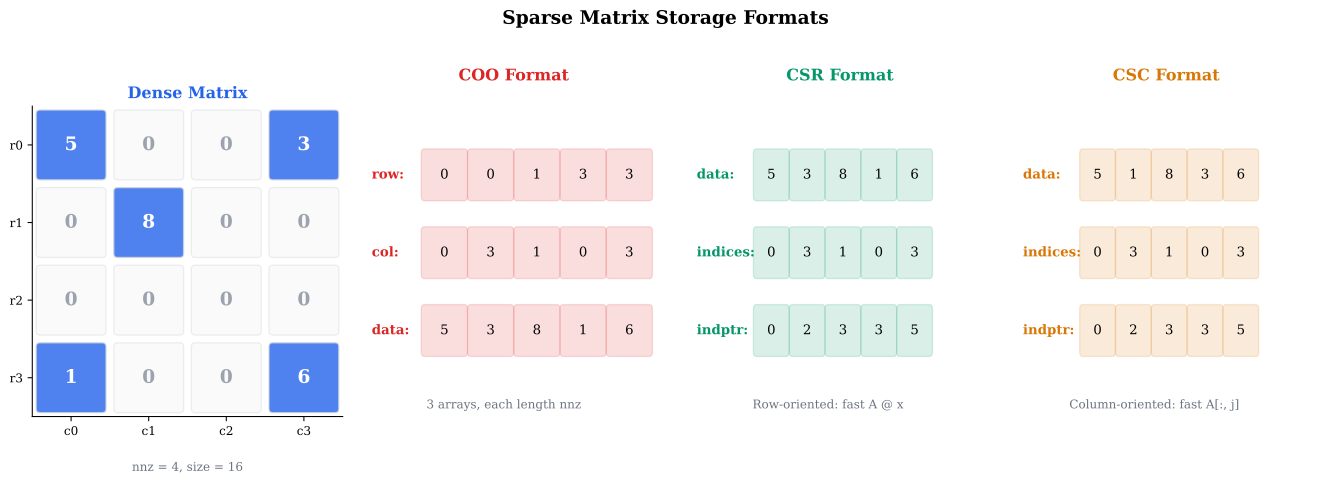
sparse matrix
A matrix where the vast majority of entries are zero. Stored in compressed formats (COO, CSR, CSC) that use memory instead of .
Related: CSR (Compressed Sparse Row)
CSR (Compressed Sparse Row)
A sparse matrix format using three arrays: data (nonzero values), indices (column indices), and indptr (row pointers). Efficient for row slicing and matrix-vector products.
Related: sparse matrix
Common Mistake: Converting Sparse to Dense Unnecessarily
Mistake:
Calling .toarray() or .todense() on a large sparse matrix
to use dense NumPy operations, defeating the purpose of sparse storage.
Correction:
Use scipy.sparse.linalg functions (spsolve, eigsh, svds,
gmres, cg) that operate directly on sparse matrices. If you
must convert, first check that the dense matrix fits in memory:
n * m * 8 / 1e9 gives the size in GB.
Common Mistake: Doing Arithmetic in COO Format
Mistake:
Performing repeated matrix-vector products or element access on a COO matrix, which requires sorting and is much slower than CSR.
Correction:
Build in COO (easy to append entries), then convert to CSR or CSC
for computation: A_csr = A_coo.tocsr(). The conversion is .
Key Takeaway
Build sparse in COO, compute in CSR. Use scipy.sparse.diags,
eye, and block_diag for structured matrices. Use spsolve and
eigsh instead of converting to dense. A
sparse matrix with 1% density uses 1000x less memory than dense.
Sparse Matrix Operations
# Code from: ch06/python/sparse_matrices.py
# Load from backend supplements endpointSparse Eigenproblems
# Code from: ch06/python/sparse_eigenproblems.py
# Load from backend supplements endpoint