Kronecker Products — Efficient Implementation
Kronecker Products: The Hidden Structure in Multi-Antenna Systems
The Kronecker product arises naturally whenever two independent structures combine. In MIMO wireless, the spatial channel correlation often factors as (the Kronecker channel model). In signal processing, multi-dimensional DFTs factor as Kronecker products of 1D DFTs. Understanding how to exploit Kronecker structure can reduce operations to .
Definition: Kronecker Product
Kronecker Product
The Kronecker product of and is:
C = np.kron(A, B)
The result has dimensions . Even for moderate , the Kronecker product can be enormous: if is and is , then is .
Definition: The vec Operator and Vec-Permutation Trick
The vec Operator and Vec-Permutation Trick
The operator stacks the columns of a matrix into a single column vector:
The key identity connecting Kronecker products and vectorization is:
This allows matrix equations to be rewritten as the linear system .
In NumPy, vec(A) is A.ravel(order='F') (Fortran/column-major order).
Definition: Key Properties of Kronecker Products
Key Properties of Kronecker Products
For conformable matrices:
- Mixed product:
- Transpose:
- Inverse:
- Eigenvalues: If are eigenvalues of and of , then eigenvalues of are
- Trace:
- Determinant: for ,
Theorem: Kronecker Matrix-Vector Product Without Forming the Full Product
The product where , , and , can be computed as:
where and .
This costs flops instead of for the naive product with the full Kronecker matrix.
Instead of forming the Kronecker product (which may not even fit in memory), we exploit the factored structure by applying and separately. This is the same principle behind fast multidimensional transforms.
Example: Efficient Kronecker Matrix-Vector Product
Compare the naive with the efficient reshape-based approach for factors.
Naive vs efficient
import numpy as np
import time

m, n, p, q = 100, 100, 100, 100
A = np.random.randn(m, n)
B = np.random.randn(p, q)
x = np.random.randn(n * q)

# Naive: form full Kronecker product
t0 = time.perf_counter()
K = np.kron(A, B)
y_naive = K @ x
t_naive = time.perf_counter() - t0

# Efficient: reshape trick
t0 = time.perf_counter()
X = x.reshape(q, n, order='F')  # or equivalently (n, q).T
Y = B @ X @ A.T
y_fast = Y.ravel(order='F')
t_fast = time.perf_counter() - t0

print(f"Naive:     {t_naive:.4f}s, memory: {K.nbytes/1e6:.0f} MB")
print(f"Efficient: {t_fast:.6f}s")
print(f"Speedup: {t_naive/t_fast:.0f}x")
print(f"Max error: {np.max(np.abs(y_naive - y_fast)):.2e}")
Key insight
The naive approach requires forming a matrix (800 MB). The efficient approach uses two matrix multiplications and zero extra memory.
Example: Kronecker MIMO Channel Model
In the Kronecker channel model, the MIMO channel is: where has i.i.d. entries. Show that the vectorized channel satisfies .
Generate Kronecker channel
import numpy as np
from scipy.linalg import sqrtm

Nr, Nt = 4, 4
rho_rx, rho_tx = 0.6, 0.8

# Exponential correlation
R_rx = np.array([[rho_rx**abs(i-j) for j in range(Nr)] for i in range(Nr)])
R_tx = np.array([[rho_tx**abs(i-j) for j in range(Nt)] for i in range(Nt)])

# Generate channel
R_rx_half = sqrtm(R_rx)
R_tx_half = sqrtm(R_tx)
Hw = (np.random.randn(Nr, Nt) + 1j * np.random.randn(Nr, Nt)) / np.sqrt(2)
H = R_rx_half @ Hw @ R_tx_half

# Verify covariance via Kronecker structure
R_full = np.kron(R_tx.T, R_rx)
h_vec = H.ravel(order='F')
print(f"Expected covariance shape: {R_full.shape}")
Kronecker Product: Naive vs Efficient Benchmark
Compare execution time and memory of the naive Kronecker product against the efficient reshape-based approach as factor size grows.
Parameters
Kronecker Product Structure
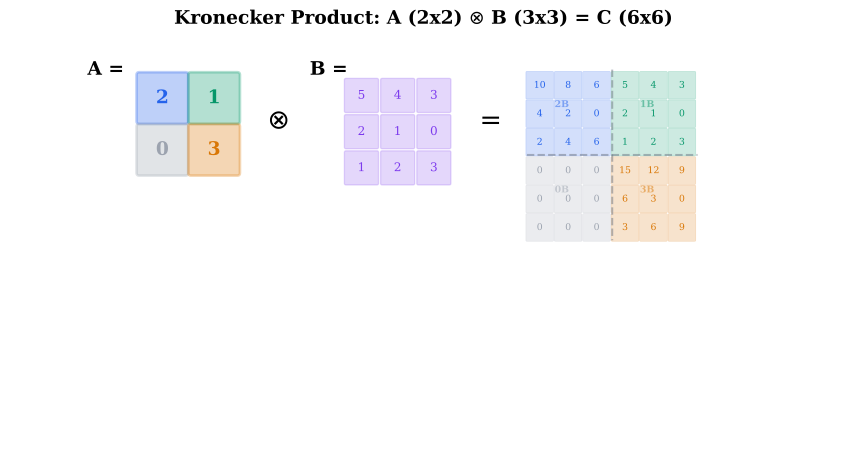
Kronecker product
The block matrix operation that replaces each entry with the block . The result has dimensions for and factors.
Related: vec operator
vec operator
The vectorization operator that stacks the columns of a matrix into a single column vector. Key identity: .
Related: Kronecker product
Common Mistake: Forming the Full Kronecker Product
Mistake:
Computing K = np.kron(A, B) and then y = K @ x for large factors.
For factors, this creates an matrix
requiring memory and flops.
Correction:
Use the reshape trick: Y = B @ X.reshape(q, n, order='F') @ A.T
and y = Y.ravel(order='F'). This uses memory and
flops. See kron_matvec in the code supplement.
Quick Check
What is the size of if is and is ?
(4D tensor)
The Kronecker product of an m x n and p x q matrix is mp x nq = 15 x 24.
Key Takeaway
Never form the full Kronecker product if you only need matvec. The identity converts an operation into two matrix multiplies. This pattern appears in MIMO channel estimation, 2D filtering, and multidimensional transforms.
Efficient Kronecker Operations
# Code from: ch06/python/kronecker_efficient.py
# Load from backend supplements endpointWhy This Matters: The Kronecker Channel Model in MIMO
The Kronecker model assumes that transmit and receive correlations are separable:
This is the most widely used spatially correlated MIMO channel model in 3GPP standards. The Kronecker structure enables efficient simulation: instead of generating a -dimensional correlated vector, generate an i.i.d. matrix and color it with two small correlation half-matrices.
Historical Note: Leopold Kronecker and His Product
The Kronecker product is named after Leopold Kronecker (1823-1891), though it was also studied independently by Johann Zehfuss. Some authors call it the Zehfuss product. Kronecker used it in his work on bilinear forms. Today, the Kronecker product is essential in quantum computing (tensor product of qubit states), control theory (Lyapunov equations), and wireless communications.