Practical Antenna Considerations
From Theory to Hardware
The preceding sections derived array patterns assuming isotropic elements with no interaction. Real arrays deviate from this ideal: elements couple electromagnetically, each element has its own radiation pattern, polarization must be managed, and the beamforming architecture dictates cost, power, and flexibility. This section addresses the practical considerations that bridge textbook array theory and deployed antenna systems.
Definition: Mutual Coupling
Mutual Coupling
Mutual coupling is the electromagnetic interaction between closely spaced antenna elements. When element is excited, some energy couples into neighbouring elements , altering their currents and thus the radiation pattern.
The coupling is modelled by the mutual impedance matrix , where is the voltage induced on element by unit current on element . The actual element currents are
where is the applied voltage vector. The effective steering vector becomes
where (or a normalised version thereof) is the coupling matrix. Coupling is strongest for and decays roughly as for parallel dipoles.
Definition: Element Pattern vs Array Pattern
Element Pattern vs Array Pattern
The element pattern is the radiation pattern of a single element in isolation. The array pattern is the product of the element pattern and the array factor:
This is the pattern multiplication principle. In practice:
- The element pattern provides a natural envelope that suppresses grating lobes outside the element's main beam
- In the 3GPP model, the element pattern is a truncated with 65 HPBW and 30 dB front-to-back ratio
- The embedded element pattern (measured when all other elements are terminated in matched loads) differs from the isolated pattern due to mutual coupling
Array Factor with Element Pattern
Compare the array pattern with and without the element pattern. The isotropic element shows grating lobes at full strength; the 3GPP element pattern suppresses them. This illustrates why the element pattern acts as a spatial anti-aliasing filter.
Parameters
Grating Lobe Onset Animation
Grating Lobe Onset
Observe how grating lobes appear as element spacing increases beyond 0.5. For , grating lobes reach full main-lobe amplitude at . The plot shows the power pattern in dB with grating lobe positions marked.
Parameters
Definition: Polarization Diversity
Polarization Diversity
Polarization diversity exploits orthogonal polarization states to create independent (or weakly correlated) channels. Two co-located antennas with orthogonal polarizations (e.g., slant, or V/H) experience largely independent fading because:
- Cross-polarized scattered components are weakly correlated
- The cross-polar discrimination (XPD) is typically 8-15 dB in urban environments
This effectively doubles the number of independent spatial channels without increasing the physical array size. The 3GPP standard mandates dual-polarized elements at the base station, and modern UE designs use 2 or 4 cross-polarized antennas.
Beamforming Architecture Comparison
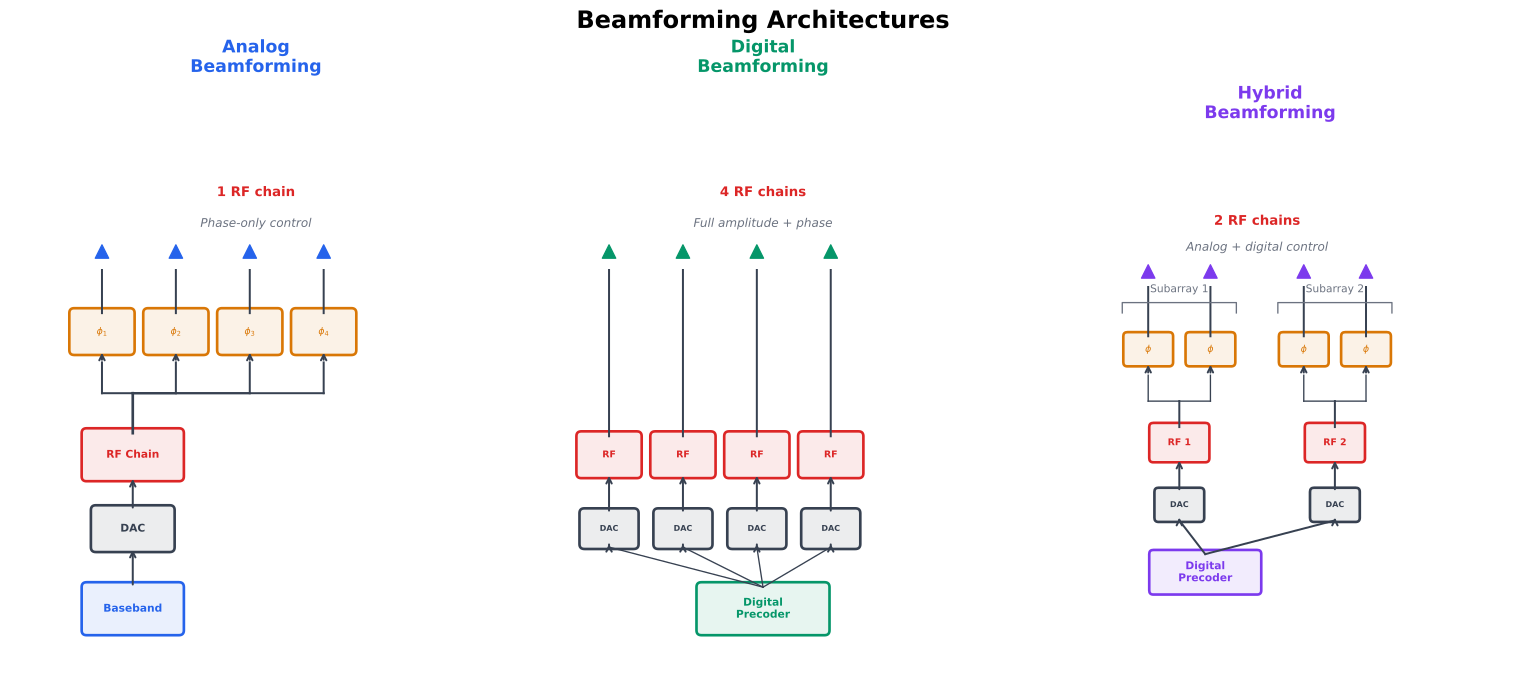
Analog vs Digital vs Hybrid Beamforming
The beamforming architecture determines how weights are applied:
Analog beamforming: phase shifters adjust the phase of each element's signal in the RF domain. Only one beam can be formed per RF chain. Weights are constrained to constant modulus ().
Digital beamforming: each element has its own RF chain, ADC/DAC, and baseband processing. Arbitrary complex weights, multiple simultaneous beams, full spatial multiplexing.
Hybrid beamforming: a compromise. RF chains each drive a subarray via analog phase shifters. Digital precoding operates across RF chains.
The choice is driven by cost, power, and the carrier frequency: at mmWave, digital beamforming with hundreds of elements is prohibitively expensive, making hybrid architectures dominant.
Beamforming Architecture Comparison
| Property | Analog | Digital | Hybrid |
|---|---|---|---|
| RF chains | 1 | ||
| Weight constraint | Constant modulus | Arbitrary complex | Mixed |
| Simultaneous beams | 1 | ||
| Spatial multiplexing | No | Full | Partial |
| Power consumption | Low | Very high | Medium |
| Hardware cost | Low | Very high | Medium |
| Typical use | mmWave single-user | Sub-6 GHz massive MIMO | mmWave multi-user |
| 5G NR example | FR2 UE | FR1 64T64R | FR2 gNB |
Historical Note: Phased Arrays in Radar
Electronically steered phased arrays were first developed for military radar in the 1950s-60s. The AN/SPY-1 Aegis radar (deployed 1983) used a 4,480-element planar array to simultaneously track hundreds of targets — demonstrating the power of electronic beam steering decades before it entered telecommunications. The transition from radar to communications accelerated with 5G NR (2018), which adopted massive MIMO phased arrays as a core technology for both sub-6 GHz and mmWave bands. Many of the beamforming algorithms used in 5G (MVDR, LCMV, DFT codebooks) originated in the radar and sonar communities.
Quick Check
A hybrid beamforming architecture has antenna elements and RF chains. What is the maximum number of independent data streams it can spatially multiplex?
64
4
16
1
Correct. The number of independent data streams is limited by . Each RF chain processes one spatial stream. The 64 elements provide beamforming gain per stream but the multiplexing order is at most .
Hybrid Beamforming Constraints at mmWave
Hybrid beamforming is the dominant architecture for 5G NR FR2 (24.25-52.6 GHz) base stations due to practical constraints:
- Power consumption: Each RF chain (ADC + mixer + LNA) draws mW at 28 GHz. A 256-element fully digital array would consume W in RF chains alone — exceeding the thermal budget of a compact panel.
- Phase shifter resolution: Commercial mmWave phase shifters provide 5-7 bit resolution. Below 5 bits, the quantization loss ( dB at 5 bits) and spurious sidelobes become noticeable.
- Subarray architectures: Most commercial 5G mmWave products (e.g., Qualcomm QTM545) use 4-8 RF chains driving 16-32 elements each, for a total of 128-256 elements.
- Calibration: The analog phase shifters must be calibrated to within to maintain beam pointing accuracy. Temperature drift of /10°C requires periodic over-the-air calibration.
- •
RF chain power budget: ~250 mW per chain at 28 GHz
- •
Phase shifter resolution: 5-7 bits in commercial products
- •
Calibration accuracy: ±5° phase, ±0.5 dB amplitude
Key Takeaway
The choice between analog, digital, and hybrid beamforming is ultimately a tradeoff between three quantities: spatial multiplexing capability ( independent streams), power consumption (), and hardware cost (). At sub-6 GHz, digital wins; at mmWave, hybrid is the pragmatic choice; analog suffices only for single-user fixed links.
Mutual Coupling
Electromagnetic interaction between adjacent antenna elements that alters their impedance and radiation patterns. Modelled by the mutual impedance matrix .
Related: Element Spacing, Embedded Pattern, Array Calibration
Polarization Diversity
Using orthogonally polarized antennas (e.g., ) to create independent fading channels without additional spatial separation. Effectively doubles the MIMO rank.
Related: Dual Polarized, Xpd, Diversity Gain
Hybrid Beamforming
A beamforming architecture combining analog phase shifters (per element) with digital precoding (per RF chain), using RF chains to balance cost, power, and multiplexing capability.
Related: Analog Beamforming, Digital Beamforming, Millimeter Wave (mmWave)