DFT/IDFT Implementation
Definition: OFDM Transceiver via IDFT/DFT
OFDM Transceiver via IDFT/DFT
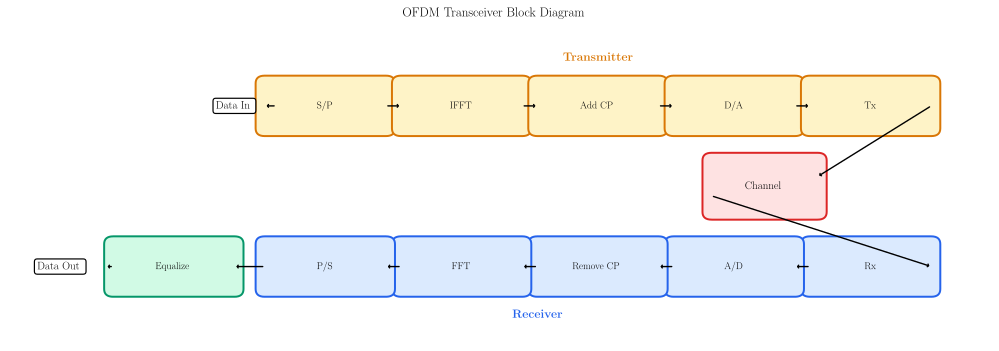
The OFDM transmitter and receiver are implemented using the inverse DFT and DFT, respectively.
Transmitter (IDFT): Given frequency-domain data symbols , the time-domain samples are:
Receiver (DFT): After removing the cyclic prefix, the receiver computes:
In matrix notation with the normalised DFT matrix where :
Definition: Cyclic Prefix (CP)
Cyclic Prefix (CP)
The cyclic prefix is a copy of the last samples of the OFDM symbol, prepended to the beginning of the transmitted block. If the time-domain OFDM symbol is , then the transmitted sequence with CP is:
The total transmitted block length is samples. The CP must satisfy where is the number of channel taps, ensuring that the linear convolution with the channel becomes a circular convolution over the -sample DFT window.
The receiver discards the first received samples (the CP portion) and applies the DFT to the remaining samples.
Definition: Circular Convolution
Circular Convolution
The circular convolution of two -point sequences and is defined as:
The fundamental property of the DFT is that circular convolution in the time domain corresponds to pointwise multiplication in the frequency domain:
This is why OFDM, combined with the cyclic prefix, diagonalises the channel: the matrix channel equation becomes scalar equations.
Definition: Cyclic Prefix Overhead
Cyclic Prefix Overhead
The CP overhead quantifies the fraction of transmitted energy and time spent on the cyclic prefix rather than on useful data:
The spectral efficiency loss due to the CP is:
Increasing (for fixed CP duration) reduces the overhead but increases sensitivity to Doppler spread and PAPR.
Theorem: Cyclic Prefix Eliminates ISI and ICI
Consider an OFDM system with subcarriers transmitting over a channel with taps: . If the cyclic prefix length satisfies , then:
-
No ISI: The received samples within the DFT window of symbol depend only on the data of symbol , not on any adjacent symbol.
-
No ICI: The DFT output on subcarrier depends only on , not on any other subcarrier with .
Specifically, the input-output relation in the frequency domain is the diagonal system:
where is the channel frequency response at subcarrier .
The CP converts the linear convolution into a circular convolution by making appear periodic within the receiver's DFT window. The DFT diagonalises circular convolution, yielding independent sub-channels.
ISI elimination
Without CP, the channel output at sample of symbol is . For , the indices become negative, pulling in samples from symbol (ISI).
With CP of length , these "preceding" samples are copies of the end of symbol : for all . The DFT window starts after the CP, so no samples from symbol enter the computation.
Circular convolution
Within the DFT window, the received signal satisfies:
This is exactly an -point circular convolution.
Diagonalisation via DFT
Taking the DFT of both sides and using the circular convolution theorem:
Since is a scalar for each , there is no inter-carrier interference. In matrix form, where .
Cyclic Prefix: Linear to Circular Convolution
Cyclic Prefix and Channel Convolution
Visualise how the cyclic prefix converts linear convolution into circular convolution. Observe the guard interval absorbing the channel transient, preventing ISI between adjacent OFDM symbols. Adjust the channel length and CP length to see when ISI occurs.
Parameters
Example: Matrix Representation of OFDM
For a 4-subcarrier OFDM system () with a 2-tap channel and CP length :
(a) Write the transmitted sequence (with CP) for data .
(b) Write the channel convolution in matrix form.
(c) Show that the DFT of the received signal yields .
IDFT to get time-domain samples
where is the DFT matrix:
The time-domain samples are .
CP insertion
With , prepend :
Transmitted:
Channel convolution in matrix form
After CP removal, the received samples satisfy a circular convolution. In matrix form:
where is the circulant matrix:
Diagonalisation
Circulant matrices are diagonalised by the DFT: , where and .
Applying the DFT to :
Hence for each .
Common Mistake: Insufficient Cyclic Prefix
Mistake:
Setting the CP length shorter than the channel delay spread () to reduce overhead.
Correction:
When , the linear convolution is not fully converted to circular convolution, causing both ISI (leakage from the previous symbol) and ICI (loss of subcarrier orthogonality). The resulting interference floor cannot be removed by increasing transmit power. The CP must satisfy , or equivalently (maximum channel delay spread).
Quick Check
In an OFDM system with subcarriers and a channel with delay spread of 5 samples, what is the minimum CP length to avoid ISI?
(no CP needed)
The channel has taps, so the maximum delay index is . We need . In practice, provides a small margin. The minimum requirement is , but is the conservative choice to handle timing uncertainty.
Key Takeaway
The cyclic prefix is what makes OFDM work. Without it, the frequency-selective channel creates ISI and ICI. With a CP of length , linear convolution becomes circular convolution, the DFT diagonalises the channel matrix, and each subcarrier sees a single complex scalar . The price: a spectral efficiency loss of .
5G NR Numerology and CP Overhead
5G NR supports multiple subcarrier spacings (numerologies): kHz, denoted by where kHz.
| Normal CP (s) | CP overhead | |||
|---|---|---|---|---|
| 0 | 15 kHz | 66.7 s | 4.69 | 6.6% |
| 1 | 30 kHz | 33.3 s | 2.34 | 6.6% |
| 2 | 60 kHz | 16.7 s | 1.17 | 6.6% |
| 3 | 120 kHz | 8.33 s | 0.57 | 6.4% |
| 4 | 240 kHz | 4.17 s | 0.29 | 6.5% |
Wider subcarrier spacing reduces the symbol duration and CP length proportionally, keeping the relative CP overhead constant at approximately 7%. However, the absolute CP duration decreases, limiting the tolerable delay spread. At mmWave (120/240 kHz SCS), the CP covers only 0.3--0.6 s of delay spread, which is sufficient for urban micro/indoor scenarios but not for large outdoor cells.
- •
Normal CP covers ~4.7 μs at 15 kHz SCS (urban macro), ~0.6 μs at 120 kHz (mmWave indoor)
- •
Extended CP (only μ=2) increases CP to ~4.17 μs but reduces to 12 symbols/slot
- •
FFT size scales with SCS: N=4096 at 15 kHz, N=512 at 120 kHz for same bandwidth
OFDM Transceiver Block Diagram
Cyclic Prefix
A copy of the last samples of an OFDM symbol prepended to the symbol before transmission. Converts linear channel convolution into circular convolution, enabling ISI-free DFT-based demodulation.
Related: Orthogonal Frequency Division Multiplexing (OFDM), Circular Convolution, Cyclic Prefix Eliminates ISI and ICI
Circular Convolution
Convolution of two periodic (or periodically extended) sequences, defined as . Corresponds to pointwise multiplication in the DFT domain.
Related: OFDM Transceiver via IDFT/DFT, Cyclic Prefix (CP), Orthogonal Frequency Division Multiplexing (OFDM)
CP Overhead
The fraction of time (and energy) consumed by the cyclic prefix: . Represents a direct loss in spectral efficiency.
Related: Cyclic Prefix (CP), Spectral Efficiency of Hybrid vs. Digital Beamforming