Hybrid Beamforming Architectures
Why Not Fully Digital at mmWave?
In a conventional MIMO system at sub-6 GHz, every antenna element has its own dedicated RF chain (mixer, ADC/DAC, filter). At mmWave, two factors make this approach prohibitively expensive:
- Power consumption: A single high-speed ADC at 1+ GS/s consumes 200–500 mW. With antennas, the ADC power alone would exceed 50–130 W — comparable to the total base station power budget.
- Cost: mmWave RF chains require wideband components (mixers, filters, amplifiers) operating at 28–71 GHz, which are significantly more expensive than their sub-6 GHz counterparts.
Hybrid beamforming addresses this by splitting the precoding into a high-dimensional analog stage (implemented with phase shifters) and a low-dimensional digital stage (implemented in baseband with a small number of RF chains). This reduces the number of RF chains from to while approaching the spectral efficiency of fully digital precoding.
The key insight is that mmWave channels are spatially sparse: propagation occurs through a small number of clusters (typically 2–5 in NLOS), so the channel matrix has low effective rank. This sparsity means that RF chains (where is the number of streams) suffice to approach optimal performance.
Definition: Hybrid Analog-Digital Precoding Architecture
Hybrid Analog-Digital Precoding Architecture
In a hybrid beamforming system with transmit antennas, RF chains, and data streams, the transmitted signal is:
where:
- is the symbol vector with ,
- is the digital (baseband) precoder,
- is the analog (RF) precoder, implemented with phase shifters.
The unit-modulus constraint on the analog precoder requires:
This constraint arises because each phase shifter can only change the phase, not the amplitude, of the signal.
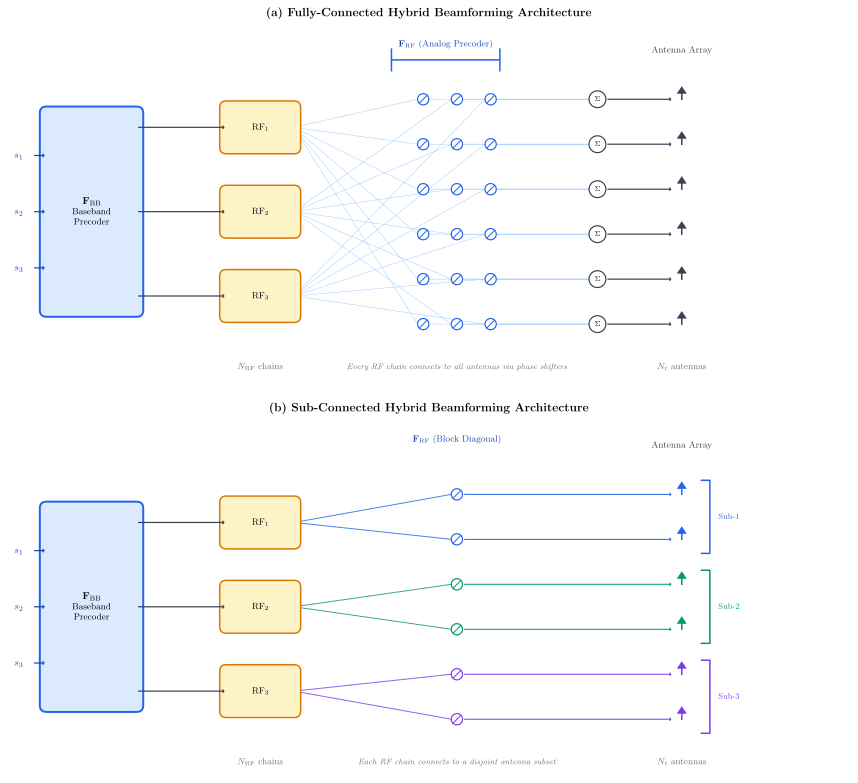
Two principal architectures exist:
Fully connected: Every RF chain connects to every antenna through a dedicated phase shifter. This requires phase shifters but provides maximum beamforming flexibility.
Sub-connected (partially connected): Each RF chain connects to a disjoint subset of antennas. This requires only phase shifters total but restricts the analog beamforming to block-diagonal structure:
where is the analog beamforming vector for the -th sub-array.
Hybrid Beamforming Architectures
Sparse mmWave Channel Model
The mmWave MIMO channel between a transmitter with antennas and a receiver with antennas is well modelled by the Saleh-Valenzuela geometric channel:
where is the number of scattering paths (clusters), is the complex gain of the -th path (incorporating path loss and phase), and , are the transmit and receive array response vectors at azimuth and elevation .
For a uniform planar array (UPA) with elements horizontally and elements vertically (), the array response vector is:
At mmWave, is typically 2–5 in NLOS (and 1 dominant in LOS), making the channel matrix low-rank and spatially sparse — the key property exploited by hybrid beamforming.
OMP-Based Hybrid Precoding (Ayach et al., 2014)
Complexity: The dominant cost is the dictionary search in step 6, requiring complex multiplications, where is the dictionary size (typically for a DFT codebook). The matrix inversion in step 8 costs per iteration. Overall: .Convergence and Performance of OMP Hybrid Precoding
The OMP algorithm greedily approximates the optimal unconstrained precoder by selecting columns from a dictionary of array response vectors. Key properties:
- Near-optimal for sparse channels: When (number of paths number of RF chains), OMP can recover the dominant paths exactly, achieving spectral efficiency within 1–2 dB of the fully digital baseline.
- Graceful degradation: As decreases below , performance degrades smoothly. The rule of thumb ensures that both the real and imaginary parts of each stream can be independently controlled.
- Dictionary design matters: The standard DFT codebook works well for ULAs, but UPAs benefit from 2D oversampled DFT dictionaries to capture elevation angles.
Hardware constraints beyond unit-modulus also affect practical implementations:
- Finite-resolution phase shifters: Commercial phase shifters typically have 4–6 bits of resolution (16–64 discrete phases). Quantising the OMP solution to the nearest discrete phase incurs 0.5–1 dB loss at 4 bits and 0.1 dB at 6 bits.
- Insertion loss: Each phase shifter introduces 3–6 dB insertion loss at mmWave, which must be compensated by the PA or accounted for in the link budget.
- Switching networks: Architectures using switches instead of phase shifters (selection-based hybrid BF) further reduce power but sacrifice beamforming resolution.
Spectral Efficiency of Hybrid vs. Digital Beamforming
The achievable spectral efficiency with hybrid precoding and hybrid combining is:
where is the effective channel after hybrid precoding and combining, and is the effective noise covariance.
The fully digital upper bound is:
where are the singular values of .
Simulation studies (Heath et al., 2016) consistently show that with , the fully connected hybrid architecture achieves within 1–3 dB of the fully digital baseline. The sub-connected architecture incurs an additional 1–2 dB penalty. As , hybrid and digital performance converge identically.
Hybrid vs. Digital Beamforming Spectral Efficiency
Compare the spectral efficiency of hybrid beamforming (both fully connected and sub-connected) against the fully digital baseline as a function of SNR. Adjust the number of antennas, RF chains, and users to explore the trade-off between hardware complexity and performance. The gap between hybrid and digital narrows as increases.
Parameters
Quick Check
In a fully connected hybrid beamforming architecture with antennas and RF chains, how many phase shifters are required?
128 phase shifters
1024 phase shifters
8 phase shifters
256 phase shifters
Correct. In the fully connected architecture, each of the RF chains connects to all antennas, requiring phase shifters.
Common Mistake: Dismissing Hybrid BF as "Clearly Inferior" to Fully Digital
Mistake:
Assuming that hybrid beamforming is a temporary compromise that will be replaced by fully digital as hardware improves, and therefore not worth optimising.
Correction:
Hybrid architectures will remain relevant for the foreseeable future at mmWave and sub-THz frequencies. The power consumption of ADCs scales as — doubling the sampling rate doubles the power. For 1 GHz bandwidth at 8 ENOB, each ADC consumes 500 mW. A 256-element fully digital system would need 128 W in ADCs alone. Even with Moore's law improvements of 2 per decade for ADC efficiency, fully digital 256-element mmWave systems remain impractical for at least another decade. Meanwhile, hybrid architectures with achieve within 1–3 dB of fully digital — a modest price for an order-of-magnitude reduction in power consumption.
Hybrid Beamforming Architecture Comparison
| Property | Fully Connected | Sub-Connected | Fully Digital |
|---|---|---|---|
| Phase shifters | 0 | ||
| RF chains | |||
| Total ADCs | |||
| Beam flexibility | Full (any direction per RF chain) | Sub-array limited | Full (any beam per element) |
| Spectral efficiency gap | 1–3 dB below digital | 2–5 dB below digital | Reference (0 dB) |
| Power (256 ant, 8 RF) | 8 W | 5 W | 130 W |
| Hardware cost | Medium | Low | Very high |
| Typical 5G NR use | FR2 gNB (28 GHz) | FR2 UE | FR1 massive MIMO (sub-6) |
Phase Shifter Technology and Insertion Loss at mmWave
The analog precoding stage of hybrid beamforming relies on phase shifters, whose characteristics critically affect system performance:
- CMOS passive phase shifters: 4–6 bit resolution, 4–8 dB insertion loss at 28 GHz, 0.5–2 mW power per element. The dominant technology for consumer 5G devices.
- SiGe active phase shifters: 5–7 bit resolution, 1–3 dB insertion loss (with amplification), 5–15 mW per element. Used in base station panels where power budget is less constrained.
- MEMS phase shifters: Very low insertion loss ( dB) and excellent linearity, but slow switching speed (10 s) limits beam tracking rate. Used in satellite and radar, not yet competitive for 5G.
The insertion loss of phase shifters is a critical design parameter: with elements and 6 dB insertion loss per phase shifter in a fully connected architecture, the total power delivered to the antennas is reduced by 6 dB, directly impacting EIRP. This loss must be compensated by the PA, which in turn increases power consumption. Sub-connected architectures reduce the number of phase shifters per path, partially mitigating this issue.
- •
CMOS passive phase shifters: 4-8 dB insertion loss at 28 GHz
- •
Phase quantisation with 4-bit shifters: ~0.5-1 dB array gain loss
- •
Switching speed: CMOS ~1 ns, MEMS ~10 μs
Hybrid Beamforming
A beamforming architecture that splits precoding into an analog stage (phase shifters) and a digital stage (baseband processing), reducing the number of RF chains from to .
Related: Phase Shifter, RF Chain, Precoding in 5G NR and Wi-Fi
Unit-Modulus Constraint
The requirement that each entry of the analog precoding matrix has constant magnitude: . This arises because phase shifters can only adjust phase, not amplitude.
Related: Hybrid Beamforming, Phase Shifter