Beam Tracking and Management
The Beam Management Challenge
At mmWave frequencies, high-gain directional beams are essential to overcome path loss — a 28 GHz link with omnidirectional antennas suffers 30 dB more loss than at 2 GHz. An -element array provides beamforming gain of dB, but only when the beam is accurately pointed toward the target. A 256-element array at 28 GHz has a half-power beamwidth of 7°. Even modest angular errors of 3–5° can halve the received power.
Beam management is the set of procedures that establish, maintain, and recover directional beam pairs between the base station (gNB) and user equipment (UE). In 5G NR, beam management is a core Layer 1/2 function defined in 3GPP TS 38.214 and involves:
- P1 (Beam sweeping): Initial beam acquisition using SSB beams
- P2 (Beam refinement at gNB): Narrowing the gNB beam using CSI-RS
- P3 (Beam refinement at UE): Narrowing the UE beam
- Beam tracking: Maintaining alignment during mobility
- Beam failure recovery: Detecting and recovering from beam failures
The fundamental tension is between training overhead (time spent searching for the best beam) and beamforming gain (which increases with narrower beams that are harder to find).
Definition: 5G NR Beam Management Framework
5G NR Beam Management Framework
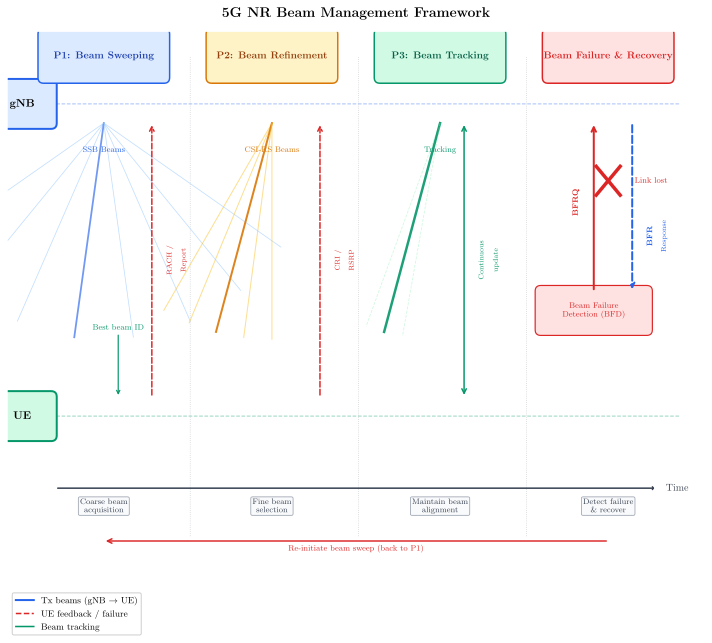
The beam management framework in 5G NR defines a hierarchical procedure for establishing and maintaining beam pairs:
P1 — Initial Beam Acquisition (Beam Sweeping): The gNB transmits synchronisation signal blocks (SSBs) over a set of wide beams that collectively cover the cell. In FR2, up to SSB beams are defined per SSB burst set, transmitted within a 5 ms half-frame. The UE measures reference signal received power (RSRP) on each SSB and reports the best beam index.
P2 — gNB Beam Refinement: After P1 identifies a coarse beam direction, the gNB transmits CSI-RS resources on a set of narrower beams within the selected coarse sector. The UE reports the best refined beam index, narrowing the angular uncertainty.
P3 — UE Beam Refinement: The UE refines its own receive beam by measuring the selected gNB beam across multiple UE beam directions, selecting the receive beam that maximises RSRP.
Beam Tracking: Once a beam pair is established, periodic CSI-RS measurements track slow beam drift due to UE mobility. The gNB can update the beam pair based on L1-RSRP reports.
Beam Failure Recovery (BFR): If the serving beam quality drops below a threshold for a specified duration, the UE initiates beam failure recovery: it identifies a candidate beam from recent measurements and transmits a beam failure recovery request (BFRQ) on the PRACH or PUCCH.
Hierarchical Beam Search
Complexity: The hierarchical search requires beam measurements to find the best beam among candidates, compared to measurements for an exhaustive search. For , this reduces overhead from 64 to 12 measurements — a reduction. The trade-off is robustness: if any intermediate stage makes an error (e.g., due to a deep fade on the correct wide beam), the search descends into the wrong sector and the error propagates to all subsequent stages. The probability of stage error increases at low SNR and with fast fading.SSB Beam Sweep Timing in 5G NR
In 5G NR FR2, the SSB burst set contains up to SSB beams. Each SSB occupies 4 OFDM symbols in time and 240 subcarriers (20 resource blocks) in frequency. With subcarrier spacing kHz (numerology ), one OFDM symbol duration is:
An SSB block (4 symbols) thus spans s. With beams multiplexed across two consecutive half-frames (5 ms each), the total SSB burst set fits within 5 ms.
The beam sweep periodicity is configurable: 5, 10, 20, 40, 80, or 160 ms. For vehicular scenarios at 100 km/h, a 20 ms periodicity is typical, corresponding to 0.56 m of displacement per sweep — well within the coherence distance at 28 GHz.
Beam Tracking via Extended Kalman Filter
Between beam sweeps, the UE moves and the optimal beam direction changes. Rather than repeating a full sweep, beam tracking exploits temporal correlation in the angle of departure (AoD) and angle of arrival (AoA).
Model the AoD evolution as a first-order Markov process:
where is the angular velocity and is the tracking interval. The extended Kalman filter (EKF) state vector is:
where is the complex path gain. The measurement is the received signal power on a set of probing beams:
The EKF prediction-update cycle maintains a running estimate with a tracking error that scales as:
where is the number of probing beams per tracking interval. Typically – suffices for pedestrian speeds, while vehicular speeds may require –.
The key advantage of EKF-based tracking over periodic re-sweeping is the dramatic reduction in overhead: tracking requires measurements per interval versus for a full sweep.
Beam Failure Detection and Recovery
Beam failure occurs when the serving beam quality (L1-RSRP or L1-SINR) drops below a configured threshold and remains below it for a timer duration (beam failure detection timer, typically 20–40 ms). Common causes include:
- Blockage: A pedestrian or vehicle obstructs the beam path
- Rotation: The UE rotates, placing the serving beam in a self-blockage zone
- Mobility: The UE moves outside the serving beam's coverage
The beam failure recovery (BFR) procedure in 5G NR:
- Detection: The UE detects beam failure when for consecutive measurement periods
- Candidate identification: The UE selects a new candidate beam from previously measured beams with (the "good enough" threshold)
- BFRQ transmission: The UE transmits a beam failure recovery request on dedicated PRACH resources (contention-free) or PUCCH, using the candidate beam direction
- gNB response: The gNB responds on PDCCH with a beam configuration update within (typically 10–20 ms)
The total interruption time from blockage onset to beam recovery is typically 30–80 ms, during which data transmission is disrupted. Multi-panel UEs with independent beam management per panel can reduce this by maintaining backup beams on different panels.
Example: Beam Training Overhead Calculation
A 5G NR base station at 28 GHz uses a codebook of beams. The slot duration is ms (SCS = 30 kHz) and the channel coherence time is ms (corresponding to pedestrian speed 3 km/h).
(a) Compute the training overhead for exhaustive beam sweeping.
(b) Compute the training overhead for hierarchical search with stages.
(c) Determine the effective throughput loss due to training overhead in each case, assuming a peak rate of 2 Gbps.
Exhaustive sweep overhead
Each beam measurement requires one slot. For exhaustive search:
Overhead fraction: .
This exceeds the coherence time! The beam found at the end of the sweep may already be outdated. Exhaustive search is infeasible for at pedestrian speed.
Hierarchical search overhead
Hierarchical search requires measurements:
Overhead fraction: .
This is feasible but still substantial — 60% of the coherence time is spent on beam training.
Effective throughput
For hierarchical search:
This motivates beam tracking (which uses only 2–4 measurements per coherence interval) rather than repeated full searches. With probing beams for EKF tracking:
Beam Training Overhead vs. Codebook Size
Explore how beam training overhead scales with codebook size for exhaustive, hierarchical, and tracking-based approaches. The dashed line marks the coherence time — any training duration exceeding means the sweep cannot complete before the channel changes.
Parameters
5G NR Beam Management Procedures
Quick Check
A hierarchical beam search with candidate beams requires how many beam measurements?
128 measurements
14 measurements
7 measurements
256 measurements
Correct. Hierarchical search requires measurements: at each of stages, two child beams are tested to refine the angular estimate.
Historical Note: From Radar Beam Scanning to 5G Beam Management
1960s–2018The concept of electronically steered beam scanning originated in military radar systems of the 1960s (the AN/SPY-1 Aegis radar, deployed in 1983, used a 4,480-element phased array). The idea of applying phased-array beam scanning to cellular communications was considered impractical until the 2010s, when advances in silicon-based mmWave circuits made consumer-grade phased arrays feasible. Qualcomm's QTM052 module (2018) — the first commercial 5G mmWave antenna module — packed a 4-element phased array with beam switching into a package smaller than a US dime. The 3GPP NR beam management framework (Release 15, 2018) codified the SSB sweeping, CSI-RS refinement, and beam failure recovery procedures now used in all 5G mmWave deployments. The framework was heavily influenced by Samsung's and Qualcomm's prototype demonstrations at 28 GHz, which showed that beam management overhead could be kept below 15% of the coherence time with hierarchical codebooks.
Beam Sweeping
The process of sequentially transmitting reference signals on different beam directions to cover the angular space. In 5G NR, SSB beam sweeping (P1 procedure) uses up to 64 beams in FR2.
Related: From Radar Beam Scanning to 5G Beam Management, SSB Beam Sweep Timing in 5G NR, Precoding Codebook
Beam Failure Recovery (BFR)
A Layer 1/2 procedure in 5G NR for re-establishing a beam pair after the serving beam quality drops below a threshold. The UE identifies a candidate beam and transmits a recovery request.
Related: From Radar Beam Scanning to 5G Beam Management, Exponential Blockage Model, Handover (Handoff)