Multi-Cell Resource Management
From Single Cell to Network
The results of Sections 20.1--20.4 assume a single isolated cell. In a real network, neighbouring cells share the same spectrum, creating inter-cell interference (ICI) that dominates the performance of cell-edge users. A cell-edge UE may experience an SINR 20--30 dB below a cell-centre UE due to strong interference from adjacent base stations. Inter-cell interference coordination (ICIC) techniques manage this interference through coordinated resource allocation across cells, without requiring the full complexity of joint multi-cell processing (CoMP). The simplest and most widely deployed approach is frequency reuse planning, which partitions the spectrum among cells so that neighbouring cells use different frequencies on their cell edges.
Definition: Inter-Cell Interference Coordination (ICIC)
Inter-Cell Interference Coordination (ICIC)
ICIC encompasses techniques where base stations coordinate their resource allocation decisions to reduce inter-cell interference, particularly for cell-edge users. Two key strategies are:
Frequency Reuse with Factor : The available bandwidth is partitioned into disjoint sub-bands. Each cell uses only one sub-band ( bandwidth), eliminating co-channel interference from the nearest interferers. The per-cell bandwidth decreases by factor , but the SINR improvement at cell edges can more than compensate.
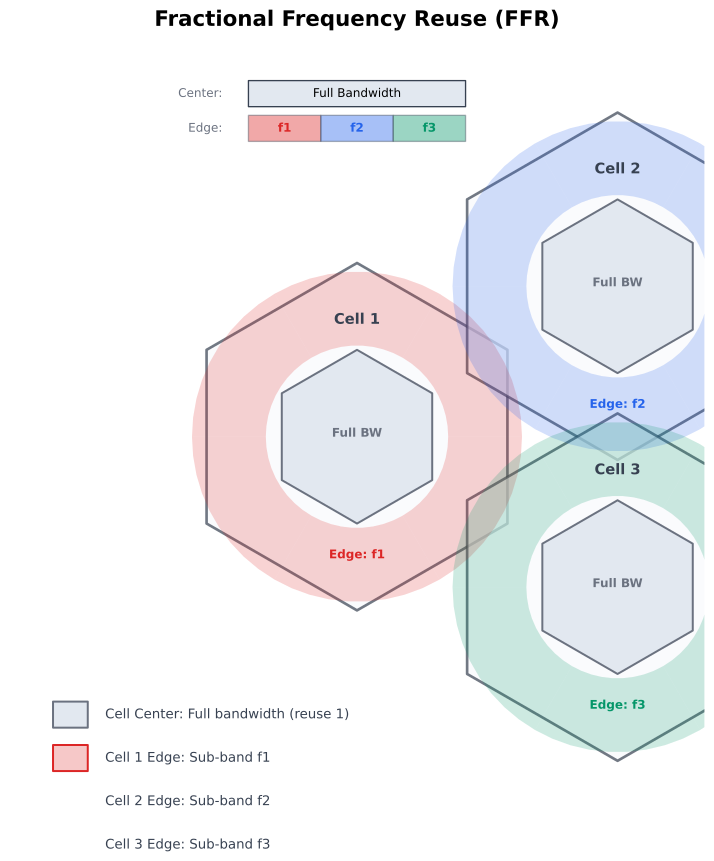
Fractional Frequency Reuse (FFR): FFR combines reuse-1 for cell-centre users with reuse- for cell-edge users:
- Inner zone (cell centre): All cells share the full bandwidth at reduced power. Interference is tolerable because cell-centre users have strong desired signals.
- Outer zone (cell edge): The bandwidth is partitioned with reuse factor (typically 3). Each cell uses a different fraction at full power, eliminating dominant interferers.
The boundary between inner and outer zones is defined by an SINR threshold , typically 0--5 dB.
FFR was standardised in LTE Release 8 as part of static ICIC. Enhanced ICIC (eICIC) in LTE Release 10 added time-domain coordination using Almost Blank Subframes (ABS) for heterogeneous networks. 5G NR supports dynamic spectrum sharing and flexible ICIC through the O-RAN RIC (RAN Intelligent Controller).
Definition: Fractional Frequency Reuse (FFR)
Fractional Frequency Reuse (FFR)
In FFR with reuse factor , the total bandwidth is divided as follows:
- A common sub-band of bandwidth is used by all cells for inner-zone users with reduced transmit power .
- The remaining bandwidth is divided into 3 equal parts of size . Each cell uses one part for outer-zone users at full power .
The SINR of a cell-edge user in cell on the reuse-3 band is:
where contains only the second-tier interferers (the first-tier interferers use different sub-bands).
Theorem: Cell-Edge SINR Improvement with Frequency Reuse
Consider a hexagonal cellular network with tiers of co-channel interferers. Under universal reuse (), the worst-case cell-edge SINR in the interference-limited regime is:
where is the cell radius, is the first-tier reuse distance, and is the path-loss exponent.
With reuse factor , the first-tier interference is eliminated and the reuse distance increases to . The cell-edge SINR becomes:
The SINR gain from reuse- relative to reuse-1 is:
For and : (9.5 dB improvement).
Increasing the reuse factor pushes interfering cells farther away, and the path-loss exponent amplifies this distance gain. The penalty is a bandwidth reduction by factor : each cell gets only bandwidth. The net effect on cell-edge throughput depends on whether the SINR gain (in dB) exceeds the bandwidth loss . For and : gain = 9.5 dB, loss = 4.8 dB, net improvement = 4.7 dB.
Reuse-1 SINR
In a hexagonal layout with 6 first-tier interferers at distance from the cell edge:
For : (1.76 dB).
Reuse-$\Delta$ SINR
With reuse , the first-tier interferers are at distance :
For , : (11.3 dB).
Gain factor
\blacksquare$
ICIC and Frequency Reuse Performance
Compare the per-user rate distribution (CDF) for different frequency reuse strategies: reuse-1, reuse-3, and FFR. The plot shows the SINR and throughput distributions for randomly placed users across a multi-cell network. Increasing the reuse factor improves cell-edge rates (left tail of the CDF) at the expense of peak rates (right tail). FFR provides a compromise that improves cell-edge performance without sacrificing cell-centre throughput.
Parameters
Reuse-1 vs. Reuse-3 vs. FFR
| Property | Reuse-1 | Reuse-3 | FFR () |
|---|---|---|---|
| Per-cell bandwidth | (varies) | ||
| Cell-edge SINR () | 1.76 dB | 11.3 dB | 11.3 dB (edge band) |
| Cell-centre SINR | 15--25 dB | 15--25 dB | 15--25 dB (full band) |
| 5th-percentile rate | Low | Medium | High |
| Sum throughput | Highest (if noise-limited) | Lowest ( BW) | Near reuse-1 |
| Scheduling flexibility | Full band for all users | Reduced per cell | Zone-dependent |
| Coordination required | None | Static frequency plan | Static + zone boundary |
| LTE support | Default | Operator-configured | eICIC (Rel. 8--10) |
| 5G NR support | Default | Operator-configured | Dynamic via O-RAN RIC |
Example: Designing a Fractional Frequency Reuse Scheme
A cellular operator has 10 MHz of bandwidth and uses a 3-sector hexagonal layout with path-loss exponent . The target cell-edge rate is 1 Mbps with 10% overhead.
(a) Compute the cell-edge SINR with reuse-1. (b) Design an FFR scheme: choose the inner/outer bandwidth split and the SINR threshold. (c) Estimate the cell-edge throughput with FFR. (d) Compare the sector sum throughput for reuse-1 and FFR.
Reuse-1 cell-edge SINR
(a) With and hexagonal geometry:
At 1.3 dB SINR, even the lowest MCS (QPSK rate-1/8) achieves only about 0.23 bits/s/Hz, giving a cell-edge rate of Mbps.
FFR design
(b) Split the 10 MHz band:
- Inner zone: 4 MHz (shared by all sectors at -6 dB power backoff)
- Outer zone: 6 MHz 3 = 2 MHz per sector (full power, reuse-3)
SINR threshold for zone assignment: 5 dB. Users with SINR > 5 dB are inner-zone (served on the 4 MHz band). Users with SINR 5 dB are outer-zone (served on their dedicated 2 MHz band).
Cell-edge throughput
(c) Cell-edge SINR with reuse-3 on the outer band:
(10.3 dB).
At 10.3 dB SINR, 16-QAM rate-1/2 ( bits/s/Hz) is feasible.
Cell-edge throughput: Mbps. This exceeds the 1 Mbps target.
Sum throughput comparison
(d) Reuse-1: average SINR 10 dB, average , sector throughput Mbps.
FFR: inner users (70% of users) at avg. on 4 MHz: Mbps. Outer users (30%) at avg. on 2 MHz: Mbps. Total: Mbps.
FFR sacrifices about 40% sum throughput but triples the cell-edge rate. This trade-off is acceptable when the QoS target mandates a minimum cell-edge rate.
Quick Check
What is the main disadvantage of increasing the frequency reuse factor from 1 to 3 in a cellular network?
Each cell can only use of the total bandwidth, reducing peak throughput
The base stations need more transmit power
The number of users that can be served decreases
It requires tight time synchronisation between cells
With reuse-3, each cell uses only bandwidth. While cell-edge SINR improves dramatically, the reduced bandwidth decreases the peak and average throughput per cell. FFR mitigates this by applying reuse only to the cell-edge band.
Why This Matters: ICIC Evolution from LTE to 5G
The evolution of ICIC reflects the increasing sophistication of interference management in cellular networks:
- LTE Release 8 (static ICIC): Frequency-domain coordination via X2 interface. The eNodeB exchanges resource usage information with neighbours and applies FFR-like strategies.
- LTE Release 10 (eICIC): Time-domain coordination using Almost Blank Subframes (ABS) for heterogeneous networks (macro + small cells). The macro cell mutes certain subframes to protect small-cell users from macro interference.
- LTE Release 11 (FeICIC): Further enhanced with CRS interference cancellation, allowing UEs to subtract the interfering cell's reference signals.
- 5G NR: Dynamic spectrum sharing, flexible slot formats, and the O-RAN RAN Intelligent Controller (RIC) enable AI/ML-driven ICIC that adapts in near-real-time to traffic and interference patterns. Coordinated scheduling across cells is supported through the Xn interface and centralised RAN (C-RAN) architectures.
FFR Hexagonal Cell Layout
Key Takeaway
Frequency reuse trades bandwidth for SINR. Increasing the reuse factor improves cell-edge SINR by (e.g., 9.5 dB for , ) but reduces per-cell bandwidth by factor . FFR resolves this tension by applying reuse only to cell-edge users, preserving cell-centre throughput (reuse-1) while protecting cell-edge users (reuse-). The result is a significant improvement in the 5th-percentile user rate at modest cost to aggregate throughput.
Fundamental Limits of D2D Coded Caching
Resource allocation in cellular networks traditionally treats content as generic bits. Ji, Caire, and Molisch showed that coded caching — proactively placing coded content fragments in user caches during off-peak hours — creates coded multicast opportunities during peak hours that fundamentally change the resource allocation problem.
In a D2D-assisted network with users, each with cache size and a library of files, the achievable per-user throughput scales as — independent of in the regime . This "global caching gain" is achieved by a coded delivery scheme where each transmission simultaneously serves users through index coding.
The result redefines resource allocation: instead of allocating bandwidth to users, the system allocates cache content during placement and coded multicast transmissions during delivery. This paradigm is explored in depth in the Coded Caching book.
Why This Matters: Scheduling in Specialised Books
The scheduling and resource allocation principles in this chapter extend into several specialised books:
- MIMO book (Ch. 8--10): Multiuser MIMO scheduling adds a spatial dimension — the scheduler selects both users and beamforming vectors, making the problem significantly richer (e.g., zero-forcing with user selection, JSDM).
- Coded Caching book (Ch. 3--6): Coded caching redefines resource allocation by replacing bandwidth allocation with coded multicast delivery, achieving gains multiplicative in the number of users.
- ITA book (Ch. 8--10): The information-theoretic capacity regions of the broadcast channel and multiple-access channel provide the fundamental limits that schedulers aim to approach.
See full treatment in MIMO Capacity: Deterministic Channels
Fractional Frequency Reuse Scheme
Inter-Cell Interference Coordination (ICIC)
A set of techniques where neighbouring base stations coordinate their resource allocation to reduce inter-cell interference, especially for cell-edge users. ICIC includes static frequency reuse planning, fractional frequency reuse (FFR), time-domain muting (eICIC), and dynamic coordination via centralised controllers.
Related: Fractional Frequency Reuse (FFR), OFDMA
Fractional Frequency Reuse (FFR)
An ICIC strategy that combines universal reuse for cell-centre users with higher reuse factors for cell-edge users. Cell-centre users access the full bandwidth at reduced power; cell-edge users are assigned disjoint sub-bands with reuse factor (typically 3) at full power, eliminating first-tier interference.