Transceiver Architecture
Why Hardware Impairments Matter
Throughout Chapters 1--22, we have modelled the communication link as — a clean mathematical abstraction. In reality, the signal passes through mixers, amplifiers, oscillators, and analog-to-digital converters, each introducing distortions that are not captured by additive Gaussian noise. I/Q imbalance rotates and distorts the constellation; amplifier nonlinearity creates spectral regrowth and in-band distortion; phase noise destroys subcarrier orthogonality in OFDM. Understanding these impairments is essential for bridging the gap between theoretical capacity and practical system throughput. This chapter equips the reader with the analytical tools to model, quantify, and mitigate the dominant RF and hardware impairments.
Superheterodyne vs. Direct-Conversion Receiver
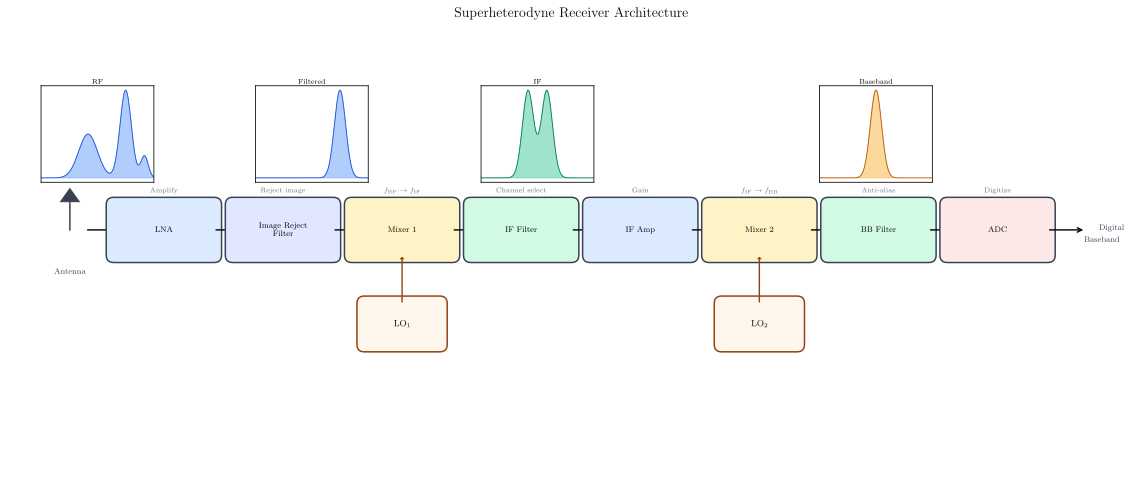
Definition: Superheterodyne and Direct-Conversion Architectures
Superheterodyne and Direct-Conversion Architectures
A superheterodyne receiver converts the RF signal to an intermediate frequency (IF) before down-conversion to baseband:
A second mixer brings the IF signal to baseband.
A direct-conversion (zero-IF) receiver converts directly to baseband in a single step using I and Q branches:
Direct conversion eliminates the IF stage and image-reject filter, enabling highly integrated single-chip designs used in modern cellular handsets.
The superheterodyne architecture dominated for decades due to its excellent selectivity (the IF filter rejects image frequencies). Direct conversion became practical only with advances in CMOS integration that allow on-chip calibration of DC offset and I/Q imbalance — impairments that are inherent to zero-IF designs.
Definition: I/Q Imbalance Model
I/Q Imbalance Model
In a direct-conversion receiver, mismatches between the I and Q branches create I/Q imbalance. Let denote the amplitude imbalance and the phase imbalance. The received baseband signal becomes:
where the imbalance coefficients are:
The image rejection ratio (IRR) quantifies the severity:
for small and . Typical requirements are IRR -- dB.
In OFDM systems, I/Q imbalance creates interference between subcarrier and its mirror subcarrier . This "mirror-subcarrier interference" can be compensated digitally if the imbalance parameters are estimated, typically using pilot-based calibration during receiver start-up.
Theorem: EVM Degradation from I/Q Imbalance
For a direct-conversion receiver with amplitude imbalance and phase imbalance (both small), the error vector magnitude (EVM) due to I/Q imbalance satisfies:
For an OFDM system with subcarriers, the effective signal-to-interference ratio on each subcarrier due to I/Q imbalance alone is:
I/Q imbalance creates a "ghost" image of the signal at the mirror frequency. The power of this ghost relative to the desired signal is . For 256-QAM (requiring EVM dB), we need dB, corresponding to (6%) and simultaneously.
Baseband signal decomposition
The received signal has desired component and interference . The interference power is .
EVM computation
$
Small-imbalance approximation
For small :
Hence .
Example: I/Q Imbalance Requirements for 256-QAM
A 5G NR receiver must support 256-QAM, which requires EVM dB.
(a) Convert the EVM requirement to a maximum in linear scale. (b) If the amplitude imbalance is (3%), find the maximum tolerable phase imbalance . (c) What is the resulting image rejection ratio in dB?
EVM conversion
(a) dB means .
Phase imbalance bound
(b) From :
Image rejection ratio
(c) dB.
This is a stringent requirement that necessitates careful on-chip I/Q calibration.
Quick Check
What is the primary advantage of a direct-conversion (zero-IF) receiver over a superheterodyne receiver?
It completely eliminates I/Q imbalance
It removes the need for an IF stage and image-reject filter, enabling higher integration
It provides better selectivity against adjacent-channel interference
It achieves higher output power than superheterodyne transmitters
By converting directly to baseband, the zero-IF architecture eliminates the IF filter (which is bulky and hard to integrate) and the image-reject filter. This enables single-chip CMOS implementations used in modern handsets.
Historical Note: From Superheterodyne to Zero-IF
1918--2000sEdwin Armstrong invented the superheterodyne receiver in 1918 during World War I, and it dominated radio design for nearly a century. Direct-conversion receivers were first proposed by Colebrook in 1924 but were impractical due to DC offset and I/Q imbalance. The revolution came with deep-submicron CMOS technology in the late 1990s, which enabled on-chip calibration algorithms to digitally correct these analogue impairments. Today, virtually every smartphone uses a direct-conversion architecture, enabled by Abidi and Razavi's pioneering work on CMOS RF design at UCLA.
Common Mistake: DC Offset in Direct-Conversion Receivers
Mistake:
Ignoring DC offset in a direct-conversion receiver design, assuming it is small enough not to matter.
Correction:
In zero-IF receivers, LO-to-RF leakage and LO self-mixing create a large DC component at baseband that can saturate the ADC or bias the AGC. DC offset can be 10--30 dB above the desired signal. Mitigation requires either AC coupling (which distorts low-frequency subcarriers in OFDM) or active DC cancellation circuits with adaptive tracking. Always include a DC removal algorithm in the baseband processing chain.
Key Takeaway
The direct-conversion architecture dominates modern wireless due to its high integration, but it demands digital calibration of I/Q imbalance ( dB for 256-QAM) and DC offset. The EVM budget must be allocated across all impairments — I/Q imbalance, phase noise, quantisation, and PA nonlinearity.
Direct-Conversion Receiver
A receiver architecture that converts the RF signal directly to baseband (zero IF) using I and Q mixers driven by a local oscillator at the carrier frequency. Eliminates the IF stage but introduces DC offset and I/Q imbalance as key impairments requiring digital calibration.
Related: I/Q Imbalance, Image Rejection Ratio (IRR)
I/Q Imbalance
Mismatch between the in-phase (I) and quadrature (Q) signal paths in a transceiver, characterised by amplitude imbalance and phase imbalance . Creates mirror-frequency interference with power ratio relative to the desired signal.
Related: Direct-Conversion Receiver, Image Rejection Ratio (IRR)
Image Rejection Ratio (IRR)
The ratio of desired signal power to image signal power caused by I/Q imbalance: . For small imbalances, . Modern receivers require IRR -- dB depending on modulation order.
Related: I/Q Imbalance, Direct-Conversion Receiver