Amplifiers and Nonlinearity
The Power Amplifier Bottleneck
The power amplifier (PA) is the single most power-hungry component in a wireless transmitter, often consuming 50--80% of the total power budget. An ideal PA would be perfectly linear with 100% efficiency. In reality, high efficiency requires operating the PA near saturation, where the input-output characteristic becomes strongly nonlinear. For signals with high peak-to-average power ratio (PAPR) — such as OFDM — this creates a fundamental tension: backing off the PA to maintain linearity wastes power, while operating near saturation distorts the signal. Modelling and mitigating PA nonlinearity is therefore one of the most critical challenges in modern transmitter design.
Power Amplifier Characteristics
Definition: Rapp Model for Power Amplifier Nonlinearity
Rapp Model for Power Amplifier Nonlinearity
The Rapp model is a memoryless AM/AM model for solid-state power amplifiers. For an input signal with envelope , the output envelope is:
where is the small-signal gain, is the output saturation amplitude, and is the smoothness parameter that controls the sharpness of the transition to saturation. Key properties:
- : soft limiter (gradual compression)
- : ideal hard limiter (no compression below , perfect clipping above)
- Typical solid-state PAs:
The Rapp model has no AM/PM conversion (phase is unchanged), making it appropriate for Class-A and Class-AB amplifiers.
For amplifiers with significant AM/PM distortion (e.g., travelling-wave tube amplifiers in satellite communications), the Saleh model is more appropriate, which includes a phase-shift characteristic .
Definition: 1 dB Compression Point and IP3
1 dB Compression Point and IP3
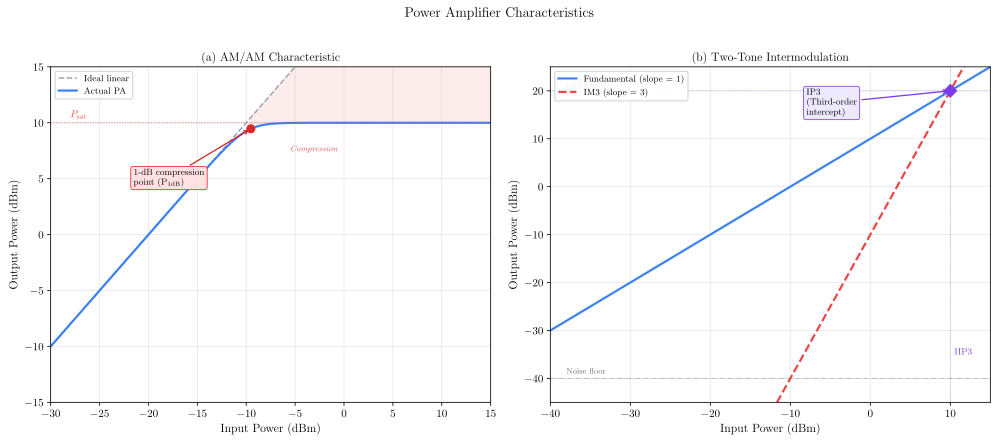
The 1 dB compression point is the input power at which the gain drops by 1 dB from its small-signal value:
The third-order intercept point (IP3) is the (extrapolated) input power at which the third-order intermodulation product equals the fundamental output. For a memoryless polynomial model , the input IP3 is:
The relationship between and IIP3 is approximately:
The input back-off (IBO) is defined as:
For OFDM signals with PAPR of 8--12 dB, the required IBO to avoid significant distortion is typically comparable to the PAPR, leading to large efficiency losses. This motivates PAPR reduction techniques (clipping, tone reservation, selected mapping) studied in Chapter 14.
Theorem: EVM--Back-off Trade-off
For an OFDM signal with PAPR (linear) passed through a Rapp-model PA with smoothness and operating at input back-off (linear), the EVM is approximately:
In the high-back-off regime (), EVM decreases exponentially with IBO, while the PA efficiency degrades linearly:
The optimal operating point minimises the total distortion plus efficiency cost: excessive back-off wastes power; insufficient back-off distorts the signal beyond EVM requirements.
The PA compresses signal peaks that exceed the saturation level. With back-off , signal peaks reach times the saturation amplitude. If (sufficient back-off), distortion is small. The Rapp smoothness controls how abruptly compression begins: larger means a sharper cliff, so distortion drops more quickly with back-off.
Distortion power analysis
Model the OFDM signal as approximately Gaussian with peak envelope . With , the saturation amplitude is .
The fraction of signal power above saturation (clipping probability) for a Rayleigh envelope is:
EVM from clipping distortion
The Rapp model softens the clipping. The effective distortion power for smoothness is:
where is the Rayleigh PDF of the envelope. Evaluating this integral via saddle-point approximation yields:
Efficiency penalty
The PA efficiency for a Class-B amplifier is . With back-off, , giving . For Class-A: .
PA Nonlinearity — Rapp Model
Visualise the AM/AM characteristic of the Rapp power amplifier model and the effect on an OFDM constellation. Adjust the smoothness parameter to see how the compression characteristic sharpens, and vary the input back-off to observe constellation distortion. The plot shows the input-output envelope curve alongside the resulting 16-QAM constellation after PA distortion.
Parameters
EVM versus Input Back-off
Explore the trade-off between EVM and input back-off for different Rapp smoothness parameters and signal PAPR values. The plot shows EVM (dB) as a function of IBO (dB), with horizontal lines marking the EVM requirements for QPSK, 16-QAM, 64-QAM, and 256-QAM. Observe how higher PAPR shifts the curves right, requiring more back-off to meet a given EVM target.
Parameters
PA Compression Sweep Animation
Watch a 16-QAM constellation progressively distort as the input back-off decreases from 15 dB (nearly linear) to 2 dB (heavily compressed). The animation sweeps the IBO parameter, showing the constellation warping in real time alongside the AM/AM curve.
Parameters
Power Amplifier Compression and Constellation Distortion
Digital Pre-Distortion (DPD) via Memory Polynomial
Complexity: Training: for basis construction, for least-squares. Run-time: per sample. Typical values: , , giving 12 complex coefficients.DPD is the standard technique in base station transmitters. By learning the inverse of the PA characteristic, DPD allows the PA to operate 2--4 dB closer to saturation without violating EVM or spectral mask requirements, significantly improving energy efficiency.
Example: Required Back-off for 64-QAM OFDM
An OFDM transmitter uses a Rapp-model PA with and must meet an EVM requirement of dB for 64-QAM. The OFDM signal has PAPR = 10 dB.
(a) Convert the EVM requirement to linear scale. (b) Using the approximation , find the minimum IBO in dB. (c) If %, what is the PA efficiency at this operating point? (d) How much efficiency is gained if DPD reduces the effective required IBO by 3 dB?
EVM conversion
(a) .
Back-off calculation
(b) With , (PAPR = 10 dB):
Solving numerically: (9.3 dB).
The required IBO is approximately 9.3 dB — close to the PAPR, as expected.
PA efficiency
(c) %.
The PA wastes over 94% of its DC power as heat.
DPD efficiency improvement
(d) With DPD, effective IBO = dB, .
%.
DPD nearly doubles the PA efficiency.
Quick Check
An OFDM signal with PAPR = 12 dB is transmitted through a PA operating at IBO = 6 dB. What happens to the signal?
The signal is transmitted without distortion since the PA has sufficient back-off
Signal peaks exceeding saturation are clipped, causing in-band distortion and spectral regrowth
Only the average signal power is affected; peak behaviour is unchanged
The PA automatically reduces its gain to avoid distortion
When PAPR exceeds IBO, peaks that surpass the saturation level are compressed/clipped. This creates two effects: in-band EVM degradation and out-of-band spectral regrowth that can violate adjacent channel leakage ratio (ACLR) requirements.
PA Efficiency in 5G Base Stations
The power amplifier consumes 50--80% of a base station's power budget. Key figures for 5G NR deployments:
- Class-B PA theoretical peak efficiency: %. Practical values: 40--50% at saturation, 5--15% with OFDM back-off.
- Doherty PA architecture: Combines a main PA and a peaking PA to maintain efficiency over a wider power range. Achieves 25--35% average efficiency for OFDM signals — the standard architecture for macro base stations.
- DPD performance: A memory polynomial DPD with , typically achieves ACLR dBc and allows 2--4 dB reduction in IBO, improving efficiency by 50--100%.
- GaN vs. LDMOS: GaN HEMTs offer 2 the power density of silicon LDMOS and are becoming standard for mmWave PAs (28/39 GHz).
- 5G NR EVM requirements: QPSK: dB, 16-QAM: dB, 64-QAM: dB, 256-QAM: dB (TS 38.104 §6.5.2).
- •
Doherty PA: 25-35% average efficiency for OFDM; standard in macro base stations
- •
5G NR EVM: -15 dB (QPSK) to -30 dB (256-QAM) per TS 38.104 §6.5.2
- •
DPD allows 2-4 dB IBO reduction, improving efficiency by 50-100%
Common Mistake: Confusing PAPR with Required Back-off
Mistake:
Setting the input back-off equal to the PAPR of the OFDM signal, assuming this guarantees zero distortion.
Correction:
PAPR measures the worst-case peak-to-average ratio, but the actual back-off requirement depends on the EVM target, the PA model (smoothness ), and whether DPD is used. With a Rapp PA () and no DPD, the required IBO is typically 0.5--2 dB less than the PAPR for moderate EVM targets ( dB). With DPD, the required IBO can be reduced by another 2--4 dB. Always compute the EVM from the actual PA model rather than using PAPR as a proxy.
Historical Note: The Rise of Digital Pre-Distortion
2000s--presentPre-distortion concepts date to the 1930s (Black's feedforward amplifier at Bell Labs), but digital pre-distortion became practical only with the advent of high-speed DACs and DSP in the 2000s. The memory polynomial model of Morgan et al. (2006) established a standard framework balancing accuracy and complexity. Today, DPD is a multi-billion dollar industry segment — every 4G/5G macro base station includes a DPD engine, typically implemented in an FPGA or dedicated ASIC consuming 1--2 W of power to save 10--50 W at the PA.
Rapp Model
A memoryless AM/AM model for solid-state power amplifiers with output . The smoothness parameter controls the compression sharpness: gives soft limiting, gives hard clipping.
Digital Pre-Distortion (DPD)
A linearisation technique that applies the inverse of the PA nonlinear characteristic to the digital baseband signal before D/A conversion and amplification. DPD allows the PA to operate 2--4 dB closer to saturation, improving energy efficiency while maintaining EVM and ACLR compliance.
Related: Rapp Model, Input Back-off (IBO)
Input Back-off (IBO)
The ratio of PA saturation power to average input signal power, expressed in dB: . Larger IBO improves linearity at the cost of reduced PA efficiency.
Related: Rapp Model, Digital Pre-Distortion (DPD)