mMTC: Massive Machine-Type Communication
Connecting Billions of Devices
Massive Machine-Type Communication (mMTC) addresses a fundamentally different traffic pattern than eMBB or URLLC. The defining characteristics are:
- Massive number of devices: -- devices per cell, each transmitting infrequently.
- Sporadic activity: in any given slot, only a small fraction of devices are active, so .
- Small payloads: typically 20--200 bytes per transmission (sensor readings, status updates).
- Relaxed latency: delays of seconds to minutes are acceptable.
- Energy constraints: devices are battery-powered and must minimise transmission energy.
The classical grant-based access (4G LTE) requires a four-step handshake (scheduling request, grant, data, ACK) that is prohibitively expensive for mMTC: the signalling overhead exceeds the payload, and the random access preamble space limits the number of simultaneously active devices.
This section develops the grant-free access paradigm and the compressed sensing framework for joint activity detection and data recovery.
Definition: Grant-Free Random Access
Grant-Free Random Access
In grant-free (also called schedule-free or configured-grant) access, each device is pre-assigned a pilot sequence (preamble) and transmits without waiting for an explicit scheduling grant from the base station. The protocol operates in two phases:
- Pilot phase: active device transmits its assigned pilot sequence over resource elements.
- Data phase: active device transmits its data payload using the remaining resources.
The base station must jointly: (a) detect which devices are active (activity detection), and (b) decode the data from active devices (data recovery).
The key advantage is the elimination of the grant handshake, reducing latency and signalling overhead.
Grant-Free vs Grant-Based Access
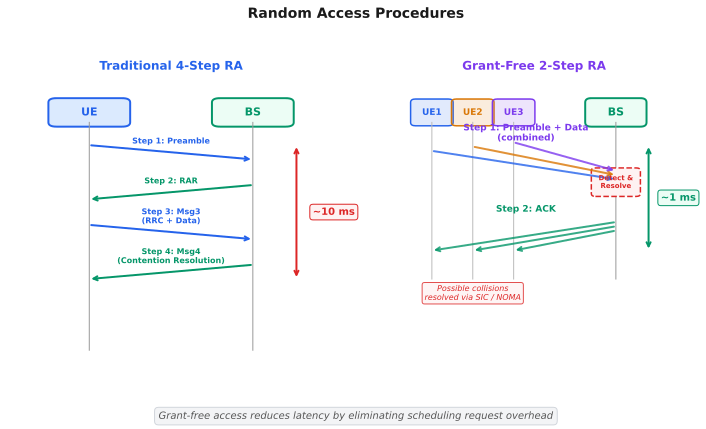
Definition: Compressed Sensing Activity Detection Model
Compressed Sensing Activity Detection Model
Consider devices, each assigned a unique pilot sequence . The received pilot signal at the base station (with antennas) is
where:
- is the pilot matrix,
- , with if device is active () and otherwise,
- is AWGN noise.
Since only devices are active, is row-sparse (has only nonzero rows). Activity detection reduces to recovering the support of from the compressed measurement .
This is a multiple measurement vector (MMV) compressed sensing problem when . The receive antennas provide independent observations of the same sparsity pattern, improving detection performance.
Theorem: Pilot Length Scaling Law for Activity Detection
Approximate Message Passing (AMP) for Activity Detection
CS-Based Activity Detection Performance
Visualise the detection probability and false alarm rate as a function of SNR for compressed sensing activity detection. Adjust the total number of devices, the active fraction, and the pilot length to observe the fundamental trade-offs. The plot shows that (i) longer pilots improve detection, (ii) smaller active fractions are easier to detect, and (iii) there is a sharp phase transition in SNR below which detection fails.
Parameters
From ALOHA to Modern Random Access
The classical ALOHA protocol and its slotted variant achieve a maximum throughput of and packets per slot, respectively. Modern mMTC demands much higher throughput from grant-free access. Key advances include:
-
Irregular Repetition Slotted ALOHA (IRSA): each user transmits multiple replicas in randomly chosen slots. Pointers between replicas enable successive interference cancellation (SIC), analogous to iterative decoding of LDPC codes on a bipartite graph. Throughput exceeds 0.8 packets/slot.
-
Coded Slotted ALOHA (CSA): generalises IRSA by replacing repetition with local coding across slots, approaching the theoretical limit of 1 packet/slot.
-
Non-Orthogonal Multiple Access (NOMA): allows multiple users to share the same resource element with different power levels or spreading codes, resolved via SIC at the receiver.
The connection to codes on graphs provides a rigorous framework for optimising the replica distribution via density evolution.
Definition: Unsourced Random Access
Unsourced Random Access
In the unsourced random access (URA) model introduced by Polyanskiy (2017), all active users share a common codebook , where is the message size in bits. The receiver outputs a list of decoded messages (without user identities). The per-user probability of error (PUPE) is
This formulation is appropriate for mMTC because:
- Device identity is typically embedded in the message (MAC address), not in the codebook.
- A common codebook eliminates the need for per-device pilot assignment, avoiding the pilot exhaustion problem.
- The performance metric is symmetric across users.
The random coding achievability bound shows that PUPE is achievable with energy-per-bit
where the second term captures the multi-user penalty.
Unsourced Random Access: PUPE vs
Compare the per-user probability of error (PUPE) for unsourced random access as a function of . Adjust the number of active users , the blocklength , and the message size . The plot shows both the achievability bound and the performance of practical coded compressed sensing schemes. Observe that the gap to the bound increases with and decreases with .
Parameters
Quick Check
An mMTC cell has devices with activity probability (so expected active devices). According to the compressed sensing scaling law, the pilot length must scale as . What is the approximate minimum pilot length?
(one pilot per device)
and , so . In practice, a constant factor -- is needed for robust RIP, so -- pilot symbols may be required. With receive antennas, this can be reduced by up to a factor of .
Example: Pilot Design for mMTC Activity Detection
A massive MIMO base station with antennas serves mMTC devices with activity probability . The coherence interval is symbols (time-frequency resource elements within which the channel is approximately constant).
(a) Determine the minimum pilot length based on the compressed sensing scaling law. (b) How many resource elements remain for data after pilot transmission? (c) If each active device transmits bits, what minimum spectral efficiency (bits per resource element) is needed for the data phase?
Expected active devices
$
Minimum pilot length
The scaling law gives
With a practical constant factor , we need pilot symbols. However, the receive antennas provide an effective measurement dimension of . Using a conservative gain factor of (due to noise averaging), we can reduce to approximately . Taking as a practical value.
Remaining data resources
$
Required spectral efficiency
Each active device uses 140 REs for data. To transmit bits:
This is a modest spectral efficiency, achievable with QPSK and rate- coding ( bits/RE), confirming feasibility.
Coded Compressed Sensing for Unsourced Random Access
Fengler, Haghighatshoar, Jung, and Caire developed a practical coded compressed sensing (CCS) scheme for unsourced random access that approaches the Polyanskiy (2017) random coding achievability bound within a few dB.
Key innovations:
-
Divide-and-conquer coding: Each -bit message is split into sub-messages. Each sub-message selects a column from a separate compressed sensing sub-codebook. The concatenation creates an effective codebook of size without storing or searching codewords.
-
Massive MIMO receiver: With base station antennas, the activity detection problem becomes an MMV (multiple measurement vector) compressed sensing problem. The antennas provide an -fold increase in effective measurements, dramatically improving detection reliability.
-
Non-Bayesian approach: Unlike AMP-based methods that assume a specific prior on the activity pattern, the CCS scheme uses non-Bayesian (covariance-based) detection that is robust to model mismatch and does not require knowledge of the number of active users.
Performance: For active users transmitting bits over channel uses with antennas, the scheme achieves per-user error probability at dB, within 3 dB of the Polyanskiy bound.
mMTC Device Constraints and Battery Life
mMTC devices (NB-IoT, LTE-M, and 5G NR RedCap) operate under severe hardware and energy constraints that shape the system design:
Device density:
- 3GPP mMTC target: up to devices per km.
- Typical activity factor: 0.1%--1% per coherence interval, so --.
- This sparsity is what enables compressed sensing approaches.
Battery life:
- Target: 10+ years on a single AA battery ( mAh).
- At 3.6 V, total energy budget Wh kJ.
- If the device transmits 100-byte packets once per hour with dBm ( mW) and Tx duration ms, the energy per transmission is J.
- With transmissions/year over 10 years: total Tx energy J — negligible compared to the battery.
- The battery bottleneck is the control plane: RACH, authentication, and DRX wake-up consume more energy than data transmission. Grant-free access eliminates the control-plane overhead.
Receiver sensitivity:
- NB-IoT achieves dBm MCL (maximum coupling loss) using 128 repetitions — enabling coverage in deep indoor/basement scenarios.
- The repetition coding trades throughput for coverage and is equivalent to increasing (blocklength) at fixed rate.
- •
Target: 10^6 devices/km^2 with 10+ year battery life
- •
Activity factor: 0.1-1% per coherence interval
- •
NB-IoT MCL: -164 dBm with 128 repetitions
- •
Grant-free access eliminates control-plane energy overhead
Historical Note: From ALOHA to Coded Random Access: 50 Years of Evolution
1970--2021The history of random access begins with Norman Abramson's ALOHA protocol (1970) at the University of Hawaii, which demonstrated that uncoordinated transmission could work at the cost of collisions. Pure ALOHA achieves throughput ; slotted ALOHA (Roberts, 1975) doubles this to .
For decades, these limits seemed fundamental. The breakthrough came with Contention Resolution Diversity Slotted ALOHA (CRDSA) (Casini et al., 2007) and its generalisation Irregular Repetition Slotted ALOHA (IRSA) (Liva, 2011), which applied the successive interference cancellation idea from turbo/LDPC decoding to random access. By transmitting replicas across multiple slots and iteratively cancelling decoded packets, IRSA achieves throughput approaching 1 packet/slot — a improvement over slotted ALOHA.
The paradigm shifted again with Polyanskiy's unsourced random access model (2017), which abandoned user identity entirely and asked: what is the minimum energy per bit needed for users to each deliver bits to a common receiver? Fengler, Jung, and Caire (2021) showed that coded compressed sensing schemes closely approach this fundamental limit.
Common Mistake: Dimensioning mMTC for Simultaneous Activation of All Devices
Mistake:
"Our cell has IoT devices. We need pilot resources for all 50,000 to avoid collisions."
Correction:
The activity factor in mMTC is extremely small: typically only -- devices are active in any given coherence interval (activity factor --). The pilot dimension must scale with , not .
The compressed sensing framework exploits this sparsity: with pilot symbols, all active devices can be detected. For and :
This is far more efficient than orthogonal pilot allocation, which would require pilot symbols — an impossibly large overhead.
Grant-Free Random Access
A multiple access protocol where devices transmit data without first requesting and receiving a scheduling grant from the base station. Reduces latency by eliminating the 4-step RACH handshake and enables massive connectivity by removing the grant bottleneck.
Related: Grant-Free Random Access, Compressed Sensing Activity Detection Model
Unsourced Random Access
A random access model (Polyanskiy, 2017) where all active users share a common codebook and the receiver outputs an unordered list of decoded messages without user identities. The performance metric is the per-user probability of error (PUPE).
Related: Unsourced Random Access, Coded Compressed Sensing for Unsourced Random Access
Random Access Protocols for Massive IoT
| Property | Slotted ALOHA | IRSA (Liva 2011) | Grant-Free CS | Unsourced RA (CCS) |
|---|---|---|---|---|
| Max throughput | packets/slot | packets/slot | Limited by pilot length | Approaches Polyanskiy bound |
| Collision handling | Discard and retransmit | SIC (iterative cancellation) | CS-based joint detection | Coded CS decoding |
| User identity | Required (packet header) | Required | Required (pre-assigned pilot) | Not required (anonymous) |
| Pilot overhead | None (data only) | None | Embedded in codebook | |
| Scalability | Poor ( problematic) | Good (up to ) | Good (CS scales with sparsity) | Excellent (designed for massive ) |
| Standards | LTE RACH, WiFi | DVB-S2/RCS2 | 5G NR grant-free (Type A) | Research stage |