Age of Information and Freshness Metrics
Freshness vs Throughput: A New Perspective
Traditional network design optimises throughput, delay, or reliability. However, many emerging applications --- autonomous vehicles receiving sensor updates, industrial control loops, real-time monitoring --- care not about how much data is delivered or how fast a given packet arrives, but about how fresh the information at the receiver is.
Consider a sensor that monitors a time-varying process and sends updates to a remote monitor. If updates are too infrequent, the monitor's knowledge becomes stale. If updates are too frequent, the queue builds up, and packets experience long delays, again leading to stale information at the monitor.
The Age of Information (AoI) metric, introduced by Kaul, Yates, and Gruteser (2012), captures this freshness concept with a single scalar that combines generation time, queueing delay, service time, and update frequency.
Definition: Age of Information (AoI)
Age of Information (AoI)
Consider a source that generates status updates at times and a monitor that receives them at times (where due to queueing, transmission, and propagation delays).
The Age of Information at the monitor at time is
where is the generation timestamp of the most recently received update.
Key properties of AoI:
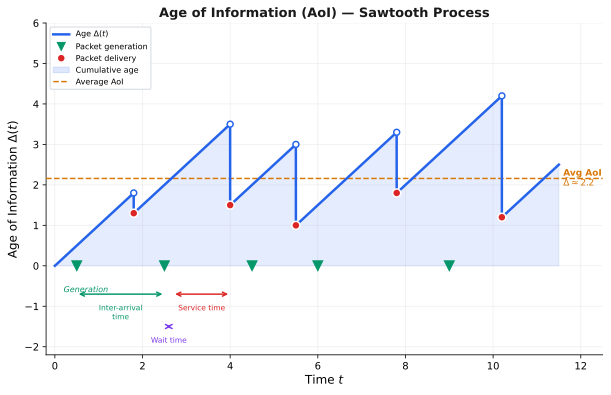
- increases linearly with slope 1 between update receptions (the information gets older).
- drops to the system time of the -th update upon its reception.
- The resulting sample path is a sawtooth pattern.
AoI differs fundamentally from packet delay: delay measures how long a specific packet takes to arrive, while AoI measures how outdated the receiver's information is. A system can have low delay but high AoI (if updates are infrequent), or moderate delay but low AoI (if updates are frequent enough to offset delays).
AoI Sawtooth: Watching Information Age in Real Time
The U-Shaped AoI Curve: Why More Updates Can Hurt
AoI Sawtooth Process
Definition: Time-Average Age of Information
Time-Average Age of Information
The time-average AoI over an observation interval is
Geometrically, is the area under the sawtooth curve per unit time. If updates are delivered in , and the -th inter-delivery time is with system time , then
where and are generic inter-delivery time and system time random variables (assuming stationarity and ergodicity).
The decomposition shows that has two components: (i) a term driven by the variability of inter-delivery times (), and (ii) a term driven by the correlation between inter-delivery time and system time.
Theorem: Average AoI for the M/M/1 Queue
Theorem: Optimal Update Rate for M/M/1 AoI
Example: Optimising Sensor Update Rate
A temperature sensor sends updates to a cloud monitor through a wireless link modelled as an M/M/1 queue with service rate packets/s.
(a) Compute the average AoI for update rates packets/s. (b) Find the optimal update rate and the minimum average AoI. (c) Compare the optimal AoI to the AoI at (high utilisation).
AoI formula
Using with :
| (s) | ||||
|---|---|---|---|---|
| 1 | 0.1 | 1.000 | 0.111 | 1.111 |
| 3 | 0.3 | 0.333 | 0.143 | 0.476 |
| 5 | 0.5 | 0.200 | 0.200 | 0.400 |
| 8 | 0.8 | 0.125 | 0.500 | 0.625 |
| 9.5 | 0.95 | 0.105 | 2.000 | 2.105 |
The AoI first decreases (as updates become more frequent) then increases (as queueing delays dominate).
Optimal rate
The optimum occurs at , giving
Note this is slightly above the value due to rounding; the true minimum is s.
Comparison with high utilisation
At (): s, which is more than 5 times the optimal AoI. This vividly demonstrates that maximising throughput (high ) is counterproductive for freshness.
Theorem: Average AoI for M/D/1 and D/M/1 Queues
Average AoI Comparison: M/M/1, M/D/1, D/M/1
Compare the average Age of Information for three queueing models (M/M/1, M/D/1, D/M/1) as a function of the arrival rate . Observe that (i) all three curves have a U-shape with a minimum at moderate utilisation, (ii) the M/D/1 queue consistently achieves lower AoI than M/M/1 due to reduced service variability, and (iii) the optimal arrival rate increases with the service rate.
Parameters
AoI Sawtooth Animation
Animated visualisation of the AoI sample path for an M/M/1 queue. Watch the age increase linearly between packet deliveries and drop upon each successful reception. Adjust the arrival rate and service rate to see how the sawtooth pattern changes. At low , the peaks are tall (infrequent updates); at high , the drops are delayed (queueing).
Parameters
Definition: Peak Age of Information (PAoI)
Peak Age of Information (PAoI)
The Peak Age of Information is the maximum age reached just before each update delivery:
where is the inter-delivery time and is the system time of the -th delivered update. The average PAoI is
For the M/M/1 queue:
In general, PAoI average AoI, with equality holding for the M/M/1 queue due to the memoryless property.
PAoI is useful for worst-case freshness guarantees. Control systems that require the information to never be older than a threshold need for all , which is a PAoI constraint.
Quick Check
A sensor sends updates to a monitor via an M/M/1 queue with packets/s. At packets/s (), the average packet delay is s, while the average AoI is s. If we reduce the update rate to (), the average delay drops to s. What happens to the average AoI?
AoI decreases to approximately 0.4 s, less than half the value at
AoI increases because fewer updates means staler information
AoI stays approximately the same because the delay reduction is offset by fewer updates
AoI drops to 0.2 s, equal to the average delay
s. By reducing from 9 to 5, the AoI drops from 1.111 s to 0.4 s --- a factor of 2.8 improvement. The reduced queueing delay more than compensates for the slightly less frequent updates. This illustrates the key AoI insight: moderate update rates often outperform aggressive ones.
Beyond Basic AoI: Emerging Freshness Metrics
The basic AoI metric has inspired several extensions that capture richer notions of information freshness:
-
Value of Information (VoI): weights the age by a non-increasing function that reflects the application's sensitivity to staleness. For example, models exponential decay of information value.
-
Age of Incorrect Information (AoII): penalises only the duration during which the monitor's estimate differs from the true source state. AoII is zero when the estimate is correct, even if the latest update is old.
-
Query Age of Information (QAoI): measures the age only at the instants when the monitor actively queries the information, rather than continuously.
-
Age of Synchronisation (AoSync): applicable to distributed systems where multiple nodes must maintain a consistent view of shared state.
These metrics are driving new research in semantic communication, where the goal is to transmit meaning rather than bits, and the value of a transmission depends on its content, timeliness, and relevance to the receiver's task.
Common Mistake: Confusing Age of Information with Queueing Delay
Mistake:
"Minimising queueing delay (mean sojourn time ) also minimises Age of Information, since lower delay means fresher updates."
Correction:
AoI and delay are fundamentally different metrics that are minimised at different operating points.
- Delay is minimised by maximising throughput (high server utilisation ). For M/M/1: , which decreases as .
- AoI is minimised at moderate utilisation . At high , updates sit in the queue and become stale before delivery.
The intuition: sending updates too frequently causes congestion, and the delivered updates are no longer fresh despite low generation-to-delivery delay for each individual packet. AoI captures the system-level freshness, not the per-packet delay.
In wireless systems: A sensor transmitting at maximum rate may saturate the uplink, causing its own updates to queue at the MAC layer. The AoI-optimal strategy is to throttle the update rate to .
Age of Information (AoI)
, where is the generation timestamp of the freshest update received by time . AoI grows linearly between updates and drops to the system delay upon delivery of a new update, creating a sawtooth pattern.
Related: Age of Information (AoI), Time-Average Age of Information
Peak Age of Information (PAoI)
The maximum value of AoI reached just before each update delivery: . PAoI captures worst-case staleness and is relevant for safety-critical applications.
Related: Peak Age of Information (PAoI), Average AoI for the M/M/1 Queue
Value of Information (VoI)
A generalisation of AoI that weights the age by a non-increasing function reflecting the application's sensitivity to staleness. VoI bridges AoI with semantic communication by incorporating task relevance.
Related: Age of Information (AoI)
Key Takeaway
Freshness is not throughput. The optimal update rate for minimising AoI is (M/M/1), far below the throughput-maximising utilisation . This U-shaped AoI curve — decreasing due to more frequent updates, then increasing due to queueing congestion — is universal across queueing models. Deterministic service (M/D/1) reduces AoI by eliminating service-time variability, and deterministic arrivals (D/M/1) further improve freshness. The key design principle: generate updates only when they will be delivered fresh.