Spectrum: From FR3 to Sub-THz
The 6G Spectrum Landscape
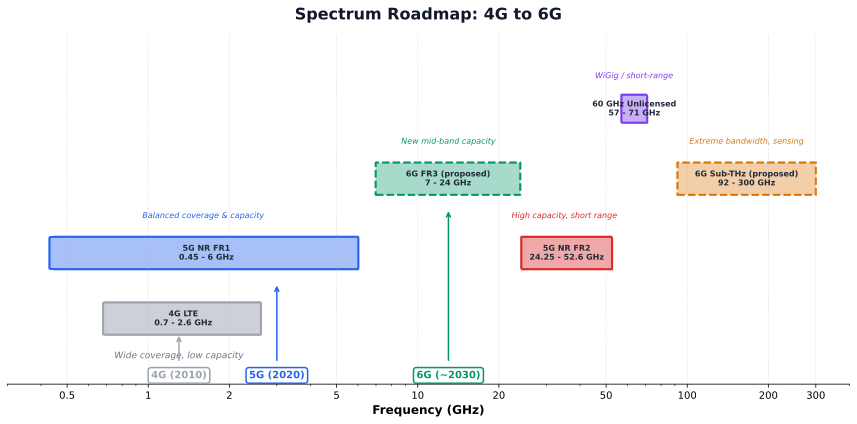
Every generation of cellular systems has been defined, in large part, by access to new spectrum. 2G through 4G operated primarily below 3 GHz; 5G NR opened FR1 (410 MHz -- 7.125 GHz) and FR2 (24.25 -- 71 GHz). The 6G vision calls for a three-tier spectrum strategy:
-
FR3 / upper mid-band (7 -- 24 GHz): the "sweet spot" that balances the coverage of sub-6 GHz with the capacity of mmWave. WRC-23 identified several FR3 bands for IMT study, including portions of 7.125 -- 8.5 GHz and 14.8 -- 15.35 GHz.
-
FR2 extension and W-band (71 -- 110 GHz): extending current mmWave allocations into the W-band, offering 10 -- 20 GHz of bandwidth with manageable atmospheric absorption.
-
Sub-THz (110 -- 300 GHz): D-band (110 -- 170 GHz) and beyond, enabling ultra-wideband short-range links with 30 -- 50 GHz of instantaneous bandwidth per carrier, at the cost of severe path loss and hardware limitations.
This section surveys the propagation, regulatory, and technology trade-offs across these tiers.
Definition: FR3 Upper Mid-Band (7 -- 24 GHz)
FR3 Upper Mid-Band (7 -- 24 GHz)
FR3 is the 3GPP designation for spectrum between 7.125 GHz and 24.25 GHz, filling the gap between FR1 and FR2. Key characteristics:
- Bandwidth: 400 MHz -- 2 GHz per carrier feasible, depending on regulatory allocation.
- Propagation: Path loss exponent -- (LOS), moderate diffraction around building edges, tolerable outdoor-to-indoor penetration (5 -- 15 dB through standard glass).
- Array size: At 10 GHz ( mm), a 64-element UPA with half-wavelength spacing fits in a cm footprint — practical for both base stations and high-end UEs.
- Coexistence: Incumbent services include fixed satellite (Ku-band), radar (X-band), and radio astronomy, requiring careful sharing frameworks and transmit power limits.
FR3 is widely regarded as the workhorse spectrum for early 6G deployments, offering a 5 -- 10 bandwidth increase over sub-6 GHz with far better coverage than mmWave.
Spectrum Roadmap from 4G to 6G
Sub-THz Transmission Windows
Atmospheric absorption creates frequency-dependent "windows" and "walls" across the sub-THz range. The dominant absorbers are O (resonance at 60 GHz and harmonics) and HO (resonances at 22, 183, and 325 GHz). The key transmission windows for 6G are:
| Window | Frequency range | Atm. loss (dB/km) | Bandwidth |
|---|---|---|---|
| W-band | 75 -- 110 GHz | 0.3 -- 0.5 | 35 GHz |
| D-band low | 130 -- 175 GHz | 0.5 -- 3 | 45 GHz |
| D-band high | 200 -- 310 GHz | 1 -- 10 | 50+ GHz |
Between the windows, the HO resonance at 183 GHz produces absorption exceeding 30 dB/km, effectively creating a "no-go" zone for terrestrial links beyond a few tens of metres. Practical sub-THz deployments will target the W-band and D-band low windows for backhaul, kiosk, and data-shower applications.
6G Spectrum Band Overview
Overlay diagram showing FR1, FR2, FR3, and sub-THz bands with their respective atmospheric absorption profiles. Toggle the 6G bands on to see the candidate allocations under study for IMT-2030.
Parameters
6G KPI Targets vs 5G
The ITU-R IMT-2030 framework (Recommendation M.2160) defines six usage scenarios for 6G and quantitative KPI targets that significantly exceed 5G IMT-2020. Key comparisons:
| KPI | 5G IMT-2020 | 6G IMT-2030 target |
|---|---|---|
| Peak data rate | 20 Gbps | 200 Gbps -- 1 Tbps |
| User experienced rate | 100 Mbps | 1 -- 10 Gbps |
| Latency (user plane) | 1 ms | 0.1 ms |
| Connection density | devices/km² | -- devices/km² |
| Reliability | ||
| Positioning accuracy | 10 m (outdoor) | 1 -- 10 cm (3D) |
| AI integration | None | Native (inference + training) |
| Sensing | None | Integrated (ISAC) |
Note the qualitative shift: 6G introduces sensing and AI as first-class KPIs, reflecting a vision of the network as a communication-computation-sensing platform rather than a pure data pipe.
5G vs 6G KPI Radar Chart
Spider (radar) chart comparing normalised 5G and 6G KPI targets across peak rate, latency, reliability, connection density, positioning, and sensing. Adjust the sensing weight to explore how the emphasis on integrated sensing shifts the overall 6G capability profile.
Parameters
Open Research Directions in 6G Spectrum
Several fundamental questions remain open as the community converges on the 6G spectrum strategy:
-
FR3 sharing and coexistence: How much transmit power can a cellular system use at 10 GHz without exceeding interference limits at co-channel satellite earth stations? Dynamic spectrum sharing (DSS) and database-driven access are under investigation.
-
Sub-THz waveform design: OFDM suffers from high PAPR and sensitivity to phase noise at sub-THz frequencies. Alternative waveforms — DFT-s-OFDM, OTFS, single-carrier with frequency-domain equalisation — are active research topics.
-
Joint communication and sensing waveforms: When the same signal must serve both data communication and radar-like sensing (ISAC, covered in Section 33.6), the waveform design space expands significantly.
-
Regulatory timeline: WRC-27 will make critical allocation decisions for FR3 and sub-THz bands. The outcome will shape 6G standardisation beginning in 3GPP Release 21 (expected 2028).
Quick Check
What is the primary advantage of FR3 (7 -- 24 GHz) over mmWave FR2 for 6G macro-cell deployments?
FR3 offers more total bandwidth than FR2
FR3 provides better coverage due to lower path loss, meaningful diffraction, and tolerable building penetration, while still offering substantial bandwidth (400 MHz -- 2 GHz)
FR3 does not require any regulatory coordination with incumbent services
FR3 enables larger antenna arrays than FR2 due to longer wavelengths
Correct. FR3 sits between sub-6 GHz (good coverage, limited bandwidth) and mmWave (abundant bandwidth, poor coverage). The moderate path loss, residual diffraction, and tolerable O2I penetration at 7 -- 24 GHz make it the leading candidate for wide-area 6G deployments where continuous coverage is essential.
Historical Note: Spectrum Evolution Across Cellular Generations
1980s -- 2030sEach cellular generation unlocked new spectrum: 1G (800 MHz analog), 2G (900/1800 MHz), 3G (2.1 GHz UMTS), 4G (700 MHz -- 2.6 GHz LTE), 5G (sub-6 GHz FR1 + 24 -- 71 GHz FR2). The 6G vision targets the largest single-generation spectrum expansion in history: FR3 (7 -- 24 GHz), W-band (75 -- 110 GHz), and sub-THz (110 -- 300 GHz) could collectively add over 100 GHz of new allocations. The ITU-R IMT-2030 framework (M.2160, 2023) formally defines the 6G vision and timeline, with WRC-27 as the key regulatory milestone.
Sub-THz Hardware Limitations
Sub-THz transceiver design faces formidable hardware challenges that constrain practical system performance:
- PA output power: Current InP HEMT and SiGe BiCMOS PAs achieve only 10 -- 100 mW per element at 140 GHz, compared to 1 -- 10 W at sub-6 GHz. Large arrays (256 -- 1024 elements) are needed to compensate via beamforming gain.
- ADC/DAC speed and resolution: 100+ GHz sampling rates require interleaved ADC architectures with 4 -- 6 effective bits, limiting the dynamic range and making wideband DPD impractical.
- Phase noise: Free-running oscillators at 140 GHz exhibit dBc/Hz, necessitating PLL multiplication from lower-frequency references and wider subcarrier spacing ( kHz).
- Packaging and integration: Half-wavelength spacing at 140 GHz is 1.07 mm, requiring wafer-level integration (antenna-on-chip or antenna-in-package) rather than discrete components.
- •
PA output power: 10-100 mW/element at 140 GHz (InP HEMT, SiGe BiCMOS)
- •
ADC effective resolution: 4-6 bits at 100+ GHz sampling rate
- •
Half-wavelength spacing at 140 GHz: 1.07 mm — requires wafer-level integration
Common Mistake: Extrapolating sub-6 GHz Assumptions to Sub-THz
Mistake:
Assuming that sub-THz links behave like scaled versions of mmWave links — just with shorter range and more bandwidth.
Correction:
Sub-THz propagation is qualitatively different: atmospheric absorption creates hard distance limits (not just attenuation); foliage and rain cause orders-of-magnitude greater loss; and the channel is dominated by specular reflections with very few scattering clusters (the channel is extremely sparse and nearly LOS-only). System design must account for these qualitative differences, not merely scale existing mmWave architectures.
Key Takeaway
FR3 (7 -- 24 GHz) is the most likely workhorse spectrum for 6G wide-area coverage, offering 5 -- 10 more bandwidth than sub-6 GHz with far better propagation than mmWave. Sub-THz (100 -- 300 GHz) enables extreme bandwidth for short-range links but faces fundamental hardware and propagation challenges.
FR3 (Frequency Range 3)
3GPP designation for spectrum between 7.125 GHz and 24.25 GHz — the "upper mid-band" filling the gap between FR1 (sub-7 GHz) and FR2 (24.25 -- 71 GHz). Widely regarded as the primary 6G band for wide-area deployments.
Related: Sub-THz Communications
Sub-THz Communications
Wireless communication at frequencies between 100 GHz and 300 GHz (the "terahertz gap"). Offers tens of GHz of instantaneous bandwidth but suffers from severe path loss, atmospheric absorption, and hardware limitations.
Related: FR3 (Frequency Range 3)