Network Architecture: Open RAN, AI-Native, NTN
From Monolithic to Disaggregated, Intelligent, Multi-Layer Networks
The 5G RAN architecture, while a significant step from 4G, remains largely vendor-proprietary with tightly coupled hardware and software. The 6G network architecture vision rests on three pillars:
- Open RAN (O-RAN): Disaggregation of base station functions into interoperable, multi-vendor components connected by open interfaces.
- AI-native design: Machine learning embedded at every protocol layer — from PHY-layer channel estimation to RAN-level resource allocation — rather than retrofitted as an optimisation layer.
- Non-terrestrial networks (NTN): Integration of LEO satellites, HAPS (high-altitude platform stations), and UAV-based access nodes to achieve ubiquitous global coverage.
This section surveys each pillar and the research challenges that must be resolved before 6G standardisation.
Definition: O-RAN Architecture and Functional Split
O-RAN Architecture and Functional Split
The O-RAN Alliance architecture disaggregates the gNB into three logical entities connected by open, standardised interfaces:
-
O-RU (O-RAN Radio Unit): Handles lower PHY functions (IFFT/FFT, cyclic prefix, beamforming weight application) and RF front-end. Connected to the O-DU via the fronthaul (Open Fronthaul, split 7.2x).
-
O-DU (O-RAN Distributed Unit): Performs upper PHY (channel coding, rate matching, scrambling), MAC scheduling, and RLC functions. Connected to the O-CU via the midhaul (F1 interface).
-
O-CU (O-RAN Central Unit): Manages PDCP, SDAP, and RRC layers. Handles mobility, dual connectivity, and inter-cell coordination.
A fourth entity, the RAN Intelligent Controller (RIC), operates at two time scales:
- Near-RT RIC: Control loops at 10 ms -- 1 s granularity (e.g., beam management, interference mitigation).
- Non-RT RIC: Control loops s (e.g., policy optimisation, ML model training and deployment, network slicing).
The key innovation is that the RIC enables third-party xApps/rApps to implement RAN optimisation algorithms over standardised APIs — a radical departure from vendor-locked SON (self-organising network) solutions.
The O-RAN 7.2x fronthaul split places the IFFT in the O-RU and frequency-domain beamforming in the O-DU, striking a balance between fronthaul bandwidth (proportional to the number of spatial layers rather than antennas) and RU complexity. The fronthaul rate for a 100 MHz NR carrier with 32 layers is approximately 25 Gbps after IQ compression.
6G Network Architecture
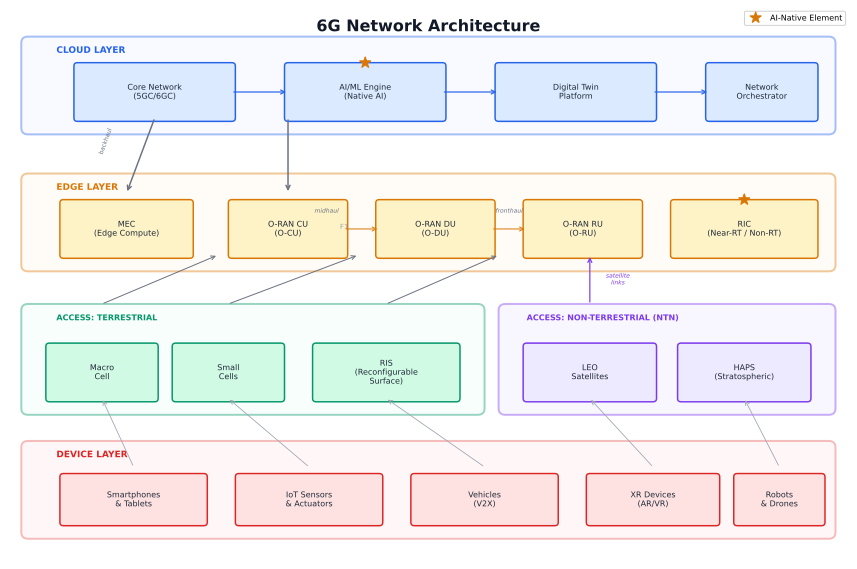
O-RAN Research Challenges
Despite the compelling vision, O-RAN faces several open challenges:
-
Fronthaul latency and jitter: The split 7.2x fronthaul must deliver IQ samples with sub-millisecond latency and tight jitter bounds. Ethernet-based transport (eCPRI) requires Precision Time Protocol (PTP) synchronisation to ns — difficult over multi-hop switched networks.
-
Performance gap: Current O-RAN deployments show 5 -- 15% throughput degradation compared to integrated (single-vendor) solutions, primarily due to suboptimal cross-layer coordination across open interfaces.
-
RIC real-time constraints: The near-RT RIC must ingest telemetry, run inference, and push control actions within 10 ms. This requires co-locating ML inference engines with the O-DU, raising questions about edge compute placement and cost.
-
Security: Open interfaces expand the attack surface. The fronthaul carries raw IQ data, and compromise of the RIC could allow adversarial control of scheduling and beamforming.
AI-Native Air Interface
In 5G, machine learning is applied as an overlay: the protocol stack is designed with model-based algorithms, and ML is used to tune parameters or replace specific blocks (e.g., CSI compression with autoencoders). The 6G vision goes further — an AI-native air interface where ML is integral to the standard from the outset.
Key research directions include:
-
Neural receivers: End-to-end learned detection that jointly handles channel estimation, equalisation, demapping, and decoding, potentially bypassing the conventional block-by-block processing chain. Early results show 1 -- 3 dB gains in highly non-linear channels (e.g., with low-resolution ADCs or strong phase noise).
-
Learned CSI feedback: At FR3/sub-THz frequencies with massive arrays, the CSI dimensionality explodes. Encoder-decoder architectures (e.g., CsiNet) can compress channel matrices to a few hundred bits while preserving 90 -- 95% of the achievable rate.
-
Foundation models for wireless: Large pretrained models (analogous to LLMs) that capture wireless channel statistics across environments, frequencies, and mobility patterns, then fine-tuned for specific deployment scenarios.
-
On-device training: Federated learning at the network edge, where UEs collaboratively train shared models without exchanging raw data — connecting to the over-the-air computation framework of Section 33.5.
Challenges for AI in the RAN
Embedding AI into the air interface standard raises fundamental questions that the research community is actively debating:
-
Standardisation of ML models: Should 3GPP standardise the model architecture (e.g., "the encoder shall be a 4-layer CNN with dimensions ..."), or only the interface (input/output dimensions, quantisation, latency constraints)?
-
Reproducibility and interoperability: If the Tx uses one vendor's neural encoder and the Rx uses another vendor's decoder, will they interoperate? This is the "neural codec" interoperability problem.
-
Robustness and worst-case guarantees: ML models trained on data from environment A may fail catastrophically in environment B (distribution shift). Safety-critical applications (V2X, URLLC) may require provable performance bounds that current ML cannot provide.
-
Computational cost: Running transformer-based neural receivers at sub-millisecond latency on a mobile chipset is beyond current hardware. Model compression, quantisation-aware training, and hardware-software co-design are active research areas.
Definition: Non-Terrestrial Networks (NTN)
Non-Terrestrial Networks (NTN)
A non-terrestrial network (NTN) extends the cellular architecture to include airborne and spaceborne access nodes:
-
LEO satellites (300 -- 1200 km altitude): One-way propagation delay 1 -- 4 ms, orbital period 90 min. Mega-constellations (Starlink, Kuiper, AST SpaceMobile) aim to provide direct-to-device (D2D) connectivity using modified NR waveforms. 3GPP Release 17 introduced NTN support in NR with timing advance compensation and Doppler pre-correction.
-
HAPS (20 km altitude): Quasi-stationary platforms in the stratosphere with 50 -- 100 km coverage radius. Propagation delay ms (comparable to terrestrial macro cells). Candidates for rural coverage and disaster recovery.
-
UAV relay nodes (100 m -- 10 km): On-demand capacity injection for events, emergencies, or temporary coverage gaps.
The NTN propagation channel differs fundamentally from terrestrial channels: Rician K-factor is very high (strong LOS), Doppler shift can exceed 45 kHz (LEO at S-band), and handovers occur every 10 -- 30 seconds due to satellite motion.
The 6G vision is to seamlessly integrate NTN with terrestrial networks so that the UE experiences a unified connectivity layer — automatically roaming between terrestrial, HAPS, and satellite access depending on availability and QoS requirements.
The key NTN link budget challenge is the free-space path loss over hundreds of kilometres. At 2 GHz and 600 km altitude, FSPL alone is approximately 160 dB. Closing this link budget with a handheld device requires satellite antenna gains exceeding 30 dBi (large phased arrays) and narrow beams (), which in turn demands precise ephemeris-based beam pointing.
NTN Integration Challenges
Integrating NTN into 6G poses unique challenges beyond the link budget:
-
Delay and Doppler: LEO round-trip delays of 4 -- 25 ms break the HARQ timing assumptions of terrestrial NR. 3GPP NTN uses disabling of HARQ feedback or extended HARQ timers, sacrificing latency for coverage. 6G aims for protocol designs that natively accommodate variable and large delays.
-
Handover storm: With LEO satellite footprints sweeping the ground at 7 km/s, a stationary UE experiences frequent handovers. Predictive handover using satellite ephemeris data (known hours in advance) is essential.
-
Inter-system interference: NTN and terrestrial systems sharing spectrum (e.g., at S-band or L-band) must manage inter-system interference through coordination zones, power control, and beamforming null placement.
-
Mega-constellation scalability: Routing traffic across thousands of interconnected LEO satellites with inter-satellite links (ISLs) requires distributed, low-latency routing algorithms — a space networking problem with no terrestrial analogue.
Example: LEO Satellite Direct-to-Device Link Budget at S-Band
A LEO satellite at altitude km operates at GHz (S-band) with a multi-beam phased array ( dBi), transmit power dBm per beam, and bandwidth MHz. The UE has an omnidirectional antenna ( dBi) and noise figure dB.
(a) Compute the free-space path loss at nadir.
(b) Compute the received SNR.
(c) What spectral efficiency and throughput can the UE achieve?
Free-space path loss
$
Noise power
$
Received SNR
\sim\sim\sim\text{SNR}_{\text{eff}} \approx 15.5$ dB.
Throughput
Shannon bound: Mbps.
With practical coding (64-QAM rate-1/2, bps/Hz): Mbps per beam.
This is sufficient for broadband messaging but far below terrestrial 5G rates — highlighting why NTN is primarily a coverage solution rather than a capacity solution.
Quick Check
In the O-RAN architecture, what is the role of the near-real-time RAN Intelligent Controller (near-RT RIC)?
It performs PHY-layer processing (FFT, channel estimation, decoding) with ML acceleration
It executes control-loop decisions (beam management, interference mitigation, scheduling policies) at 10 ms -- 1 s granularity via xApps over standardised APIs
It trains large-scale ML models offline using historical network data
It manages the inter-satellite links in non-terrestrial networks
Correct. The near-RT RIC sits between the non-RT RIC (policy, s) and the O-DU/O-CU (real-time, ms). It ingests E2 interface telemetry and pushes control actions — enabling third-party algorithms to optimise beam selection, power control, and scheduling without modifying the base station software.
Convergence of Communication, Computation, and Sensing
The three architectural pillars — disaggregation (Open RAN), intelligence (AI-native), and expanded coverage (NTN) — converge toward a 6G network that is far more than a faster data pipe. The ITU-R IMT-2030 usage scenarios reflect this convergence:
- Immersive communication: XR, holographic telepresence (peak rates Gbps, latency ms).
- Hyper-reliable low-latency: Industrial control, remote surgery ( reliability, ms latency).
- Massive communication: + devices/km² for IoT.
- Ubiquitous connectivity: Global coverage via NTN.
- Integrated AI and communication: Network-as-a-service for distributed ML training and inference.
- Integrated sensing and communication (ISAC): Using the wireless signal for environment sensing (covered in Section 33.6).
The remaining sections of this chapter dive into specific enabling technologies: near-field XL-MIMO, full-duplex, over-the-air computation, and digital twins / ISAC.
Historical Note: From 1G Analog to 6G Cloud-Native
1980s -- 2030sThe RAN architecture has undergone radical transformations across generations. 1G used fully analog base stations; 2G introduced digital signal processing; 3G WCDMA and 4G LTE progressively centralised processing but remained vendor-proprietary. 5G introduced functional splits (CU/DU) and virtualisation (vRAN). The O-RAN movement (founded 2018) aims to complete the disaggregation by standardising open interfaces, enabling multi-vendor deployments and AI-driven optimisation — a paradigm shift as significant as the move from analog to digital.
5G vs 6G Network Architecture
| Feature | 5G (Release 15-17) | 6G Vision |
|---|---|---|
| RAN architecture | CU/DU split, mostly single-vendor | O-RAN disaggregated, multi-vendor, open interfaces |
| Intelligence | ML as overlay (SON, optional) | AI-native at every layer (neural Rx, learned CSI, foundation models) |
| Coverage | Terrestrial + limited NTN (Rel-17) | Seamless terrestrial + LEO + HAPS + UAV |
| Spectrum | FR1 + FR2 | FR1 + FR2 + FR3 + sub-THz |
| Sensing | Not supported | Integrated (ISAC) |
| Compute | Edge compute (MEC) | Network-native computation (AirComp, split inference) |
Why This Matters: LEO Satellite OTFS in the OTFS Book
The high-Doppler LEO satellite channel is a natural fit for delay-Doppler domain modulation. The OTFS book (Chapters 12--14) develops OTFS-based waveform design for NTN, including Doppler pre-compensation and equalization in the delay-Doppler domain. Buzzi, Caire, and Colavolpe's work on cell-free macro-diversity for LEO NTN provides the architectural framework connecting NTN integration with massive MIMO principles.
See full treatment in Sub-THz Communications (100-300 GHz)
Cell-Free Macro-Diversity for LEO NTN
Proposed a cell-free massive MIMO architecture for LEO satellite networks where multiple visible satellites jointly serve ground users through macro-diversity combining. The framework adapts the terrestrial cell-free paradigm (Chapter 18) to the NTN setting, addressing satellite mobility, inter-satellite handover, and fronthaul via inter-satellite links (ISLs). Demonstrated significant coverage and rate improvements over single-satellite association, particularly for users at cell-edge (horizon) positions.
Open RAN (O-RAN)
An industry initiative to disaggregate base station functions into interoperable, multi-vendor components (O-RU, O-DU, O-CU) with open interfaces and a RAN Intelligent Controller (RIC) for AI-driven optimisation.
Related: RAN Intelligent Controller (RIC)
RAN Intelligent Controller (RIC)
A logical entity in the O-RAN architecture that hosts third-party optimisation algorithms (xApps/rApps). The near-RT RIC operates at 10 ms -- 1 s granularity; the non-RT RIC handles s policy decisions and ML model management.
Related: Open RAN (O-RAN)