Near-Field Communications and XL-MIMO
From Massive MIMO to Extremely Large Arrays
Massive MIMO (Chapter 18) operates in the far field, where the wavefront arriving at the array is well approximated as a plane wave. Beamforming then amounts to steering a beam in a given direction (angle). As arrays grow to hundreds or thousands of elements at FR3/sub-THz frequencies — so-called XL-MIMO or extremely large aperture arrays (ELAA) — two qualitative shifts occur:
-
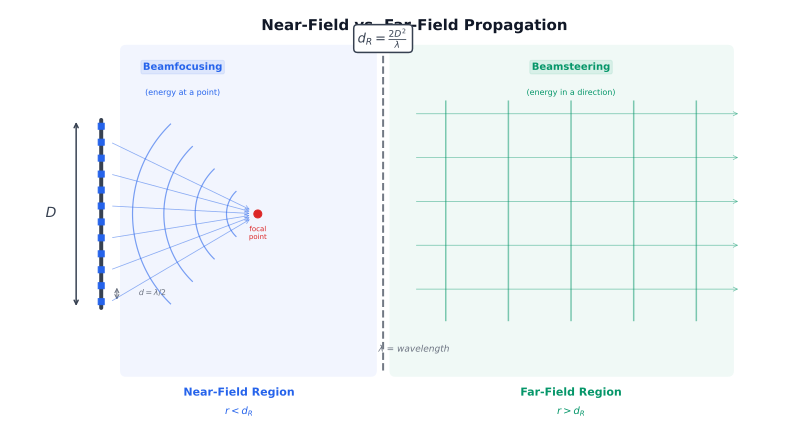
Near-field operation: The Rayleigh distance grows with the aperture squared, placing many users inside the near field where the spherical wavefront must be modelled. Beamforming becomes beamfocusing: energy is concentrated at a specific 3D point rather than just a direction .
-
Spatial non-stationarity: Different parts of the array "see" different sets of scatterers because the array aperture spans a significant fraction of the propagation environment. The familiar assumption that all array elements share the same large-scale fading breaks down.
These two phenomena fundamentally change MIMO signal processing and motivate new channel models, codebook designs, and scheduling algorithms for 6G.
Definition: Rayleigh Distance (Near-Field Boundary)
Rayleigh Distance (Near-Field Boundary)
The Rayleigh distance marks the boundary between the radiative near field (Fresnel region) and the far field (Fraunhofer region) of an antenna or array with physical aperture :
where is the wavelength. For distances , the spherical curvature of the wavefront across the array aperture introduces phase errors exceeding relative to the plane-wave approximation. In this regime:
- The channel between a point source at and the -th array element depends on both range and angle (not just angle).
- Conventional far-field array response vectors must be replaced by near-field response vectors that incorporate element-specific distances.
- Beamfocusing at a point achieves higher gain at the target location than far-field beamsteering, at the expense of a tighter focal spot and reduced gain at other ranges.
The Rayleigh distance is also called the Fraunhofer distance . For a ULA with elements and half-wavelength spacing, , giving . Doubling the number of elements quadruples .
Near-Field vs Far-Field Geometry
Example: Rayleigh Distance Scaling Across 6G Bands
Compute the Rayleigh distance for the following three array configurations, representative of 6G deployments:
(a) FR3 at 10 GHz, elements, half-wavelength spacing.
(b) mmWave at 28 GHz, elements, half-wavelength spacing.
(c) Sub-THz at 140 GHz, elements, half-wavelength spacing.
For each case, determine whether a user at m is in the near field or far field.
FR3, 10 GHz, $N = 256$
mm, mm m.
At m: deep near field (). Note the enormous aperture ( m) — this would be a large wall-mounted panel.
mmWave, 28 GHz, $N = 512$
mm, mm m.
At m: deep near field.
Sub-THz, 140 GHz, $N = 1024$
mm, mm m.
At m: deep near field.
All three configurations place a 20 m user firmly in the near field — underscoring that near-field operation is the norm, not the exception, for XL-MIMO at any 6G frequency.
Beamfocusing vs Beamsteering
In the far field, the beamforming gain at a target user is determined solely by the angular alignment. A user at the same angle but a different range receives the same beam gain. In the near field, beamfocusing concentrates energy at a specific point in 3D space:
-
The beamforming vector for focusing at is the conjugate of the near-field steering vector: where is the distance from the -th element to the focal point.
-
A user at the same angle but a different range experiences a focus gain loss that depends on , where is the depth of focus.
-
This range selectivity creates a new spatial dimension for user scheduling: two users at the same angle but different ranges can be simultaneously served with separate focused beams — impossible in far-field MIMO.
The interactive plot below compares beamfocusing and beamsteering gain as a function of user range.
Beamfocusing vs Beamsteering Gain
Compare the received power as a function of range for near-field beamfocusing (matched to a specific focal point) and far-field beamsteering (matched only to angle). The vertical dashed line marks the Rayleigh distance . Observe how beamfocusing provides higher gain at the target range but drops off more steeply away from the focus point.
Parameters
Definition: Spatial Non-Stationarity in XL-MIMO
Spatial Non-Stationarity in XL-MIMO
In conventional massive MIMO, all array elements share the same set of scattering clusters — the channel is spatially stationary across the array. In XL-MIMO, the array aperture may span several metres, and different parts of the array observe different propagation environments. This phenomenon is called spatial non-stationarity.
Formally, let be the set of scattering clusters. For each cluster , define the visibility region as the subset of array elements that can "see" cluster . The channel vector for user becomes:
where is the indicator function and is the complex gain of cluster .
Consequences for signal processing:
- MR/ZF/MMSE precoding must account for per-element visibility; a global covariance matrix is no longer Toeplitz.
- Channel estimation: pilot signals may need to be processed over sub-arrays (segments of the XL array) rather than the full array.
- User scheduling can exploit the fact that two users with non-overlapping visibility regions cause zero inter-user interference, even without precoding.
XL-MIMO Spatial Non-Stationarity
Visualise the visibility map (which array elements see which scatterers) and the resulting channel power variation across the array for a single user. Adjust the number of array elements, user position, and number of scattering clusters to observe how spatial non-stationarity becomes more pronounced with larger arrays.
Parameters
Near-Field Beamfocusing Transition
Near-Field Beamfocusing Range Sweep
Watch the beam pattern evolve as the focal range sweeps from 1 m (deep near field) through the Rayleigh distance to the far field. Observe the transition from tight 3D focusing (narrow depth of focus) to broad angular beamsteering (range-independent).
Parameters
Near-Field Beamfocusing for XL-MIMO
Open Research Directions for Near-Field XL-MIMO
Near-field XL-MIMO is one of the most active 6G research areas. Key open problems include:
-
Near-field channel estimation: The search space is 2D (range angle) rather than 1D (angle only), increasing pilot overhead. Polar-domain sparsity and parametric estimation methods are being developed to reduce this overhead.
-
Codebook design: Far-field DFT codebooks are suboptimal in the near field. Polar-domain codebooks that jointly quantise range and angle are needed for beam management.
-
Wideband near-field effects: At sub-THz bandwidths ( GHz), the beam focus point becomes frequency-dependent — a phenomenon called beam squint in range, distinct from the angular beam squint studied in Chapter 27.
-
Channel modelling: Measurement campaigns for XL-MIMO at FR3 and sub-THz frequencies are still scarce. Standardised near-field, spatially non-stationary channel models are needed for system-level evaluation.
-
Hybrid architectures for near-field: Analog beamforming with phase shifters can only approximate the element-dependent phases needed for beamfocusing. True-time-delay (TTD) elements or sub-array-based hybrid architectures are promising but add hardware complexity.
Theorem: Spatial Degrees of Freedom in the Near Field
For a continuous linear aperture of length communicating with a point source at distance in the near field (), the number of effective spatial degrees of freedom (DoF) scales as:
This is a factor of larger than the far-field DoF (which is 1 for a point source). Equivalently, the angular resolution improves with decreasing range in the near field, enabling range-domain multiplexing — serving users at the same angle but different ranges on separate spatial streams.
In the far-field limit (), (beamsteering provides only angular selectivity).
In the near field, the array "sees" the source from a wider angular extent (the subtended angle increases as range decreases). More angular extent means more resolvable directions, hence more DoF. This is why near-field XL-MIMO can support more simultaneous users than conventional massive MIMO.
Subtended angle and resolution
A source at range subtends an angle at the aperture. The angular resolution of the aperture is . The number of resolvable directions is . Including the factor-of-2 from the Nyquist spatial sampling rate: .
Theorem: Beamfocusing Gain over Beamsteering
For a ULA with elements and half-wavelength spacing, the beamfocusing gain at the focal point relative to far-field beamsteering (matched only to ) is:
For , this ratio approaches , representing a significant additional gain from range matching. The depth of focus (range resolution) is approximately:
which shrinks quadratically with range, enabling tighter focusing at closer distances.
Beamfocusing exploits the spherical wavefront curvature to concentrate energy at a specific range. The additional gain comes from constructive interference across all elements being optimised for the exact distance, not just the angle.
Phase error analysis
Far-field beamsteering applies linear phase progression . The true near-field phase includes a quadratic term . The mismatch between FF and NF phases causes a gain loss that equals when the source is at range . Computing the array factor ratio yields the stated expression.
2D Markov Prior for Visibility Region Detection in XL-MIMO
Proposed a 2D Markov random field prior for modelling the spatial non-stationarity pattern (visibility regions) in XL-MIMO channels. The key insight is that visibility regions exhibit spatial smoothness — neighbouring array elements are likely to share the same visibility state. By embedding this prior into a Bayesian channel estimation framework, the method achieves near-oracle performance in estimating both the channel coefficients and the visibility mask, with significantly reduced pilot overhead compared to per-element estimation. This work directly addresses the spatial non-stationarity challenge described in this section.
Key Takeaway
Near-field operation is the norm for XL-MIMO at 6G frequencies — a 256-element array at 10 GHz has km. Beamfocusing enables range-domain user separation impossible in far-field MIMO, but demands new channel models, codebooks, and estimation algorithms that operate in the 2D (range angle) domain.
Rayleigh Distance
The boundary between the near field and far field of an antenna array: . Users at experience spherical wavefronts; users at see approximately planar wavefronts.
Related: Beamfocusing, XL-MIMO (Extremely Large MIMO)
Beamfocusing
Near-field beamforming that concentrates energy at a specific 3D point by matching the spherical-wave phase profile across the array, rather than steering to a direction only (far-field beamsteering).
XL-MIMO (Extremely Large MIMO)
MIMO systems with apertures large enough that near-field effects, spatial non-stationarity, and per-element visibility regions become significant. Typical configurations: 256 -- 4096 elements at FR3/sub-THz frequencies.
Related: Rayleigh Distance, Beamfocusing
Quick Check
A ULA with elements and half-wavelength spacing operates at GHz ( mm). What is the approximate Rayleigh distance?
m
m
m
m
Correct. mm m. m m. Any user within 82 m of this array is in the near field — which encompasses most indoor and many outdoor urban scenarios.