Reflection, Diffraction, and Scattering
Three Ways Waves Interact with the Environment
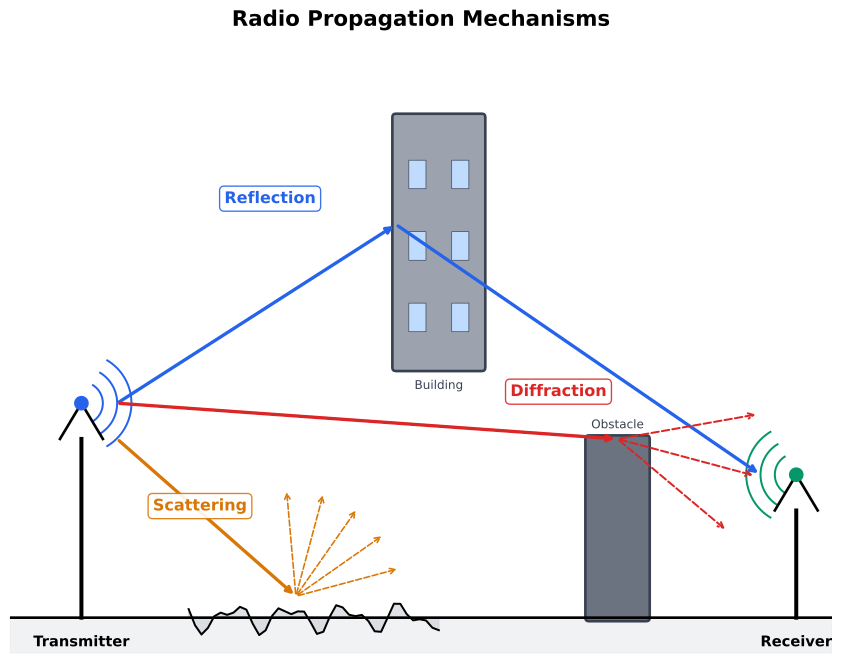
When an electromagnetic wave encounters an object, three things can happen: reflection (the wave bounces off a smooth surface), diffraction (the wave bends around an edge or obstacle), and scattering (the wave is redirected by objects smaller than or comparable to the wavelength). These mechanisms determine whether a receiver can operate without a direct line of sight — and they create the multipath that shapes the small-scale fading of Chapter 6.
Definition: Fresnel Reflection Coefficients
Fresnel Reflection Coefficients
When a plane wave hits a smooth planar boundary between two media (permittivities , ) at incidence angle , the reflection coefficient depends on polarisation:
Perpendicular (TE) polarisation:
Parallel (TM) polarisation:
At grazing incidence (): for both polarisations.
For a perfect conductor: at all angles.
Definition: Brewster Angle
Brewster Angle
The Brewster angle is the incidence angle at which the parallel-polarisation reflection coefficient vanishes ():
At Brewster's angle, only perpendicular-polarised waves are reflected. For typical building materials (), .
Definition: Fresnel Zones
Fresnel Zones
The -th Fresnel zone is the locus of points such that the excess path length via (compared to the direct path) is :
where , are the distances from to the transmitter and receiver, and is the direct distance.
The radius of the -th Fresnel zone at a point fraction along the path is
If the first Fresnel zone is at least 60% clear of obstructions, the path loss is approximately equal to free-space.
Definition: Knife-Edge Diffraction
Knife-Edge Diffraction
When a single sharp obstacle of height above the line of sight blocks the direct path, the Fresnel–Kirchhoff diffraction parameter is
where and are the distances from the obstacle to the transmitter and receiver.
The diffraction loss (dB) relative to free space is approximated by:
For (deep shadow): dB.
Knife-Edge Diffraction Loss
Adjust the obstacle height and position to see how diffraction loss varies. When (obstacle below the line of sight), there is little loss. When (deep shadow), loss increases logarithmically.
Parameters
Knife-Edge Diffraction Loss vs Obstacle Height
Definition: Rough-Surface Scattering
Rough-Surface Scattering
When the surface roughness is comparable to or larger than the wavelength, the reflected energy is scattered in many directions rather than concentrated in the specular direction.
The Rayleigh roughness criterion determines whether a surface appears smooth or rough:
means the surface is electromagnetically smooth; otherwise it is rough. Scattering from rough surfaces (foliage, building facades) redistributes energy and contributes to both path loss and multipath.
Common Mistake: Line of Sight Does Not Mean Free Space
Mistake:
Assuming that if the transmitter and receiver can "see" each other, the path loss equals free-space path loss.
Correction:
Even with a clear LOS, ground reflections, nearby surfaces, and atmospheric effects modify the received power. The two-ray model (Section 5.3) shows that ground reflections can cause the path-loss exponent to increase to 4 beyond the breakpoint distance. True free-space conditions require an anechoic chamber or deep space.
Quick Check
What percentage of the first Fresnel zone must be clear of obstructions for the path loss to be approximately free-space?
20%
40%
60%
100%
Correct. The engineering rule of thumb is that 60% clearance of the first Fresnel zone gives approximately free-space propagation.
Reflection, Diffraction, and Scattering
Why This Matters: Propagation Mechanisms Create Multipath
The reflection, diffraction, and scattering mechanisms described here create multiple signal copies that arrive at the receiver with different delays, amplitudes, and phases. In Chapter 6, we model the superposition of these copies as small-scale fading — the rapid fluctuations that determine instantaneous link quality. The power delay profile, coherence bandwidth, and Doppler spread all follow from the multipath structure created by the mechanisms of this section.
See full treatment in Multipath Propagation: Physics and Consequences
Reflection
The change in direction of a wave at a smooth boundary between two media. Characterised by the Fresnel coefficients.
Diffraction
The bending of waves around obstacles or through apertures. Allows reception in the shadow region behind buildings and hills.
Related: Fresnel Zones, Knife Edge
Fresnel Zone
Concentric ellipsoids around the direct path where the excess path length equals . The first zone carries most of the signal energy.
Related: Diffraction, Line Of Sight