Path-Loss Models
Definition: Two-Ray Ground-Reflection Model
Two-Ray Ground-Reflection Model
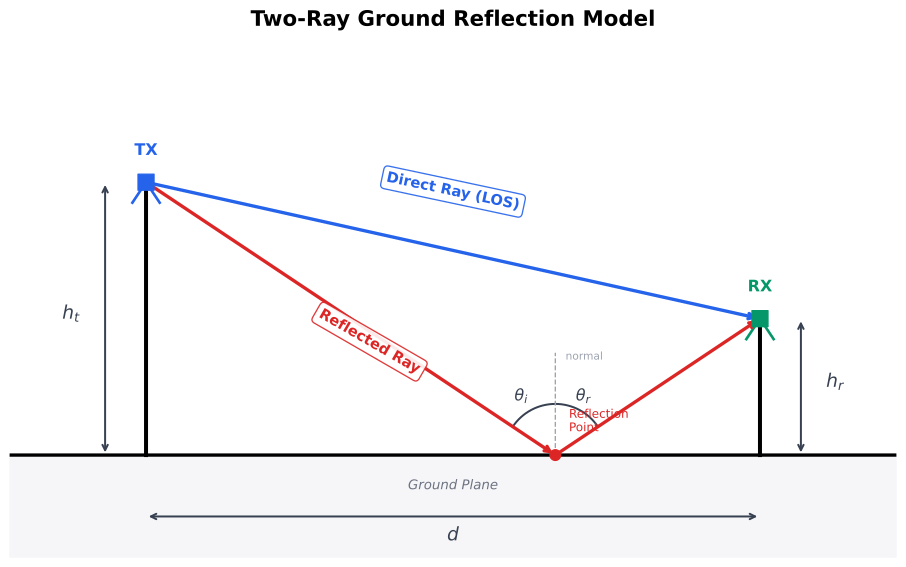
Over a flat, reflecting ground plane, the received signal is the sum of a direct ray and a ground-reflected ray. For antenna heights and and distance :
where (grazing incidence) and the phase difference is
For (far field):
The path-loss exponent changes from 2 (free space) to 4 beyond the breakpoint distance:
Theorem: Two-Ray Model — Near and Far Regimes
The two-ray model exhibits two distinct regimes:
-
Near field (): constructive and destructive interference cause oscillations around free-space path loss. Average exponent .
-
Far field (): the direct and reflected rays nearly cancel, giving (exponent 4). The received power becomes independent of wavelength:
Beyond the breakpoint, the ground reflection nearly cancels the direct ray. The residual power comes from the small path-length difference between the two rays, which scales as . Squaring gives the dependence.
Far-field approximation
For , the path-length difference is (geometric approximation).
The phase difference is .
For , , so .
Substituting into the Friis equation:
.
Free-Space vs. Two-Ray Path Loss
Compare free-space path loss () with the two-ray model. Adjust antenna heights to see how the breakpoint distance shifts.
Parameters
Example: Breakpoint Distance for a Cellular System
A cellular base station has m. A mobile user has m. The carrier frequency is 1800 MHz. Find the breakpoint distance and the path loss at km.
Wavelength and breakpoint
m.
m km.
Path loss at 1 km
Since m , we are in the oscillation region near the free-space regime.
dB.
The two-ray model predicts oscillations around this value. At exactly , the path loss transitions to the regime.
Two-Ray Ground-Reflection Model Geometry
Two-Ray Interference Pattern
Definition: Log-Distance Path-Loss Model
Log-Distance Path-Loss Model
A general model that captures the average path loss as a function of distance:
where:
- is a reference distance (typically 1 m or 100 m)
- is the path loss at (often set to free-space)
- is the path-loss exponent (PLE)
| Environment | Typical |
|---|---|
| Free space | 2 |
| Urban cellular | 2.7–3.5 |
| Suburban | 3–5 |
| Indoor (same floor) | 1.6–3.3 |
| Indoor (through floors) | 4–6 |
| Dense urban (mmWave) | 2–4 |
Path-Loss Model Comparison
Compare Friis (free-space), two-ray, and log-distance models on a single plot. Adjust the path-loss exponent to see how different environments affect received power vs. distance.
Parameters
Why This Matters: Path-Loss Exponent in Network Planning
The path-loss exponent is a key input to cellular network planning. A higher means faster signal decay, which reduces inter-cell interference but also reduces coverage. In dense urban deployments, is typically 3–4, leading to cell radii of 100–500 m. In rural areas, allows cells to cover several kilometres. 5G millimeter-wave cells have – but suffer high penetration loss, limiting cells to tens of metres indoors.
Common Mistake: Path-Loss Exponent Is NOT Universal
Mistake:
Using (free-space) for all environments, or a single value of for all distances.
Correction:
The path-loss exponent depends on the environment, frequency, antenna heights, and distance range. Even within one environment, may differ in LOS vs. NLOS conditions. Always use measurement- calibrated values or standardised models (Section 5.4) for engineering calculations.
Quick Check
In the two-ray model, what is the path-loss exponent beyond the breakpoint distance?
2
3
4
6
Correct. Beyond the breakpoint , the direct and reflected rays nearly cancel, giving .
Quick Check
How does the breakpoint distance change when the frequency doubles?
It halves
It doubles
It stays the same
It quadruples
Correct. . Doubling doubles .
Two-Ray Model
A propagation model that accounts for the direct ray and a single ground-reflected ray. Predicts beyond the breakpoint distance.
Related: Breakpoint Distance, Path-Loss Exponent
Breakpoint Distance
. The distance beyond which the two-ray model transitions from the to the regime.
Related: Two-Ray Model, Free Space Path Loss
Path-Loss Exponent
The exponent in . Free space: . Typical urban: –. Dense indoor: –.
Related: Log-Distance Path-Loss Model, Two-Ray Model