Receive Diversity
Definition: Selection Combining (SC)
Selection Combining (SC)
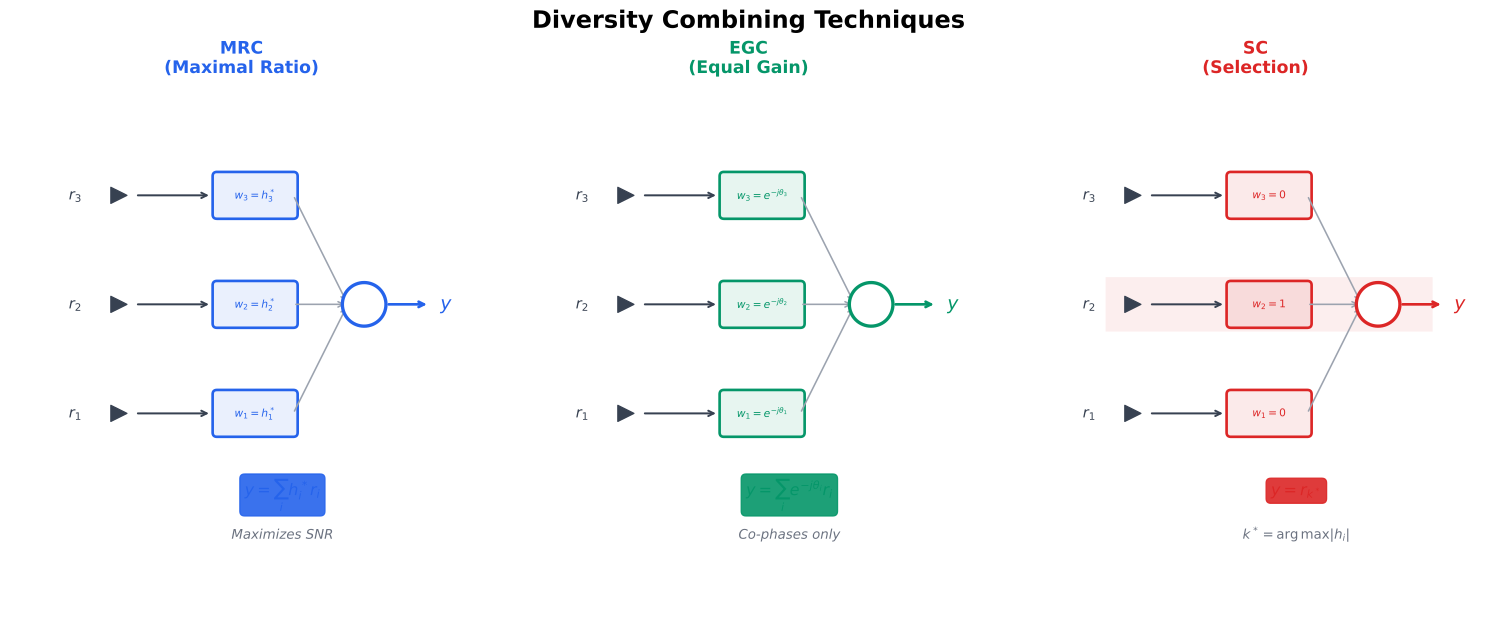
Selection combining chooses the branch with the highest instantaneous SNR and discards the others:
For i.i.d. Rayleigh branches with CDF , the CDF of is
Selection combining is the simplest diversity technique: it requires monitoring all branches but processing only one. However, it wastes the signal energy received on the non-selected branches.
SC only needs to measure the SNR (or signal strength) on each branch; it does not require knowledge of the channel phase. This makes it suitable for non-coherent systems.
Definition: Equal-Gain Combining (EGC)
Equal-Gain Combining (EGC)
Equal-gain combining co-phases all branches and adds them with equal weights:
where is the received signal on branch . The output SNR is
EGC requires knowledge of the channel phases but not the amplitudes, making it simpler than MRC while still capturing energy from all branches.
By the Cauchy-Schwarz inequality, EGC is always suboptimal compared to MRC. The performance gap is small for branches with similar average SNR, typically less than 1 dB for i.i.d. branches.
Definition: Maximal-Ratio Combining (MRC)
Maximal-Ratio Combining (MRC)
Maximal-ratio combining weights each branch proportionally to its channel gain and inversely proportionally to its noise power:
For equal noise power on all branches, the combining weights are , and the output SNR is
MRC is the optimal linear combining strategy: it maximises the output SNR among all linear combiners. It requires full CSI (both amplitude and phase) of every branch.
Theorem: MRC Maximises Output SNR
Among all linear combiners , the weight vector (i.e., the matched filter to the channel vector) maximises the output SNR:
where for i.i.d. noise. No other linear combiner can achieve a higher SNR.
MRC is the spatial matched filter. Just as the matched filter in time maximises SNR by aligning with the signal waveform, MRC aligns the combining weights with the channel vector to maximise the signal component while keeping the noise normalised.
Output SNR expression
The combined output is where . The signal power is and the noise power is .
Cauchy-Schwarz bound
By the Cauchy-Schwarz inequality, , with equality iff for some scalar .
Therefore .
Optimal weights
Equality is achieved when (or any scalar multiple). This is the MRC weight vector. The maximum output SNR equals the sum of the branch SNRs.
Theorem: MRC BER for BPSK in Rayleigh Fading
For BPSK with -branch MRC over i.i.d. Rayleigh fading, the exact average BER is
where and is the average SNR per branch.
At high SNR (), this simplifies to
confirming diversity order .
The formula extends the single-branch result (which uses ) to branches. As increases, and the dominant term is .
Conditional BER
Given the MRC output SNR , the conditional BER is .
Averaging over Erlang distribution
Since , we compute
Using the Craig representation and integrating over yields the closed-form expression involving and the binomial sum.
High-SNR approximation
For : , , and . The sum , giving .
MRC Combining Procedure
Complexity: per symbolMRC converts the -branch fading channel into an equivalent AWGN channel with SNR . After combining, standard AWGN detection (e.g., nearest-neighbour for QAM) is applied to the combined signal.
Example: MRC with Two Branches
A 2-branch MRC receiver in Rayleigh fading has and with and transmitted symbol (BPSK).
(a) Compute the branch SNRs and .
(b) Compute the MRC output SNR.
(c) Compare with selection combining.
Branch SNRs
(9.5 dB)
(21.6 dB)
MRC output SNR
(21.8 dB)
The MRC output SNR is the sum of the branch SNRs.
Comparison with SC
(21.6 dB)
MRC provides 0.2 dB gain over SC in this case. The gain is small because one branch dominates. When branches have comparable SNR, the MRC advantage is larger (up to 10 dB for equal branches).
Example: Comparing SC, EGC, and MRC at L = 4
Four i.i.d. Rayleigh fading branches have average SNR dB per branch. Compute the average output SNR for SC, EGC, and MRC.
MRC average output SNR
$
SC average output SNR
For i.i.d. branches:
EGC average output SNR
EGC performance lies between SC and MRC. For Rayleigh fading with branches:
Summary: MRC (16.0 dB) > EGC (15.3 dB) > SC (13.2 dB). The EGC loss relative to MRC is only 0.7 dB — a remarkably small price for not needing amplitude estimates.
SC vs EGC vs MRC Comparison
Compare the BER performance of the three combining techniques as a function of average SNR per branch. All three achieve the same diversity order , but MRC provides the best coding gain (leftmost curve), followed by EGC, then SC.
Parameters
BER with MRC
Exact BER curves for MRC with varying number of branches and modulation schemes. Observe how each additional branch steepens the BER curve by one decade per 10 dB.
Parameters
Adding Diversity Branches
Watch the BER curve evolve as diversity branches are added one by one. Each frame adds a new branch to the MRC receiver, steepening the high-SNR slope and shifting the curve leftward.
Parameters
Quick Check
Why is MRC optimal among all linear combiners?
It selects the best branch, discarding weak ones
It weights branches proportionally to their SNR, which is the spatial matched filter
It uses equal weights, which averages out the fading
It requires no channel knowledge
MRC applies the Cauchy-Schwarz-optimal weight vector , which is the matched filter to the spatial channel vector. This maximises the output SNR to .
Common Mistake: EGC Requires Phase Knowledge
Mistake:
Implementing EGC without estimating the channel phases, assuming that equal-gain means no channel knowledge is needed.
Correction:
Equal-gain combining co-phases the branches before adding them: . Without accurate phase alignment, the signals would add destructively and EGC would perform worse than selection combining.
The "equal-gain" refers to equal amplitude weights (all branches weighted by 1), not equal or zero channel knowledge. EGC needs phase estimates but not amplitude estimates — it is simpler than MRC but more demanding than SC.
Comparison of Combining Techniques
| Property | SC | EGC | MRC |
|---|---|---|---|
| Output SNR | |||
| Diversity order | |||
| SNR loss vs MRC (L=4) | 2.8 dB | 0.7 dB | 0 dB (optimal) |
| CSI requirement | SNR only | Phase only | Full (amplitude + phase) |
| Complexity | Low | Medium | Medium |
| Chains processed | 1 |
Why This Matters: MRC in RAKE Receivers
In CDMA systems (IS-95, UMTS), the RAKE receiver implements MRC across multipath components. Each "finger" of the RAKE despreads and demodulates one resolvable multipath tap, and the outputs are combined using MRC weights.
If the channel has resolvable paths (each separated by at least one chip duration ), the RAKE receiver achieves diversity order — turning the multipath channel from an enemy (ISI) into an ally (diversity).
In modern OFDM systems (LTE, 5G NR), the RAKE is replaced by frequency-domain equalisation, but the underlying principle of multipath diversity remains the same.
See full treatment in Channel Estimation in OFDM
Maximal-Ratio Combining (MRC)
The optimal linear diversity combining technique that weights each branch by the conjugate of its channel gain. The output SNR equals the sum of the branch SNRs: .
Related: Diversity Order, Spatial Matched Filter, MRC in RAKE Receivers
Selection Combining (SC)
A diversity combining technique that selects the branch with the highest instantaneous SNR and discards the rest. Simplest to implement but wastes energy on non-selected branches.
Related: Maximal-Ratio Combining (MRC), Equal-Gain Combining (EGC), Diversity Order
MRC Performance with Imperfect Channel Estimation
The MRC analysis assumes perfect channel state information at the receiver (CSIR). In practice, the channel must be estimated from pilot symbols, introducing estimation error where is the estimation noise.
With imperfect CSI, the MRC weights become , and the output contains a residual self-interference term. The effective SNR degrades to approximately
where is the channel estimation SNR (depends on the number of pilot symbols and pilot power).
At high operating SNR, the BER floor caused by estimation error can dominate. In 5G NR, demodulation reference signals (DM-RS) typically achieve – dB, which is sufficient for up to MRC branches before the estimation error becomes the bottleneck.
- •
Pilot overhead scales linearly with branches (each branch needs channel estimation)
- •
High-mobility scenarios degrade estimation quality due to channel ageing
- •
In mm-wave bands, phase noise further degrades coherent combining
Diversity Combining Architectures
Array Gain
The increase in average output SNR due to coherent combining of signals from multiple antennas. For MRC with branches, the array gain is (i.e., dB). Array gain exists even without fading; diversity gain requires fading.
Related: Maximal-Ratio Combining (MRC), Joint Communication-Sensing Beamforming, Diversity Gain