Transmit Diversity
Definition: Alamouti Scheme (2x1 STBC)
Alamouti Scheme (2x1 STBC)
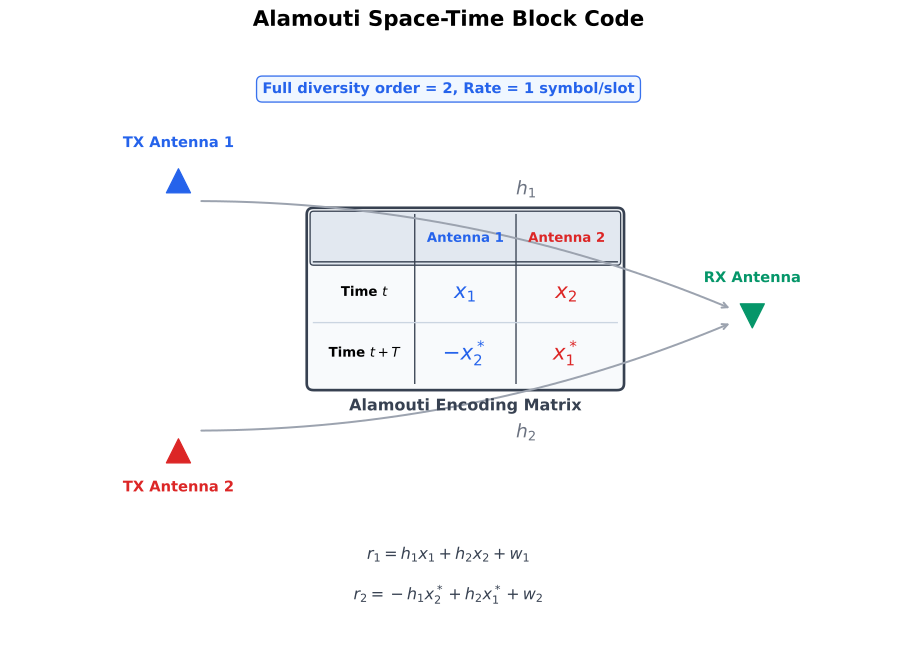
The Alamouti scheme is a transmit diversity technique for two transmit antennas and one (or more) receive antennas. Over two consecutive symbol periods, two symbols and are transmitted according to the encoding matrix:
- Time slot 1: antenna 1 sends , antenna 2 sends
- Time slot 2: antenna 1 sends , antenna 2 sends
The received signals are:
where are the channel gains from antennas 1 and 2 (assumed constant over two symbol periods).
At the receiver, simple linear combining yields:
The two symbols are perfectly decoupled, and the effective channel gain is — the same as 2-branch MRC.
The Alamouti scheme is the only orthogonal STBC for complex constellations that achieves full rate ( symbol per channel use) with full diversity ().
Theorem: Alamouti Achieves Full Diversity at Rate 1
The Alamouti scheme for a system achieves:
-
Full diversity order : the scheme extracts the maximum diversity available from two transmit antennas.
-
Rate 1: two symbols are transmitted over two time slots, so the rate is symbol per channel use — no rate loss.
-
ML decoding via linear processing: the two symbols can be decoded independently using simple linear combining, with no joint ML search required.
The effective SNR per symbol is
where the factor of 2 in the denominator arises because the total transmit power is split equally across the two antennas.
The Alamouti encoding matrix has orthogonal columns: . This orthogonality is what enables perfect symbol decoupling at the receiver. It is equivalent to the channel matrix having orthogonal columns, which converts the two-antenna channel into two parallel scalar channels.
Equivalent channel model
Stack the received signals as
Orthogonality of $\ntn{ch}_{\text{eff}}$
$
The off-diagonal terms vanish, confirming perfect decoupling.
Diversity order
The effective SNR is . For Rayleigh fading, is chi-squared with degrees of freedom. The error probability therefore decays as , giving diversity order .
Definition: Space-Time Block Codes (Orthogonal STBC)
Space-Time Block Codes (Orthogonal STBC)
An orthogonal space-time block code (OSTBC) for transmit antennas encodes symbols over time slots using a transmission matrix satisfying
for some constant . This orthogonality condition ensures that ML decoding decomposes into independent scalar detections.
The rate of the code is symbols per channel use. The Alamouti scheme is the special case , , , .
For real constellations (e.g., BPSK, M-PAM), rate-1 orthogonal designs exist for any . For complex constellations (e.g., QAM), the situation is fundamentally different — see the rate constraint theorem below.
Theorem: STBC Rate Constraints for Complex Constellations
For orthogonal STBC with transmit antennas and complex-valued constellations:
- : maximum rate (Alamouti)
- : maximum rate
- : maximum rate
In general, for , there exists no rate-1 complex orthogonal design. The rate decreases as increases, creating a fundamental tension between transmit diversity order and transmission rate.
This is why the Alamouti scheme () holds a unique position: it is the only complex OSTBC that achieves full rate and full diversity simultaneously.
Orthogonality of the code matrix imposes linear constraints among the columns. With more antennas, more constraints are needed, leaving fewer degrees of freedom to carry independent symbols. The result is analogous to the impossibility of finding more than 2 anticommuting complex matrices — a topological constraint from the theory of Hurwitz-Radon families.
Necessary conditions
The Hurwitz-Radon theorem states that the maximum number of real matrices satisfying is , the Hurwitz-Radon number of .
For complex orthogonal designs, the corresponding constraint is more restrictive: it requires pairs of anticommuting unitary matrices.
Explicit constructions
- : Alamouti code achieves .
- : The Tarokh-Jafarkhani-Calderbank rate- code encodes 3 symbols in 4 time slots.
- : Known constructions achieve at most .
Converse
It can be shown that no complex matrix with can simultaneously satisfy the orthogonality condition and achieve . The proof uses algebraic properties of the Clifford algebra.
Alamouti Encoding and Decoding
Complexity: per symbol pair (linear combining only)The decoding complexity is the same as single-antenna detection — no matrix inversion or joint ML search is needed. This makes Alamouti extremely attractive for practical implementation.
Example: Alamouti 2x1 System
Consider a Alamouti system with channel gains and , transmitting QPSK symbols and . Noise is and .
(a) Compute the received signals and .
(b) Apply the Alamouti decoder and verify symbol decoupling.
(c) Compute the effective SNR.
Received signals
Computing (with the power normalisation absorbed into ): these are complex numbers that the receiver stores.
Alamouti decoding
Expanding:
The symbol is recovered with effective channel gain . Similarly for .
Effective SNR
1 \times 2\gamma = (|h_1|^2 + |h_2|^2) E_s / N_0\blacksquare$
Alamouti Performance
Compare the BER of the Alamouti scheme against single-antenna (1x1) and receive diversity (1xN) systems. The Alamouti scheme achieves the same diversity order as 1x2 MRC but with a 3 dB power penalty due to the transmit power split.
Parameters
Quick Check
How does the Alamouti scheme compare to MRC receive diversity?
Same diversity order, same SNR performance
Same diversity order, but Alamouti has a 3 dB penalty
Alamouti has higher diversity order than 1x2 MRC
Alamouti is always better because it uses more antennas
Both achieve diversity order 2. However, Alamouti splits the transmit power across two antennas, resulting in half the per-antenna power. This causes a 3 dB loss relative to MRC with two receive antennas and a single transmit antenna at full power.
Common Mistake: Alamouti Needs No CSIT but Requires CSIR
Mistake:
Believing that the Alamouti scheme requires channel state information at the transmitter (CSIT) to form the space-time code.
Correction:
The Alamouti encoding matrix depends only on the data symbols , not on the channel gains . The transmitter needs no channel knowledge whatsoever.
However, the decoder must know and (CSIR) to perform the combining step . This is a key advantage of Alamouti over transmit beamforming, which requires CSIT.
The Alamouti scheme also assumes the channel is constant over two consecutive symbol periods (quasi-static fading). If the channel varies within the Alamouti block, the orthogonality breaks down and performance degrades.
Historical Note: Alamouti's 1998 Paper
1998Siavash Alamouti published "A Simple Transmit Diversity Technique for Wireless Communications" in the IEEE Journal on Selected Areas in Communications in October 1998. The paper is remarkable for its simplicity: the core idea fits on a single page. Yet it solved a problem that had stymied researchers for years — how to achieve transmit diversity without channel feedback.
The Alamouti scheme was immediately adopted into the 3GPP WCDMA standard (1999) and has been included in every subsequent cellular standard (HSDPA, LTE, 5G NR) as the baseline open-loop transmit diversity mode. As of 2024, it remains one of the most cited papers in wireless communications, with over 15,000 citations.
Practical Importance of Alamouti
The Alamouti scheme appears in virtually every modern cellular standard:
- 3G WCDMA/HSPA: Open-loop transmit diversity (STTD)
- 4G LTE: Transmit diversity mode for 2-antenna eNodeB
- 5G NR: SFBC (space-frequency block coding) — a frequency-domain variant of Alamouti used with OFDM
Its appeal lies in three properties: (1) no CSIT needed, (2) simple linear decoding, and (3) no rate loss. For more than 2 TX antennas, standards typically switch to precoding-based schemes that exploit CSIT rather than orthogonal STBC, due to the rate loss of OSTBC with .
Why This Matters: STBC in LTE and 5G NR
In LTE, the Alamouti scheme is implemented as transmit diversity for Physical Downlink Control Channel (PDCCH) and as an optional mode for the data channel (PDSCH) with 2 antenna ports.
In 5G NR, the scheme is adapted to the OFDM waveform as Space-Frequency Block Coding (SFBC): instead of encoding across two time slots, the Alamouti matrix is applied across two adjacent OFDM subcarriers. This avoids the assumption that the channel is constant over two OFDM symbols (which may not hold at high Doppler) while maintaining the diversity benefit.
For 4 or more antenna ports, 5G NR uses codebook-based precoding rather than STBC, since the rate loss of OSTBC with is unacceptable for high-throughput data channels.
See full treatment in Peak-to-Average Power Ratio (PAPR)
Alamouti Scheme
A space-time block code for two transmit antennas that achieves diversity order 2 at rate 1 with simple linear decoding and no channel knowledge at the transmitter. The only complex OSTBC with no rate loss.
Related: Alamouti Scheme (2x1 STBC), Transmit Diversity, Sfbc
Space-Time Block Code (STBC)
A coding scheme that distributes data symbols across multiple transmit antennas and time slots to achieve transmit diversity. Orthogonal STBCs enable simple ML decoding via linear processing.
Related: Alamouti Scheme (2x1 STBC), Orthogonal Space-Time Block Code (OSTBC), Transmit Diversity
Alamouti Encoding and Decoding Walkthrough
Alamouti Performance Degradation at High Doppler
The Alamouti scheme assumes the channel is constant over two consecutive symbol periods: . When this quasi-static assumption is violated (high Doppler), the orthogonality of breaks down, creating inter-symbol interference between and .
The degradation becomes significant when the normalised Doppler , where is the symbol period. For example, at GHz and km/h (high-speed train), Hz. With a 15 kHz subcarrier spacing (5G NR), — well beyond the safe range.
This is why 5G NR uses SFBC (space-frequency block coding) instead of STBC: the Alamouti matrix is applied across two adjacent OFDM subcarriers rather than two time slots. Since adjacent subcarriers experience nearly identical channels (separated by only kHz ), the orthogonality holds even at high Doppler.
- •
STBC requires for near-ideal performance
- •
SFBC requires (coherence bandwidth)
- •
In delay-Doppler channels (high mobility + multipath), neither STBC nor SFBC may suffice — see OTFS in Ch. 14
Alamouti Space-Time Encoding and Decoding
Lattice Codes Achieving the Optimal Diversity-Multiplexing Tradeoff
Zheng and Tse (2003) established the fundamental diversity-multiplexing tradeoff (DMT) for MIMO channels, showing that a system with transmit and receive antennas achieves . The question of whether practical codes could achieve every point on this curve was open.
El Gamal, Caire, and Damen showed that lattice space-time (LAST) codes — constructed from algebraic number field lattices — achieve the optimal DMT at every multiplexing gain . This resolved the constructive existence problem: not only does the tradeoff exist, but explicit, decodable codes can achieve it.
This result provides the theoretical justification for the adaptive switching between diversity and multiplexing modes used in LTE and 5G NR. At the cell edge (low SNR), the system operates near for maximum diversity; at the cell centre (high SNR), it increases for throughput.
Why This Matters: From Diversity to Spatial Multiplexing
This chapter treats diversity as a reliability-enhancing technique. The MIMO book (Chapters 3–5) develops the complementary viewpoint: multiple antennas can also provide spatial multiplexing gain, transmitting independent data streams on parallel spatial channels. The diversity-multiplexing tradeoff (Zheng-Tse, 2003) formalises the tension between these two uses of multiple antennas.
The Coded Modulation book (Chapters 8–12) extends the STBC framework to non-orthogonal space-time codes, including algebraic constructions (Golden code, LAST codes) that achieve optimal diversity-multiplexing tradeoff points.
See full treatment in The MIMO Channel Matrix
Transmit Diversity
Diversity obtained by transmitting redundant versions of a signal from multiple antennas. Unlike receive diversity, the transmitter must encode the signal across antennas (e.g., Alamouti STBC) to create the diversity without requiring channel knowledge at the transmitter.
Related: Alamouti Scheme (2x1 STBC), Alamouti Scheme (2x1 STBC), Receive Diversity