5G NR Use Cases
One Standard, Three Worlds
Previous generations of cellular technology optimised for a single use case: voice (2G), mobile broadband (3G/4G). 5G NR is the first standard designed from the outset to serve three fundamentally different service categories: eMBB (enhanced Mobile Broadband) — peak rates Gbps; URLLC (Ultra-Reliable Low-Latency Communications) — BLER at 1 ms latency; mMTC (massive Machine-Type Communications) — devices/km. These use cases impose contradictory PHY requirements: eMBB wants long TTIs and high-order modulation for efficiency; URLLC wants short TTIs and low code rates for reliability; mMTC wants low power and simple waveforms for battery life. NR's flexible framework — scalable numerology, mini-slots, grant-free access — enables multiplexing these services on a single carrier.
Definition: 5G Use Case Performance Targets
5G Use Case Performance Targets
The ITU-R IMT-2020 requirements define the three service categories:
| Metric | eMBB | URLLC | mMTC |
|---|---|---|---|
| Peak data rate | DL 20 Gbps | Not primary | Not primary |
| User-plane latency | 4 ms | 1 ms | Relaxed |
| Reliability | BLER | BLER | BLER |
| Connection density | — | — | /km |
| Mobility | 500 km/h | — | Stationary |
| Spectral efficiency | 30 bps/Hz (DL) | — | — |
| Battery life | — | — | 10 years |
eMBB drives the mainstream 5G deployment with wide bandwidths (up to 400 MHz in FR2) and massive MIMO.
URLLC requires mini-slot scheduling, redundant transmissions, and conservative MCS selection to meet the BLER target at 1 ms user-plane latency.
mMTC targets IoT with grant-free access, repetition-based coverage enhancement, and narrow-band operation for long battery life.
In practice, most current 5G deployments focus on eMBB. URLLC is deployed for industrial automation, and mMTC capabilities in NR are complemented by NB-IoT and LTE-M (which coexist with NR in the same carrier via in-band deployment).
Definition: URLLC Physical Layer Mechanisms in NR
URLLC Physical Layer Mechanisms in NR
NR provides several physical layer features for URLLC:
Mini-slot transmission: 2-symbol or 7-symbol scheduling (Section 24.2) reduces the TTI to as low as 18 s (), enabling ms round-trip latency.
Preemptive scheduling: A URLLC mini-slot can preempt an ongoing eMBB transmission. The eMBB UE is notified via DCI format 2_1 and discards the punctured REs.
Configured grant (grant-free): The UE can transmit without waiting for a scheduling grant, eliminating the request-grant latency (2--4 ms saving). Two types:
- Type 1: RRC-configured periodic resources.
- Type 2: Semi-persistent scheduling activated by DCI.
Repetition and multi-slot: PDSCH/PUSCH can be repeated across slots () for time diversity and reliability.
BLER target: The outer loop targets initial BLER instead of the eMBB , requiring 10--15 dB additional SNR margin. This is achieved through lower MCS, more conservative link adaptation, and HARQ redundancy.
The URLLC reliability target of for a 32-byte packet within 1 ms is extremely demanding. It requires not only PHY reliability (low BLER) but also MAC reliability (no scheduling collisions, no HARQ retransmission delay exceeding 1 ms). Achieving this in practice requires careful co-design of scheduling, HARQ, and radio resource management.
Theorem: SNR Penalty for URLLC Reliability
For a coded system with block length and target block error probability , the required SNR above the Shannon limit (in the normal approximation regime) is:
where is the channel dispersion and is the inverse Gaussian Q-function.
For an AWGN channel at rate bits/channel use:
Key result: Reducing BLER from to requires approximately -- dB additional margin for typical NR block lengths ().
The normal approximation captures the penalty of operating at finite block length. The Q-function inverse maps the reliability requirement to a penalty: vs. . The difference of 3 in normalised units translates to 4--6 dB depending on the code rate and block length.
Finite block length capacity
The maximum achievable rate at block length and error probability over an AWGN channel is (Polyanskiy et al., 2010):
where and .
SNR penalty
Rearranging for the SNR needed to achieve rate at BLER with block length :
The SNR penalty relative to Shannon () is:
Numerical comparison
For , bit/channel use, AWGN: bits. bits.
Difference: bits/c.u., corresponding to 4.5 dB SNR penalty at this operating point.
eMBB vs URLLC Scheduling with Preemption
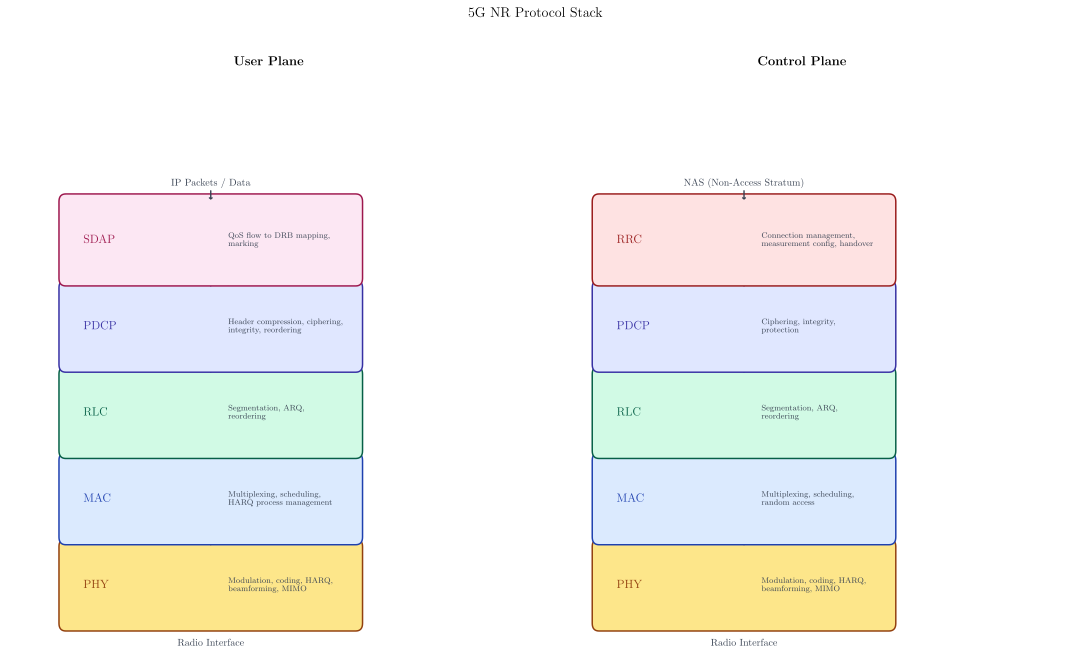
NR Protocol Stack
5G NR Use Case Trade-offs
Explore the trade-off space of 5G NR use cases by adjusting the importance weights for throughput and latency. The plot shows the achievable performance region for eMBB, URLLC, and mMTC configurations, mapping out how resource allocation (bandwidth, mini-slot length, MCS, repetitions) shifts as priorities change. Observe how favouring throughput moves toward eMBB parameters while favouring latency moves toward URLLC.
Parameters
Example: URLLC Link Budget for Industrial Automation
An NR URLLC link must deliver 32-byte packets with reliability within 1 ms user-plane latency at (60 kHz SCS).
(a) How many OFDM symbols are available in 1 ms? (b) If using a 2-symbol mini-slot with QPSK and code rate 1/3, how many RBs are needed for 256 bits? (c) What is the required SNR for BLER with this configuration? (d) Is there time for one HARQ retransmission within 1 ms?
Symbols per ms
(a) At : slot = 0.25 ms, 14 symbols/slot. In 1 ms: OFDM symbols.
RB requirement
(b) 256 data bits at code rate 1/3: 768 coded bits. QPSK: 2 bits/RE. REs needed: 384. Per mini-slot (2 symbols, excluding DM-RS): 12 REs/RB (12 subcarriers 1 data symbol, 1 symbol for DM-RS). RBs needed: RBs.
Required SNR
(c) For QPSK rate 1/3, the code block has coded bits. Using the normal approximation:
Shannon SNR for rate : ( dB). Finite-blocklength penalty at , : dB.
Required SNR dB.
HARQ feasibility
(d) Mini-slot duration: s. Processing time (N2 for URLLC): 5 symbols s. Round trip (Tx + processing + HARQ + Rx + processing): s.
Total: 250 s ms. Yes, at least 3 HARQ transmissions fit within 1 ms, further improving reliability.
Quick Check
What is the primary physical layer mechanism that enables URLLC to preempt eMBB transmissions in NR?
URLLC uses a different numerology with wider SCS than eMBB
Mini-slot scheduling with DCI format 2_1 preemption indication
URLLC always transmits on a dedicated carrier separate from eMBB
URLLC uses higher transmit power than eMBB to capture the channel
NR allows a URLLC mini-slot to be scheduled on top of an ongoing eMBB slot-based transmission. The eMBB UE is informed via DCI format 2_1 that certain REs have been punctured by URLLC, allowing it to adapt its decoding accordingly.
URLLC Latency Budget Breakdown
The 1 ms user-plane latency target for URLLC encompasses the entire chain from PDCP layer at the gNB to PDCP at the UE. A typical downlink budget at (60 kHz SCS):
| Component | Duration |
|---|---|
| gNB processing (N1) | 3 symbols = 53.7 s |
| DL transmission | 2-symbol mini-slot = 35.8 s |
| UE processing (N2) | 5 symbols = 89.5 s |
| HARQ feedback (UL) | 1--2 symbols = 17.9--35.8 s |
| Total (1st Tx) | 200 s |
| Margin for retx | 800 s |
This leaves room for 3--4 HARQ retransmissions within 1 ms at , providing time diversity that greatly enhances reliability. At (30 kHz), symbol durations double and only 1--2 retransmissions fit within 1 ms.
- •
gNB processing time N1 = 3--5 OFDM symbols (depends on UE capability)
- •
UE processing time N2 = 5--10 symbols (capability 1 vs capability 2)
- •
Fronthaul delay adds 50--250 μs in C-RAN deployments
Key Takeaway
URLLC reliability costs 4--6 dB of SNR. Reducing BLER from (eMBB) to (URLLC) at typical NR block lengths () requires 4--6 dB additional SNR margin from the finite-blocklength penalty. This is equivalent to halving the cell radius or quadrupling the transmit power — a fundamental information-theoretic cost that no coding scheme can avoid.