5G NR MIMO and Beam Management
Massive MIMO Meets Standards — The Beam Management Challenge
Chapter 18 showed that massive MIMO can deliver extraordinary spectral efficiency through spatial multiplexing of many users. Translating this into a deployable standard requires solving a practical challenge: with 64--256 antennas forming narrow beams, how does the network and UE find each other? At sub-6 GHz, the base station can transmit cell-wide reference signals and rely on digital beamforming. At mmWave, the link budget demands beamformed reference signals, but the UE does not initially know which beam to listen on. NR's beam management framework — the P1/P2/P3 procedures — provides a systematic solution using SSB beam sweeping, CSI-RS beam refinement, and beam failure recovery. This is arguably the most complex new physical layer procedure in NR compared to LTE.
Definition: NR CSI Framework — Type I and Type II Feedback
NR CSI Framework — Type I and Type II Feedback
NR defines two CSI feedback types for closed-loop MIMO:
Type I (single-panel, codebook-based):
- The UE selects one beam from a DFT-based codebook and reports a PMI (Precoding Matrix Indicator).
- Wideband selects a beam group; subband selects the best beam and co-phase within the group.
- Overhead: 10--20 bits per reporting instance.
- Suitable for FDD with moderate antenna counts (up to 32 ports).
Type II (multi-beam, high-resolution):
- The UE reports a linear combination of beams from the oversampled DFT codebook: where are orthogonal beams and are complex combining coefficients.
- Wideband: beam indices and wideband amplitudes.
- Subband: phase and amplitude of each beam per subband.
- Overhead: 50--200 bits per instance.
- Near-optimal for MU-MIMO with large antenna arrays.
Type II CSI trades higher feedback overhead for significantly better MU-MIMO performance. The key insight is that a linear combination of beams can represent most practical channels with high fidelity, whereas Type I's single-beam selection misses the spatial structure needed for multi-user interference management.
SSB Burst Set Structure
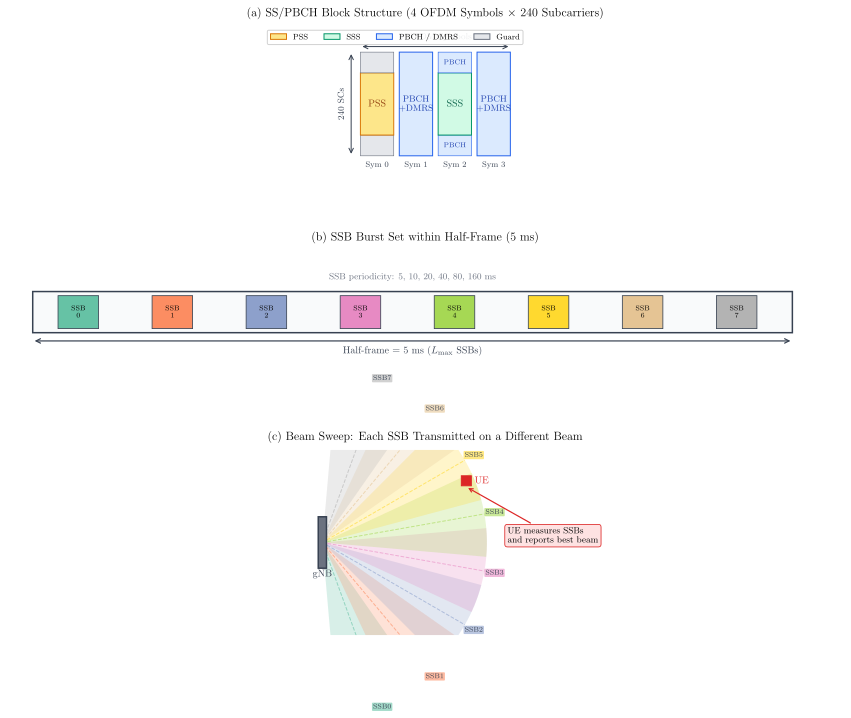
Definition: NR Beam Management Procedures (P1/P2/P3)
NR Beam Management Procedures (P1/P2/P3)
NR beam management is a hierarchical framework for beam acquisition, refinement, and tracking:
P1 — Beam Sweeping (Initial Acquisition): The gNB transmits SSBs (SS/PBCH Blocks) in different beam directions. Up to beams are swept per SSB burst set (4 in FR1, 64 in FR2). The UE measures RSRP on each SSB and reports the best beam index.
P2 — gNB Beam Refinement: After P1 identifies a coarse beam, the gNB transmits CSI-RS on a finer grid of beams around the P1 direction. The UE reports the best refined beam.
P3 — UE Beam Refinement: The UE sweeps its own receive beams (analog Rx beamforming) while the gNB holds its Tx beam fixed. This aligns the UE's receive beam to the gNB's transmit beam.
Beam Failure Recovery: If the serving beam quality drops below a threshold (), the UE initiates beam failure recovery by identifying a new candidate beam (from SSB or CSI-RS measurements) and sending a BFRQ on PRACH or PUCCH.
The P1/P2/P3 hierarchy reflects a practical constraint: exhaustive beam search over all gNB and UE beam combinations would take measurements, which is prohibitive for large arrays. The hierarchical approach reduces this to measurements.
Theorem: SSB Beam Sweep Latency and Coverage
An SSB burst set with beams and periodicity has the following properties:
Angular coverage per beam: For a ULA with antennas, each beam covers approximately:
To cover a sector of angular width (typically ), the minimum number of beams is:
Initial access latency (worst case):
where is the SSB periodicity (5--160 ms, default 20 ms) and accounts for PRACH timing alignment.
More antennas create narrower beams (higher gain) but require more beams to cover the sector, increasing sweep time. This is the fundamental antenna gain vs. access latency trade-off in mmWave systems. With antennas, 32 beams are needed for coverage, each with beamwidth.
Beamwidth of a ULA
The half-power beamwidth of a ULA with elements and half-wavelength spacing is approximately:
(The exact 3 dB beamwidth depends on the taper/window, but is a standard approximation for uniform weighting.)
Number of beams for sector coverage
A sector spans radians. With beam spacing equal to the HPBW to ensure coverage with at most 3 dB loss at beam edges:
For : . FR2 supports up to 64 SSBs, which is nearly sufficient.
Access latency
The UE must wait for the SSB carrying the best beam. In the worst case (beam at the end of the sweep), this is one full SSB periodicity . After detection, RACH and RAR add 3--5 ms.
Total worst-case: ms. With ms: 25 ms.
SSB Beam Sweeping for Initial Access
SSB Beam Sweep Pattern
Visualise the SSB beam sweep pattern for different configurations. The plot shows the beam directions in the angular domain, the beam gain pattern, and the time-domain SSB burst structure. Adjust the number of SSB beams to see how coverage and sweep time trade off, and vary the periodicity to observe its impact on initial access latency.
Parameters
NR CSI Feedback — Type I vs Type II
Compare the spectral efficiency achievable with Type I (single-beam) and Type II (multi-beam) CSI feedback as a function of SNR. Adjust the number of antenna ports, the number of beams in Type II, and the transmission rank. Observe how Type II with beams approaches ideal (genie-aided) CSI performance for MU-MIMO, while Type I saturates due to quantisation error.
Parameters
Example: Beam Management Design for FR2
A 5G NR mmWave gNB at 28 GHz uses a 64-element ULA panel covering a sector.
(a) How many SSB beams are needed for full sector coverage? (b) With SSB periodicity of 20 ms, what is the worst-case initial access latency? (c) After P1, the gNB refines within a window using CSI-RS. How many P2 beams are needed at twice the angular resolution? (d) Estimate the total beam alignment time (P1 + P2 + P3) if the UE has 4 Rx beams.
SSB beam count
(a) Beamwidth rad . Beams for : . NR FR2 supports SSBs, so we use 64 beams (slight under-coverage at sector edges, acceptable with overlap from adjacent panels).
Access latency
(b) Worst case: UE must wait for the entire SSB burst. SSB burst duration: 64 SSBs 4 symbols s ms. Plus periodicity wait: up to 20 ms. Total worst-case P1: ms.
P2 refinement beams
(c) P2 window: . P2 beamwidth: (doubled resolution). P2 beams: .
Total alignment time
(d) P1: 22 ms (worst case). P2: 12 beams at 1 CSI-RS per slot ( ms each) = 1.5 ms. P3: 4 UE Rx beams 0.125 ms = 0.5 ms. Total: ms.
In practice, P2 and P3 can partially overlap, reducing this to ms.
Quick Check
What is the purpose of the P3 procedure in NR beam management?
To select the initial gNB transmit beam during cell search
To refine the gNB transmit beam using CSI-RS
To align the UE receive beam while the gNB holds its transmit beam fixed
To handle beam failure recovery when the serving beam is lost
P3 is UE Rx beam refinement. The gNB transmits on its selected beam (from P1/P2) while the UE sweeps its analog receive beams to find the best Rx direction. This is particularly important for mmWave UEs with analog Rx beamforming (phased arrays).
JSDM: Joint Spatial Division and Multiplexing
Adhikary, Nam, Ahn, and Caire proposed JSDM, a two-stage precoding framework for FDD massive MIMO that separates users into groups based on their channel covariance eigenspaces and applies a pre-beamforming matrix per group followed by a MU-MIMO precoding matrix within each group. The pre-beamformer exploits the long-term spatial statistics (which change slowly and require low feedback overhead), while the inner precoder handles fast fading.
The NR Type I CSI dual-stage codebook ( structure) is a direct standardisation of this concept: selects a wideband beam group (analogous to the JSDM pre-beamformer) and selects the subband precoder within that group. JSDM demonstrated that FDD massive MIMO is feasible without prohibitive CSI feedback — a result that directly informed the 3GPP NR MIMO design.
Why This Matters: Massive MIMO Theory Behind NR MIMO
The massive MIMO concepts in Chapter 18 — channel hardening, favourable propagation, TDD reciprocity-based precoding, and pilot contamination — are the theoretical foundations for NR's MIMO design. The NR beam management framework (P1/P2/P3) is the practical answer to the initial access problem that massive MIMO creates: narrow beams increase gain but require beam alignment before data transmission can begin. The MIMO book in this library provides the full theoretical treatment, including DPC-achieving precoding, RZF/ZF/MMSE precoder analysis, and the cell-free massive MIMO paradigm that may define 6G.
Why This Matters: Reconfigurable Intelligent Surfaces as Passive Beamformers
The beam management overhead in NR motivates research into reconfigurable intelligent surfaces (RIS) (Chapter 28), which create additional controllable propagation paths without active RF chains. RIS can assist beam alignment by reflecting the gNB beam toward the UE, potentially reducing the number of SSB beams needed for coverage — especially in NLOS scenarios where direct beam paths are blocked.
Key Takeaway
Beam management is the price of massive MIMO at mmWave. Narrow beams from large arrays provide the gain needed to close the mmWave link budget, but they require a multi-stage alignment procedure (P1/P2/P3) before any data can flow. The worst-case initial access latency of 25 ms at FR2 is an order of magnitude longer than LTE's cell search, creating a fundamental tension between array gain and access speed.
Common Mistake: Beam Failure in Dynamic Environments
Mistake:
Relying solely on the initial P1/P2/P3 alignment without continuous beam tracking, assuming the beam remains stable after initial alignment.
Correction:
In mobile scenarios, the optimal beam direction changes continuously. Without beam tracking, a UE moving at 30 km/h can exit a 3 mmWave beam in 50 ms. NR provides beam failure detection (BFD) via periodic L1-RSRP measurements and beam failure recovery (BFR) via PRACH-based beam re-selection. Additionally, SSB and CSI-RS measurements must be configured at appropriate periodicity (10--40 ms) to track beam drift proactively.
SSB (SS/PBCH Block)
Synchronisation Signal / Physical Broadcast Channel Block: a time-frequency resource carrying PSS, SSS, PBCH, and DM-RS, transmitted in a specific beam direction. NR supports up to 4 (FR1) or 64 (FR2) SSBs per burst set for beam sweeping.
Related: Beam Management, CSI-RS (Channel State Information Reference Signal)
Beam Management
The NR framework for beam acquisition, refinement, and maintenance using hierarchical procedures: P1 (SSB sweep for initial beam), P2 (CSI-RS for gNB beam refinement), P3 (UE Rx beam refinement), and beam failure recovery.
Related: SSB (SS/PBCH Block), CSI-RS (Channel State Information Reference Signal)
CSI-RS (Channel State Information Reference Signal)
A configurable reference signal in NR used for channel measurement, beam management (P2 refinement), and CSI acquisition for link adaptation and precoding. Unlike LTE's always-on CRS, CSI-RS is transmitted only when configured, reducing overhead.
Related: SSB (SS/PBCH Block), Beam Management