5G NR Physical Layer
From Fixed to Flexible — The NR Design Philosophy
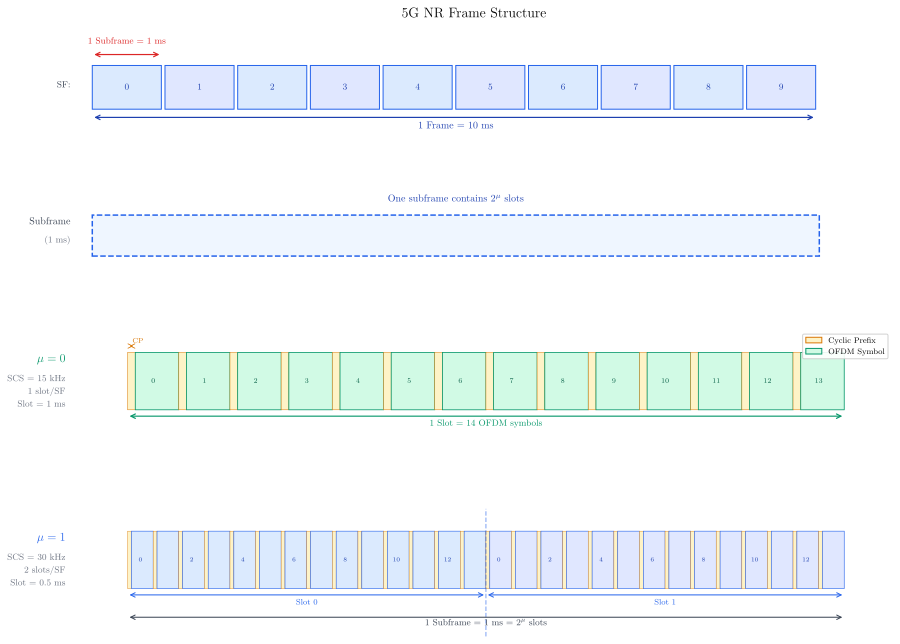
LTE's fixed 15 kHz subcarrier spacing and 1 ms TTI served sub-6 GHz bands well, but 5G NR must operate from 400 MHz to 52.6 GHz (and beyond in Release 17+). At mmWave frequencies, phase noise demands wider SCS (Chapter 23), shorter delay spreads allow shorter CPs, and low-latency use cases require sub-millisecond scheduling. NR addresses this with flexible numerology: the SCS scales as kHz for , keeping the resource grid structure while adapting the time-frequency granularity to the deployment scenario. This single design decision — parameterised rather than fixed numerology — is the most consequential architectural difference between LTE and NR.
5G NR Frame Structure
Definition: 5G NR Numerology and Scalable OFDM
5G NR Numerology and Scalable OFDM
NR defines a family of OFDM parameterisations indexed by numerology :
| SCS | Symbol | CP | Slot | Symbols/slot | |
|---|---|---|---|---|---|
| 0 | 15 kHz | 66.7 s | 4.7 s | 1 ms | 14 |
| 1 | 30 kHz | 33.3 s | 2.3 s | 0.5 ms | 14 |
| 2 | 60 kHz | 16.7 s | 1.2 s | 0.25 ms | 14 |
| 3 | 120 kHz | 8.33 s | 0.59 s | 0.125 ms | 14 |
| 4 | 240 kHz | 4.17 s | 0.29 s | 62.5 s | 14 |
Key relationships (all scale by powers of 2):
- kHz
- ms
- Slots per subframe:
- Each slot always contains 14 OFDM symbols (normal CP)
Bandwidth Parts (BWP): A contiguous set of RBs with a single numerology. A UE can be configured with up to 4 BWPs per carrier, but only one is active at a time. BWPs enable dynamic bandwidth adaptation for power saving.
(15 kHz) is backward-compatible with LTE numerology. (30 kHz) is the most common for sub-6 GHz 5G deployments, offering a good balance of latency (0.5 ms slot), Doppler tolerance, and delay spread handling. (120 kHz) is standard for FR2 (mmWave).
Definition: Mini-Slot Scheduling in NR
Mini-Slot Scheduling in NR
NR supports scheduling at sub-slot granularity using mini-slots (formally called non-slot-based scheduling):
- A mini-slot can be 2, 4, or 7 OFDM symbols.
- PDCCH and PDSCH can start at any symbol within a slot.
- For URLLC, a mini-slot transmission can preempt an ongoing eMBB slot-based transmission (indicated via DCI format 2_1).
The minimum scheduling latency is:
For (120 kHz) with a 2-symbol mini-slot: s, enabling sub-100-s user-plane latency.
Mini-slot scheduling is a key enabler of URLLC. By allowing transmission to start at any symbol boundary and occupy as few as 2 symbols, NR can achieve the 1 ms latency target even with (30 kHz SCS), without requiring the very wide SCS that would waste CP overhead in sub-6 GHz channels.
Theorem: NR Capacity Scaling with Numerology
For a fixed total bandwidth and channel with delay spread and oscillator linewidth , the effective spectral efficiency of numerology is:
where:
- CP efficiency:
- ICI from phase noise:
The optimal numerology balances:
- Larger : better phase noise tolerance (higher SIR), lower latency, but higher CP overhead fraction and shorter CP (vulnerable to large delay spreads).
- Smaller : more CP budget for delay spread, but worse phase noise and higher latency.
Doubling the SCS halves the symbol duration and CP duration. If the delay spread fits within the shorter CP, no energy is lost to ISI, and the improved phase noise resilience is a net gain. If the delay spread exceeds the CP, ISI destroys more performance than the phase noise improvement saves.
CP efficiency
The fraction of each OFDM symbol carrying useful data is:
For all NR numerologies, (first symbol slightly different), giving %.
Phase noise limited capacity
The effective SNR including phase noise ICI is:
At high SNR, , which scales as . Larger raises the ceiling.
Delay spread constraint
The CP must exceed the channel delay spread: . For : s, supporting delay spreads up to m path difference — appropriate for mmWave (short range, limited scattering).
NR Numerology Scaling: to
NR Resource Grid Visualisation
Visualise the 5G NR time-frequency resource grid for different numerologies. The plot shows OFDM symbols in time and subcarriers in frequency, with colour coding for PDSCH, PDCCH (CORESET), DM-RS, and CSI-RS resource elements. Adjust the SCS to see how the grid scales, and change the number of resource blocks to explore different bandwidth configurations.
Parameters
NR Numerology Parameter Comparison
Compare the key parameters across 5G NR numerologies. Selecting a SCS shows the slot duration, CP length, maximum supported delay spread, phase noise tolerance, and the time-frequency resource grid dimensions. Observe the scaling relationships: all time-domain parameters halve when increases by 1, while frequency-domain parameters double.
Parameters
Example: Choosing the Right NR Numerology
A 5G deployment must support three scenarios:
- Urban macro at 3.5 GHz: delay spread ns.
- Indoor hotspot at 28 GHz: delay spread ns.
- Highway V2X at 5.9 GHz: max Doppler Hz.
(a) For each scenario, determine the appropriate numerology . (b) Verify the CP is sufficient for the delay spread. (c) Verify the SCS is sufficient for the Doppler spread.
Numerology selection
(a) Urban macro 3.5 GHz: (30 kHz SCS, standard for FR1 mid-band). Indoor 28 GHz: (120 kHz SCS, standard for FR2). Highway V2X: (30 kHz) or (60 kHz) for high Doppler tolerance.
CP verification
(b) Rule of thumb: CP should be . Urban: ns. CP at : 2340 ns ns. Sufficient.
Indoor: ns. CP at : 590 ns ns. Sufficient.
Doppler verification
(c) ICI from Doppler is negligible when . Highway: Hz. At : Hz Hz. Acceptable. At : Hz. Comfortable margin.
works for all sub-6 GHz scenarios including high mobility.
Quick Check
What is a Bandwidth Part (BWP) in 5G NR?
A frequency band allocated by the regulator for 5G operation
A contiguous set of RBs with a single numerology, configurable per UE for dynamic bandwidth adaptation
The total system bandwidth divided equally among active UEs
A guard band between adjacent carriers to prevent interference
A BWP defines a contiguous frequency region with a specific numerology () and bandwidth. UEs can switch between up to 4 configured BWPs — using a narrow BWP for power saving (monitoring only a few RBs) and a wide BWP for high throughput.
LDPC Decoder Throughput Requirement in NR
NR's peak data rate of 13 Gbps per carrier requires the channel decoder to sustain a coded throughput of:
LTE's turbo decoders, with their inherent sequential iteration structure, plateau at 1 Gbps. NR's choice of LDPC codes (quasi-cyclic structure with two base graphs) enables massively parallel decoding with hardware throughput exceeding 20 Gbps.
Base Graph 1 (BG1): optimised for large transport blocks ( bits, 46 parity check rows, rate ). Base Graph 2 (BG2): optimised for small blocks ( bits, 42 rows, rate , used for URLLC).
The lifting sizes (8 sets) allow the same decoder hardware to serve different block lengths by adjusting the parallelism factor.
- •
LDPC decoder must sustain >14 Gbps coded throughput for peak rate
- •
Turbo decoders limited to ~1 Gbps: insufficient for NR
- •
BG1 and BG2 are selected based on TBS and code rate at the MAC layer
Common Mistake: Wrong Numerology for High Mobility
Mistake:
Using (120 kHz SCS) for a high-mobility scenario at sub-6 GHz because "wider SCS gives better Doppler tolerance."
Correction:
While wider SCS improves the ratio , reducing relative ICI from Doppler, also shortens the CP to 0.59 s. At sub-6 GHz (e.g., 3.5 GHz highway macro), the channel delay spread can reach 1--3 s, far exceeding the short CP. The resulting ISI from insufficient CP is worse than the Doppler ICI that the wider SCS was meant to fix. For sub-6 GHz high mobility, (30 kHz) provides the best balance: 2.34 s CP handles typical delay spreads, and 30 kHz SCS comfortably accommodates Doppler up to 1500 Hz.
Historical Note: The 5G NR Standardisation Timeline
2015--20223GPP began the 5G study item in 2015 (Release 14) and completed the first NR specification (Release 15) in two phases: the Non-Standalone (NSA) variant in December 2017 (enabling EN-DC with LTE anchor) and the Standalone (SA) variant in June 2018. This aggressive timeline — 3 years from study to specification — was driven by commercial pressure from operators and the 2020 Olympics deadline (later postponed to 2021). Release 16 (July 2020, "5G Phase 2") added URLLC enhancements, NR-V2X, NR positioning, and IAB (Integrated Access and Backhaul). Release 17 (March 2022) introduced NR-NTN (non-terrestrial networks), RedCap (reduced capability) devices, and extended MIMO (up to 16 layers).
Numerology
In 5G NR, the OFDM parameter set indexed by : SCS kHz, slot duration ms, CP duration scaling accordingly. covers 15 kHz to 240 kHz SCS.
Related: Bandwidth Part (BWP), Mini-Slot
Bandwidth Part (BWP)
A contiguous set of resource blocks with a single numerology, configured per UE. Enables dynamic bandwidth adaptation: the UE operates on a narrow BWP for power saving and switches to a wide BWP for high-throughput data transfer.
Related: Numerology, Mini-Slot
Mini-Slot
A scheduling unit shorter than a full slot (2, 4, or 7 OFDM symbols) in NR, enabling low-latency transmission for URLLC. Can start at any symbol within a slot and may preempt ongoing eMBB transmissions.
Related: Numerology, Bandwidth Part (BWP)